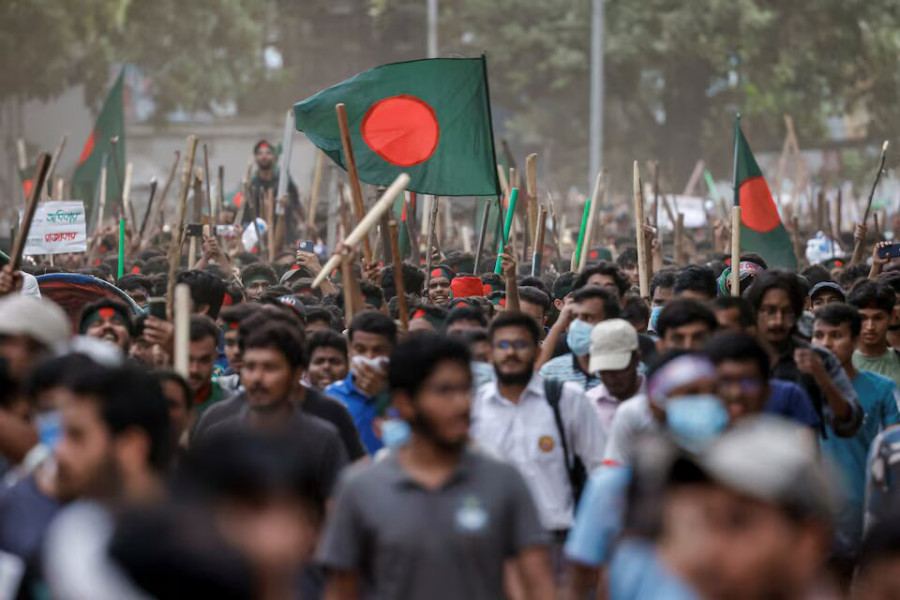
Bangladesh’s 13th parliamentary election will be held on February 12. This election promises a much-awaited political transition from the Muhammad Yunus-led interim regime that assumed power after Sheikh Hasina’s ouster to a democratically elected government. Awami League remains banned and is not allowed to participate in this election. The election is a bilateral contest between a 10-party coalition led by the Bangladesh Nationalist Party (BNP) and an 11-party coalition led by the Bangladesh Jamaat-e-Islami (JI). Notably, along with the parliamentary election, Bangladeshi voters will vote in a referendum that proposes several constitutional changes.
What’s in the manifestos
The 90-point ‘people’s manifesto’ of the JI, which outlines 26 priority areas and promises “towards a discrimination-free humane Bangladesh inspired by the aspiration of the July revolution” and pledges a modern welfare state. Meanwhile, the BNP is campaigning to establish a ‘welfare state’ as its chairperson, Tarique Rahman said, “I have a plan”.
Jamaat’s political capital is the July uprising; the cover of the manifesto includes the pictures of Abu Sayeed, the first person to be killed during the July uprising in Rangpur, Osman Hadi of Inqilab Moncho, who was killed during the election campaign and Abrar Farhad, who was killed by the Chatra League in 2019. It also states, “Let us build Bangladesh together.” However, its position on women, as articulated by Amir Shafiqur Rahman, would cast a shadow on its electoral performance, as they constitute 50 percent of the voters.
The BNP emphasises its role in the liberation war and its contribution to establishing multiparty democracy. It underscores ‘Bangladesh before All’ as its guiding principle. While promising good governance and democracy, the party seeks to ensure that the correct history of the liberation war is presented in the school curriculum. In Bangladesh, there is a tendency to alter the history of the liberation war in the curriculum to highlight the ruling party’s view of it. It also promises to establish a separate division within the Liberation War Ministry dedicated to the July 2024 martyrs. Likewise, it promises to build a modern defence force on BNP’s founder and President General Zia ur Rahman’s vision of ‘People’s War doctrine’.
The Islami Andolan Bangladesh, which in the last minute decided not to become a part of the Jamaat-led alliance in its manifesto, promised that if elected to power, they would “uphold the spirit of the Liberation War and the July Uprising”.
The National Citizen Party (NCP), the party of the youth that led the July uprising, presented a 36-point manifesto titled ‘Youth and Dignity’, emphasising a ‘new Bangladesh’, promising fundamental state reforms, re-establishing democracy, and ensuring accountable governance.
Bangladesh-first foreign policy
As India’s role in Bangladesh and relations between the two countries have remained a contested topic since Hasina’s fall, all the major political parties contesting the election have asserted that if they come to power, they will prioritise Bangladesh. Jamaat’s manifesto is anchored on the principle of ‘Bangladesh’s Interest First.’ It emphasises sovereignty and national interest—building a sovereign state with zero compromise on independence. The Amar Bangladesh Party, an alliance partner of Jamaat, states that it will follow a dignified and realistic foreign policy, which will be based on national interest, international law and Bangladesh’s constitution. Rather than blindly following another nation, it will prioritise its own country.
The NCP manifesto states that it will not compromise in safeguarding Bangladesh’s sovereignty, security and independent foreign policy. It has a section on relations with India and has often accused Hasina of having an unequal relationship by signing unequal treaties with India. The core of its foreign policy outlook towards India is the issue of Sheikh Hasina’s extradition. It says it wants to establish “a sovereign, state-to-state strategic relationship with India based on equality, mutual dignity, and fairness. Any form of hegemonic behaviour, interference in internal affairs, or pursuit of unilateral advantage is unacceptable.” Interestingly, the NCP has a defence strategy which speaks of inducting surface-to-air missiles and raising a drone brigade.
On foreign policy, the BNP believes that beyond Bangladesh’s borders, it has friends, not masters. Bangladesh’s sovereignty, national interest, national security and people’s welfare will receive top priority. In its relations with neighbouring states, the party emphasised equality, mutual respect and understanding. It speaks of border killings and push-ins and has said it will take legal measures against any foreign nationals living in Bangladesh illegally. The party also emphasises regional cooperation, especially SAARC, an initiative of its founder, Gen Zia ur Rahman.
The Referendum
On the day of the election to the Parliament, a referendum is held on the proposed constitutional reforms—47 of them—which constitute a crucial part of the political transition. There are 84 proposals in total, out of which 47 relate to the constitution and 37 pertain to ordinary legislation. However, people are asked to cast a ‘Yes’ or ‘No’ vote on four separate categories of the constitutional reform proposals. The reform proposals that form these four broad categories are clubbed in such a way that many proposed reforms are not explicitly stated, but a ‘Yes’ vote will include everything. The third point of the proposals being voted on states that the parties have reached consensus on 30 proposals from the July charter, but it does not specify which proposals.
However, parties contesting the election are not interested in debating these proposals to garner support for a ‘Yes’ vote. The reform proposals were discussed with the parties, but they do not think it is necessary to explain them to voters. Proposals such as forming a caretaker government, the role of the opposition, limiting the term of the prime minister to two terms, and whether to allow Members of Parliament representing parties to vote independently have been raised in Bangladesh whenever political reform is discussed. Some of these proposals were discussed during the 2007-2008 military-backed caretaker regime.
There is often criticism that people are being forced to choose between ‘Yes’ and ‘No’. The interim regime’s campaign for a ‘Yes’ vote continued until the Election Commission restrained it. The Jamaat and the NCP are actively campaigning for a ‘Yes’ vote. The BNP campaign, though, has focused on securing a parliamentary majority; it has done little campaigning for a ‘Yes’ vote because many of these reform proposals will be discussed in Parliament, and the party’s position on reform will only be implemented if it gets a majority. There is no campaign against a ‘No’ vote.
The election is crucial for Bangladesh’s politics as it will shape its future. This election will also, for the first time, see Jamaat Islami in a stronger political position. Though it is speculated that the BNP will win the election, the Jamaat will likely shape politics and significantly influence the outcome.




 14.77°C Kathmandu
.PNG&w=200&height=120)