



 14.81°C Kathmandu

Sat, Oct 24, 2026
Columns
Balen, fire and fury
Pitted against Oli, his hallowed aura of invincibility is at the ballot’s altar.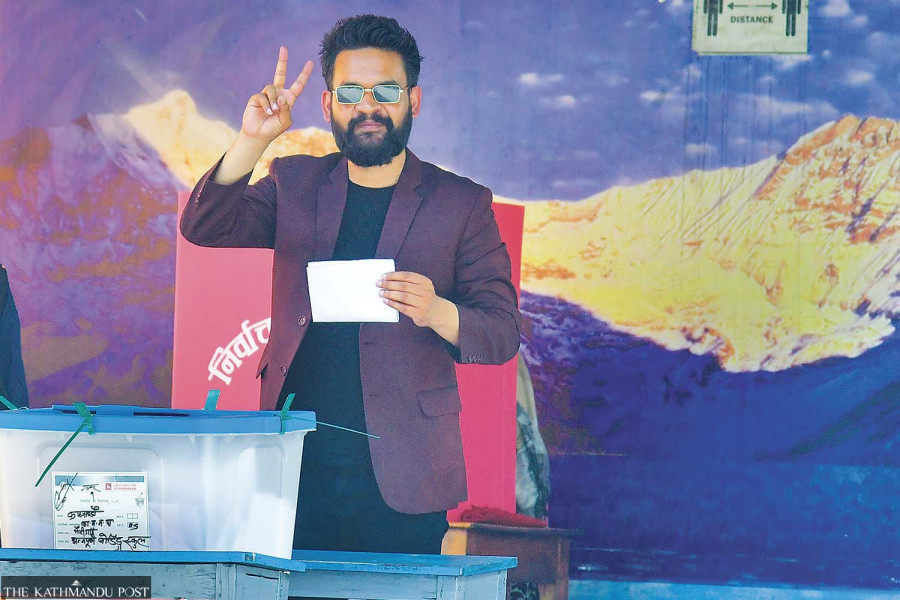
bookmark
Mohan Guragain
Published at : February 9, 2026
Updated at : February 9, 2026 07:11
Balendra Shah, popularly known as Balen, wants to beat communists in their own game. In a lyrical tactic, Nepal’s Marxist-Leninists drew the poor’s attention with heartrending songs of poverty and inequality. Artistes like Raamesh Shrestha, JB Tuhure and Jivan Sharma have lived in Nepali hearts for decades for their timeless songs, such as ‘Gai ta bandhyo’, ‘Aama didi bahini ho’ and ‘Simali chhaya ma basi’, to name some of their most iconic numbers.
‘Gai ta bandhyo’ regained public attention after its inclusion in the hit Nepali movie Balidan in the 1990s. After Nepal became a republic, as an achievement of the revolutions aroused by such songs, Balen remade the piece, accompanied by a new video. By this time, the song had started mocking the very revolutionaries who fumbled at governance in their own political set-up. A thrust of this song, throughout, has been that ‘there is nobody to speak for the poor’.
For the March parliamentary election, Balen is in the Jhapa-5 race, primarily against KP Oli, a prominent communist figure in Nepal. Oli is among the Jhapa Naxalite movement leaders who executed landlords in the eastern Tarai district in the 1970s to give the land to the tiller. He later spent much of the communist movement’s time in jail, only to be freed when the banned Marxists and Congressis bolstered their campaigns against the partyless Panchayat system in the late 80s.
Oli had served as prime minister multiple times, until September’s Gen Z revolt ousted him. Some portray him as a master manipulator of Nepali politics, putting him on par with the late Nepali Congress leader Girija Prasad Koirala. Another of his arch-rivals, Pushpa Kamal Dahal, the Maoist revolutionary who led an insurgency to an arguable success, isn’t acknowledged as being so cunning, but was another person responsible for Oli’s downfall.
Balen is a figure who emerged from the September fire, shining. Many try to link him to the Singha Durbar arson that ravaged the governing seat in Kathmandu. In an older Facebook post, Balen threatened to set the central secretariat on fire if the traffic police again stopped for checks any vehicle operated by the Kathmandu Metropolitan City Office that he led as mayor.
Dahal was an Oli comrade in the 2017 parliamentary elections, which installed strong communist governments both at the centre and in the provinces. The failures of their unified communist party to govern the country properly in the federal set-up, infighting during the Covid-19 pandemic—which compounded public hardship—and a series of government changes after the party split created space for youths such as Balen to venture into politics.
Balen had been campaigning for years when he stood for Kathmandu mayor in 2022. Rabi Lamichhane, a loudspeaking journalist who delivered his justice before television cameras, took a plunge into politics for the November parliamentary elections later that year.
Oli’s mistakes gave rise to both these newcomers in politics. Balen’s mayoral opponent from Oli’s CPN-UML was the former Kathmandu metropolis chief Keshav Sthapit, who had lost track of the changing times. A young candidate like Sunita Dangol, who won the deputy mayor race with a huge margin, could have beaten Balen in the mayoral contest itself.
In the last election, Oli fielded candidates against Balen. This time around, Balen ran all the way to Jhapa to challenge Oli in his home ground.
Balen complements Lamichhane’s angry-young-man figure of Nepali politics. Now in the latter’s party, Balen is almost single-handedly driving the Rastriya Swatantra Party’s electoral vehicle. The RSP is one of the parties on which Balen did not spare his social media whiplash as he collectively derided domestic forces and foreign powers at one swipe earlier. Balen’s fury has now found greater manifestation.
A political movement preferably has a face. The Gen Z revolt was necessitated by the Oli government’s social media ban, and some youths registered their intent with the administration to demonstrate peacefully against it. The September 8 killings of 19 youths in police firings triggered what became the biggest destruction of the Nepali state apparatus in the country’s history. Balen’s social media posts had become so potent by then that he could instruct the revolting youths on what to do next. To his bidding, the Nepali Army negotiated a way out for the nation lost in the cloud of Nepal’s only urban revolt.
While Lamichhane came out of jail, allegedly hoping to lead a government in the revolt’s aftermath, Balen turned down the youths’ PM offer.
It’s probably not in Balen’s nerves to take the position that came so easily to him. Instead, he wants to earn it a harder way, beating another prime ministerial candidate—Oli from the UML—most immediately.
History has caught Oli helpless three times—while he languished in prison for 14 years with chronic illnesses, and then when he had to be flown out of Baluwatar on an army chopper. This time, he puts on a brave face despite the challenge Balen presents. But it’s for the mighty people to decide if Balen or Oli should represent them.
Beating Oli alone won’t enthrone Balen at Singha Durbar. The RSP under Lamichhane has to emerge as the biggest political party to make Balen the prime minister.
Balen toured the eastern hills, so as also to speak to his voters in Jhapa. His visits to far-western districts are an obvious move to bolster his PM prospects.
What exactly happens after March 5 is unknown, even to the individual voter, forget armchair analysts and self-appeasing politicians.
Which party can ride the electoral wave and which ones will be swept away will be seen in a matter of weeks from now. Balen’s hallowed aura of invincibility is at the ballot’s altar.
Portraying his party as the protagonist against the so-called destructive forces, Oli has been trying every trick in the book to delay the elections. As he grows increasingly jittery over potential defeat, Oli even tried electoral tie-ups with Dahal’s coalition of leftist forces, to no avail. Dahal seemed to have a hand in inflaming the Gen Z movement and tried to cash in on it later, but is having to wade into the elections without an assured victory.
For his part, Balen rapped leaders of the old guard enough for their failures. Can he also provide a rocking rebuttal to allegations that he did not send fire engines in time to douse the Singha Durbar and Supreme Court fires?
The theory of revolution does not support Oli’s repeated victory in Jhapa, but if he defies the odds, will Balen’s fury hold the same fire?
Mohan Guragain
Mohan Guragain is a desk editor at The Kathmandu Post. He edited a provincial youth-oriented monthly paper for nearly two years before joining The Himalayan Times in 2008. Guragain also writes occasionally on politics and socio-economic issues. He joined the Post in 2010.




Most Read from Columns


Editor's Picks





E-PAPER | October 24, 2026

×