As the bilateral relationship between India and Bangladesh has spiralled downward since the ouster of Sheikh Hasina, one has seen a tit-for-tat response on many bilateral matters. This is notwithstanding the effort of the two countries to normalise their relationship. After Sharif Osman Hadi’s killing, the rhetoric has reached a new height: Not just that both countries have summoned the high commissioners to send messages to each other—a rare practice in the bilateral relations—but the visa centres are being closed amid heightened security.
It needs to be noted that after the fall of the Hasina government, the Indian visa centre and the Indian Cultural Centre in Dhaka were attacked by mobs. While a group of people marched to the Indian High Commission in Dhaka, and there was an attack on India’s Assistant High Commission in Chittagong in the aftermath of Hadi’s killing, the demonstration, on a much smaller scale, in front of the Bangladesh High Commission in Delhi was against the lynching of Das.
The growing anti-Indianism steered by Islamic elements has emerged as a new ploy as Bangladesh moves towards the election. The Islamists have always emphasised their affinity with Pakistan and have continually portrayed India as a threat to Bangladesh. The anger against the Awami League, in a planned manner, is directed towards India by vested quarters. Social media is filled with hate-India posts, emphasising that India has not only sheltered Hasina but also the killers of Hadi.Interestingly, some even went to the extent of saying that in case India attacks Bangladesh, Pakistani missiles, along with Chinese military might, would be enough to teach India a lesson. This is not the first time one has seen this spurt in anti-Indianism. Towards the end of Mujib’s rule, anti-India sentiment was fuelled by pro-Pakistani elements as well as those who perceived Mujib’s regime as pro-India. This sentiment was cultivated further to entrench the military regime that succeeded the post-Mujib chaos.
India’s historical connect
Historically, India’s treatment of East Pakistan has been different. Each time there was an India-Pakistan war, India did not take advantage of its ‘defenceless’ position. While the two Punjabs in the western border of India witnessed massacres during partition, the two Bengals’ experience of violence was different, sporadic. Connectivity—rail, road and waterways—existed till the 1965 war. The cultural and linguistic affinity they shared with West Bengal in India was looked at with suspicion by the Pakistani state. The affinity was always downplayed by Islamists. Both the Islamist and leftist narratives portrayed India as hegemonic and expansionist, and its role in the liberation war was projected as limited to the division of Pakistan, although India hosted 10 million refugees and confronted hostile external players for its support of the Bangladesh war. This convergent narrative has undermined India’s broader engagement. In this context, India’s support for the Hasina regime is being portrayed as the basis of anti-Indianism, and this narrative, which is supported by Bangladeshi elites, has deeper roots.
Anti-Indianism and the interim regime
Bangladesh, since the takeover by the interim regime in August 2024, has displayed all the traits of the Pakistani state: hostile, rhetorical and challenging India’s territorial integrity. Both elements within the government, as well as outside, have resorted to irredentism—greater Bangla, claiming North East, or projecting Bangladesh as guardian of the Bay of Bengal, threatening to cut off the Siliguri corridor. In 2011, Manmohan Singh had said, “We must reckon that at least 25 percent of the population of Bangladesh swears by the Jamiat-ul-Islami (sic) and they are very anti-Indian and they are in the clutches, many times, of the ISI.” Though this remark drew criticism in Bangladesh, what is happening in Bangladesh now reflects what Singh had flagged more than a decade back. Though there was a meeting between Jamaat and Indian officials, there is a strong belief that Jamaat is fuelling anti-Indianism. Even now there is a debate on the Islamic moncho, which Hadi was leading as a front of the JeI. Anti-India electoral politics is not new, but it has acquired a new dimension as the Awami League remains banned and the politics continues to revolve around the misdeeds of their regime and brings into focus Hasina’s presence in India and India’s support for the AL.
Politics of cricket
As the election nears, India, as a precautionary measure, has announced Bangladesh as a non-family station, anticipating violence and mob attacks as a manifestation of anti-India politics. This puts Bangladesh in the category of Iraq, Pakistan and Afghanistan. The politics over Mustafizur Rahman, who was not allowed to play for Kolkata Knight Riders (KKR), has snowballed into a major controversy. Following the expulsion from playing in the privately owned league, the Bangladesh Cricket Board announced that it would withdraw from the forthcoming T20 World Cup hosted by India and Sri Lanka, demanding a change of venue, citing security threats to its players. As if this were not enough, Pakistan, as an expression of solidarity with Bangladesh, wants to withdraw from the World Cup as the International Cricket Council mulls several options.
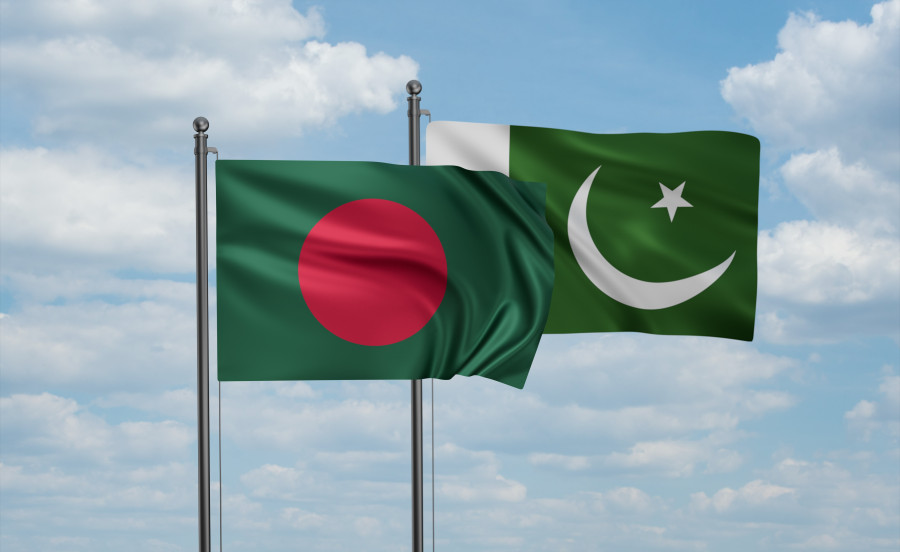
In the emerging geopolitics, Bangladesh, after Hasina’s removal, has tried to move closer to Pakistan to underline its antipathy to India. Pakistan has not lost the opportunity to exhibit bonhomie as a diplomatic success to marginalise India in Bangladesh. Major General (Retd) ALM Fazlur Rahman, the person who was appointed by the interim regime to the National Independent Investigation Commission to reinvestigate the BDR mutiny and whose findings said it was India that benefited, in a social media post, said that if India attacks Pakistan following the Pahalgam attack, Bangladesh, along with China, should jointly occupy India’s north east.
The rise of anti-Indianism as a foreign policy choice of the interim regime in Bangladesh has soured bilateral relations with India. The tit-for-tat response, often summoning of diplomats by respective foreign ministries and the rise of rhetoric in the election period, appears like Bangladesh is ‘new Pakistan’ for India in terms of the rhetoric of threats it wants to pose as anti-Indianism becomes an electoral tool. It is a challenging time for diplomacy to inject pragmatism into the bilateral relations that will hold the two countries’ ties together.




 14.77°C Kathmandu
.PNG&w=200&height=120)