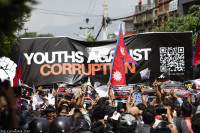
When ordinary people break down from sorrow and pain and see no way forward, they look towards a light, search for a party and seek a reliable, organised voice that can rescue them from afflictions and sufferings. At present, they are facing problems such as inflation, unemployment, agricultural crises due to climate change, or water scarcity. Not only are they frustrated with the government’s sluggish service delivery but are also victims of social discrimination. The state appears to them as a distant, flickering lantern. In such times, people want the companionship of a party. They seek liberation from laxity, corruption, impunity and syndicates. They desire honest and accountable leadership.
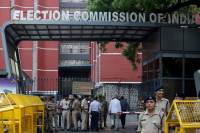
While traveling from village to village, I also observed another kind of curiosity among people. For instance, if democracy gets trapped in a crisis, which party will be ready to go to jail or even sacrifice their lives? If civic rights shrink, which parties will have the courage to resist? Currently, more than a hundred parties are registered with the Election Commission for electoral purposes. There is a rush to form parties. Having more parties in a democracy is considered fine only as long as they show sensitivity towards the people. After all, why can’t leaders look beyond elections? In reality, the roots of clinging to elections run very deep.
Democracy talks about issues of public interest. Today, hardly any attention is paid to public issues. Politics is happening merely for electoral purposes. The upcoming election is extremely important. In this election, the existence of Nepali democracy will be at the centre. The truth is not that Nepal’s parties are in danger, but that in the current times, hope is continuously diminishing. It is worth pondering what we are losing. I believe something is happening with our parties that is killing the democratic soul.
Somewhere, we are being shaped into a nation with angry, boiling hearts, small minds and narrow souls. This is an infection where, for the first time, you don’t feel that the purpose of producing knowledge is truth. A framework for public discourse is being created that completely eliminates the need for thoughtful understanding. In no time, speaking the truth has become a dangerous thing. Conversations in Kathmandu’s tea shops only emerge after heavy filtering.
In practice, this system is slowly turning into a competition of numbers rather than ideas. Old parties have kept postponing self-reform, and new parties have gotten entangled in the haste of winning and losing even before self-building. This constitution did not envision democracy without political parties. According to the spirit of the constitution, parties give expression to individual grievances through voting. They show hope of raising ambitions even among grassroots people. And they serve as platforms for the interests of all classes in seeking political solutions.
The problem with old parties is not that they are old; rather, they are intent on repeating past mistakes in upcoming elections. Organisational inertia, dynasticism, factionalism and power preservation are internally neutralising every proposal for reform. On the other hand, new parties that came as alternatives quickly want to become machines for winning elections and parking policy, ideological training and long-term roadmaps to a ‘future to-do list’. In this situation, the question is connected more to the people than to the parties. So, what should the people do?
First, citizens must accept that democracy is not just about the right to vote; it is also the responsibility of continuous intervention. A public that is active on election day and inactive for the remaining five years will only weaken democracy. They need to learn to vote not for the party, but for the party’s conduct. They must look beyond manifestos and to the party’s behaviour in both parliament and the streets. More important than what a leader says is whether they remain democratic equally in power and in opposition.
Second, people must emerge from the politics of the ‘lesser evil’ option. Repeatedly voting with the thought that ‘there is no one else’ is the very thinking that saves parties from being accountable. If people start asking uncomfortable questions such as, ‘Where is internal democracy?’, ‘When will leadership transition?’, and ‘Where is the policy?’, the parties will have to change. Third, civil society, the media and the intellectual class must become continuous democratic watchdogs, not just seasonal ones during elections. The protection of democracy happens in society, not in parliament.
People will come to vote in elections, but without trust. Votes will be cast, but hope will not be generated. And when democracy stops giving hope, people start looking towards strong hands, quick solutions and undemocratic attractions. Democracy lives not just from parties, but from citizens. If parties remain trapped in short-term power games, people will have to guard long-term democracy themselves.
Political parties should be representatives of social interests, carriers of ideology and mediums for long-term policy transformation. But in practice, politics is shrinking to lightweight populism and making pleasing statements to somehow achieve numerical majority in elections. In traditional political parties, the erosion of internal democracy, centralisation of leadership and organisational inertia have limited the possibilities of reform. The hunger for power has turned ideological reevaluation into an unnecessary luxury. On the other hand, new parties eager to be called alternatives, which emerged with claims of presenting political options, also quickly get trapped in the narrow circle of electoralism. Winning elections should have been a means, but it has become the goal itself.
This situation challenges a fundamental principle of democracy that political parties are not just units for acquiring power but institutions of public reason. When parties get entangled in short-term power arithmetic instead of long-term social-economic transformation, democracy remains procedural, but its soul begins to weaken. In democracy, parties should be institutions of public reason where society’s uncomfortable questions come into debate, clash and transform into policy. The question is clear: Do we need parties that win elections or ones that keep democracy dynamic? If parties never learn to debate with society beyond just winning elections, democracy will continue breathing but become meaningless.




 19.73°C Kathmandu