



 16.76°C Kathmandu
Sat, Oct 10, 2026
Arts
Capturing the past and future in the same frame
The exhibition ‘Changing Times’ suggests that the past and future are not opposites, but forces that continue to shape each other in the present.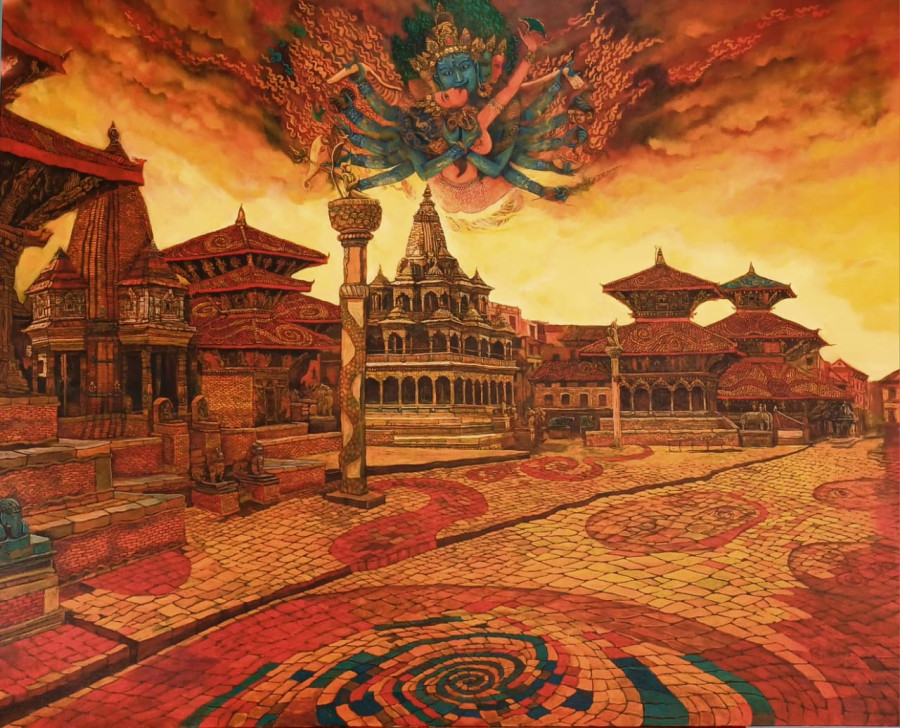
bookmark![]()
Roshan Pradhan’s ‘A Tale of Two Ages’ ![]()
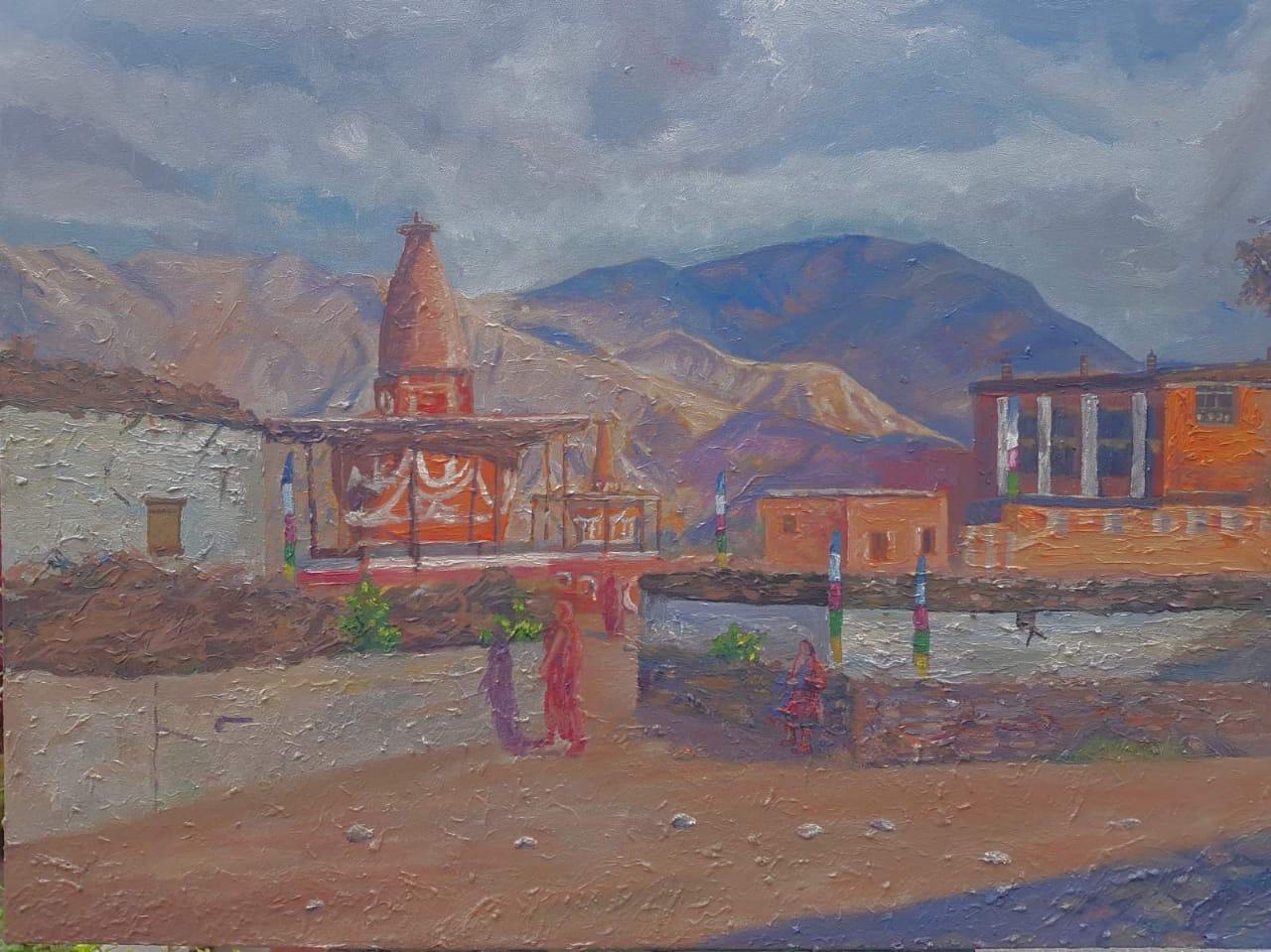
Rudra Bahadur Pun’s ‘Mustang 2’
Sanskriti Pokharel
Published at : February 2, 2026
Updated at : February 2, 2026 06:33
Kathmandu
Can tradition and technology exist in the same breath, or are they forever locked in opposition?
This question lingers as you move through the exhibition ‘Changing Times’ at The Kalā Salon, where mythology, spirituality, memory and artificial intelligence unfold across canvases in different visual languages.
Though each artist approaches a distinct theme, their works are united by a shared preoccupation with time. The past is not distant here, nor is the future abstract. Instead, both feel present.
Curator Sophia L Pandé says, “This exhibition is the culmination of over a year’s work; the results are thoughtful artworks.”
Roshan Pradhan’s ‘A Tale of Two Ages’ stages the tension between past and future dramatically. The canvas is split into two confronting worlds that meet at the centre like opposing forces in conversation. On one side stands a commanding, human-bodied figure crowned with a fierce Bhairav mask, draped in traditional ornaments and a tiger-skin garment.
Behind the figure, green hills roll into waterfalls and organic forms, suggesting a world still guided by nature and cosmic balance. The atmosphere feels alive, breathing, and spiritually charged.
Facing it is a humanoid robot with metallic limbs, with joints and gears visible. Though built in the image of a human, it appears uncertain, one hand raised as if in defense rather than attack. The land behind this figure is dry and fractured, filled with crumbling towers and a dust-heavy sky. Nature has thinned into ruin, replaced by rigid structures and lifeless ground.
The emotional tension lies in their posture. The Bhairav figure advances with grounded authority, while the robot recoils. It feels less like a battle between past and future and more like a philosophical encounter between the organic and the engineered, the spiritual and the artificial, permanence and fragility.
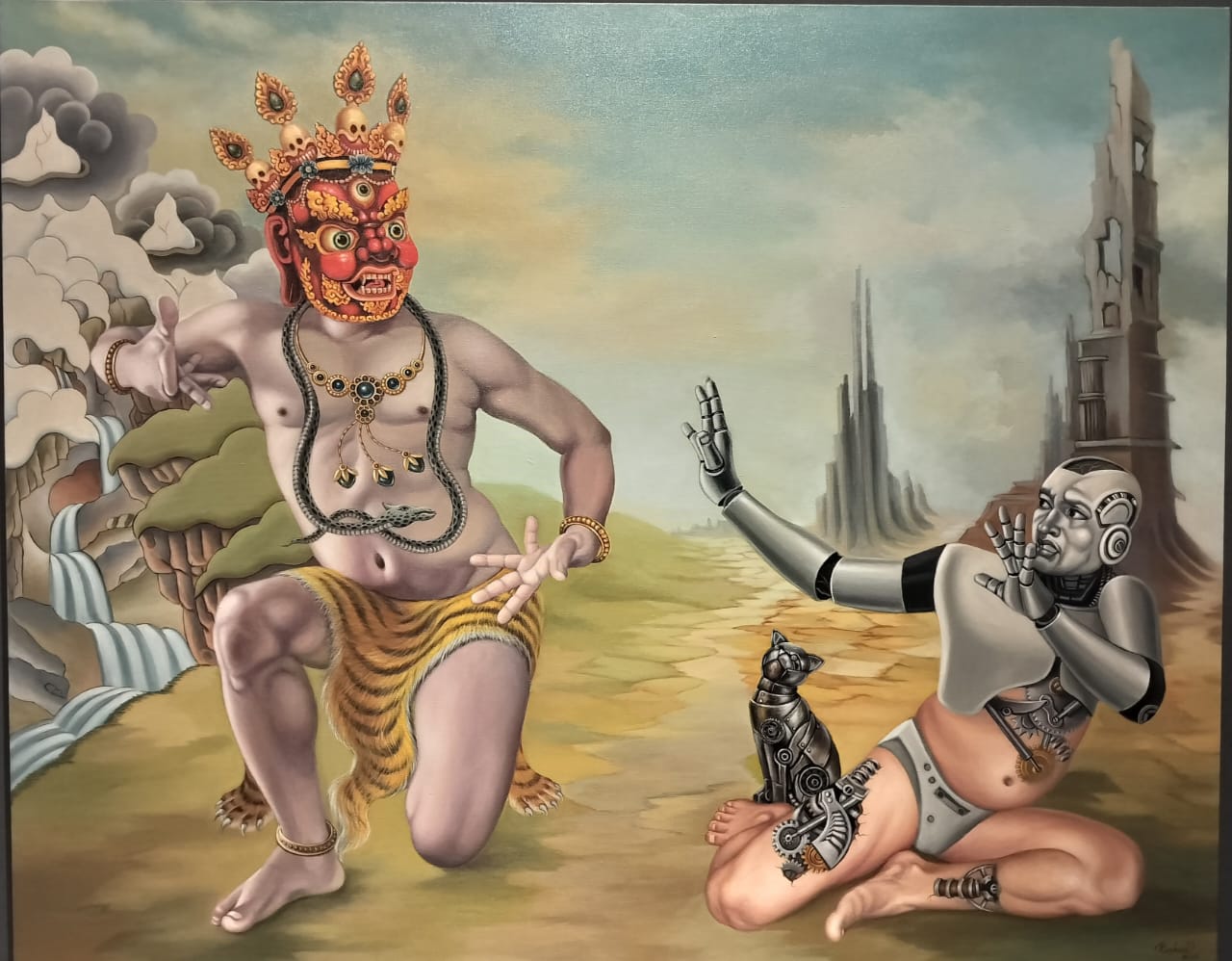
“For the past few years, I’ve been trying to fuse technology and tradition in my work,” says Pradhan. He does not dismiss AI as a threat but places it within a larger cosmic hierarchy. “Today, we cannot live without AI, and we also cannot live without nature. But the key point I’m showing is this: no matter how powerful AI becomes, if God or nature wills it, everything can be destroyed in a moment.” His painting becomes less a warning and more a reminder of scale. Human innovation may feel vast, but it remains small before elemental forces.
A meditative tone emerges in Mala Shrestha’s ‘Water of the Divine Mother’. At its centre, a tree branch curves into the shape of a palm, forming a gesture reminiscent of a mudra. From this palm, water flows downward into a calm pool where fish swim, and lotus flowers float. The scene carries a sense of gentle continuity, where nature and spirituality are not separate but intertwined in a shared rhythm.
The tree becomes a symbolic body. Its trunk cradles a divine mother figure, suggesting origin and protection, while a brick wall with small shrine-like niches in the background evokes lived faith and everyday devotion. The composition feels nurturing rather than dramatic, offering stillness in contrast to the tension seen elsewhere in the exhibition.
“I mainly work with the motif of Buddha’s hands to express emotions. Buddha’s hand is a symbol of peace,” Shrestha says. “Right now, the world is full of conflict and disturbance. I want viewers to feel calm when they see my paintings.” Speaking of the flowing water, she adds, “It symbolises life, joy, and calmness.” On the tree imagery, she reflects, “Trees are the foundation. Just like parents are the foundation of a child’s life, trees symbolise origin and respect for roots.” Her work gently redirects attention from global anxieties to inner quiet and emotional grounding.
Similarly, Pasang Bikram Lama’s ‘Pancha Tattva Mandala’ draws the viewer inward through a carefully structured mandala where symmetry and colour create a sense of stillness. Earthy textures along the outer layers contrast with the vivid precision of the inner geometry, guiding the eye toward a calm yet powerful centre. The experience of looking at it feels almost meditative, as if viewing mirrors is centring oneself.
“The circle represents the universe,” Lama explains. “The five elements are earth, water, fire, air, and space. These elements are the basis of existence. Without them, life cannot exist.” He combines this elemental philosophy with Buddhist symbolism, adding, “I’ve combined the Pancha Tattva Mandala with the concept of the Five Buddha Mandala.”
The result is a work that feels deeply rooted in Himalayan spiritual tradition yet visually aligned with contemporary design language. “In this work, I try to blend traditional forms with contemporary patterns,” he says. The painting suggests that tradition is not static. It evolves, absorbing new forms while holding on to its philosophical core.
Memory and mythology shape Pradhumna Shrestha’s ‘Shangri-la’, which presents Patan Durbar Square as both a real place and an emotional one. The detailed temples and brick buildings ground the scene in heritage, while soft, swirling patterns make it feel more like a memory than a precise record. The square feels as much as it is seen.
Above the square floats Chakrasamvara, placed not only as a deity but as a protective presence in the sky. The divine figure does not dominate the architecture but hovers gently, like a guardian woven into the atmosphere itself. Warm light washes over the scene, blurring the line between physical space and remembered feeling. The work suggests that heritage is not only brick and wood, but also stories, beliefs, and emotions passed through generations.
As Shrestha puts it, his work grows from “heritage, childhood nostalgia, and the feelings I get when I visit these places, where stories, myths and personal memory become part of the architecture itself. By placing deities and mythical beings in the sky, I visualise the invisible layers of faith that live alongside physical monuments.”
Together, these works move between confrontation and calm, dystopia and devotion, memory and mandala. They suggest that while tools, cities and eras may change, certain concerns remain constant. Where do we belong in time? How do we carry the past forward? And what do we risk losing as we rush toward the future?
In different ways, each artist suggests that the answer lies not in choosing between tradition and modernity, but in holding both together.
_________________
Changing Times
When: January 15 to February 15
Where: The Kalā Salon, Chhaya Centre, Thamel
Time: Daily 11:00 am to 8:00 pm
Entry: Free
Sanskriti Pokharel
Sanskriti Pokharel, a former reporter and sub-editor at the Post, is a final-year student of Journalism, Mass Communication, and English Literature at St. Xavier's College, with experience in media, research, and communication.
Editor's Picks

Constitutional Bench caught in seniority, ‘pick and choose’ dispute

A Dom boy’s long road to becoming a doctor

From blankets to handmade dolls, two foreign women bring comfort to flood survivors

News Analysis: When institutional defence exposes institutional fault lines

It’s a bird … it’s a plane … it’s the Indian ambassador’s farewell tweets
E-PAPER | October 10, 2026

×