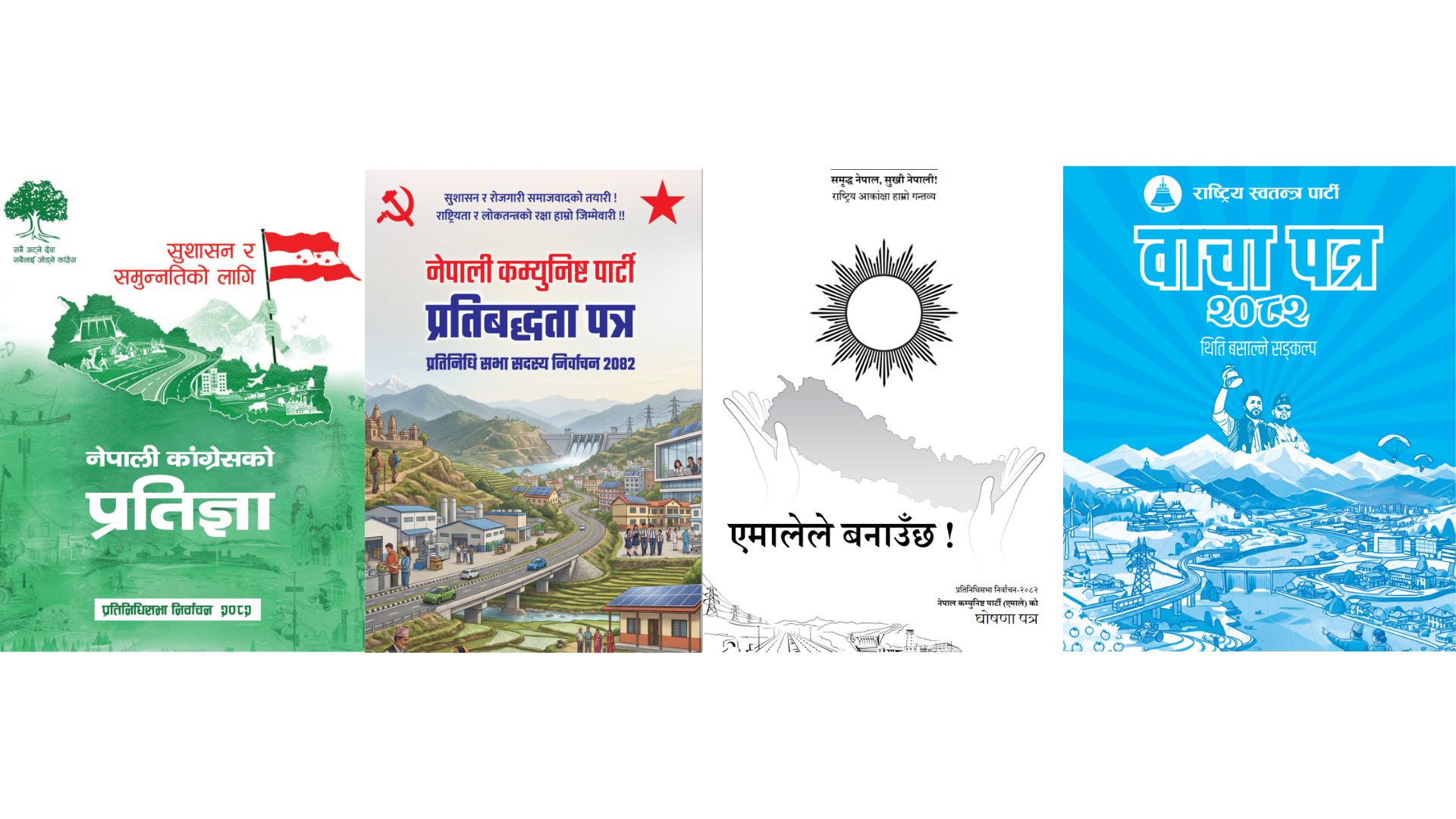
As major parties unveil their manifestos, art and culture remain sidelined, even as youth leaders and artists enter mainstream politics. While political parties use music as their primary force to broadcast their political agenda, it remains neglected in policy planning.
Nepal stands at a crossroads as major political parties, responding to the recent Gen Z movement, unveil manifestos ahead of the upcoming election. Yet, a noticeable void remains—the politics of art and culture.
The rise of Balen Shah, from a Hip-Hop rapper to the mayor of Kathmandu Metropolitan City and now presented as a monumental figure of the Rastriya Swatantra Party (RSP), signals a growing political agency among youth and artists.
However, the irony is rather difficult to overlook.
The entry of an artist into the political mainstream seems to have brought strong momentum for artistic and cultural upliftment. However, major political parties, including the RSP, fall short in addressing the full spectrum of Nepali art and culture. Being treated as ornamental rather than foundational to nation-building, discussions around the subject remain peripheral.
The political manifestos were unveiled across different parts of Nepal, with the major political parties presenting ‘Commitment Documents’, ‘Electoral Promises’, and ‘Pledge Documents’. While the uprisings’ commitments primarily revolve around governance and infrastructural reform, the political discourse continues to neglect cultural policy frameworks, the creative economy, heritage preservation, and artistic freedom.
Among Nepal’s four major political forces, two, Nepali Congress (NC) and Nepali Communist Party (NCP), have acknowledged art, culture and literature in their official documents. Others remain stagnant in the matter.
Nepali Congress, in its 200-page ‘Pledge Document’, devotes five pages (175 to 179) to the section ‘Our Civilisation, Our Culture’.
This section proposes systematically researching the existing heritage and folklore of Nepali Society. Further, it aims to incorporate these findings into a digital archive and promote the development of cultural industries.
NC commits to establishing multi-purpose art centres with amphitheatres, art galleries, training rooms, and digital archives in all seven provinces. The manifesto also proposes systemic educational reforms to promote the ‘teacher-artist’ concept. With seven sub-headings, the document envisions broader cultural uplift, aiming to revive Nepal’s spiritual heritage and civilisation, prioritise the creative economy, preserve heritage and culture, and promote the scientific study of traditions.
In its 52-page ‘Commitment Document’, the Nepali Communist Party frames culture, art and literature (pages 45 and 46) as a mirror of Nepali society and commits to prioritising them. In the four bullet points, the manifesto pledges to preserve and promote indigenous art forms and to incentivise innovative and creative contributions through recognition and awards.
In contrast, CPN-UML’s ‘25 Pillars of Prosperity’, art and culture appear largely absent as a distinct policy priority. The 12th pillar (page 63) commits to promoting Nepal’s tourism sites through cinema, social media, influencers and travel bloggers.
Among the 100 points addressed in the ‘Manifesto’ of the Rastriya Swatantra Party, the 50th point (page 26) acknowledges the multi-cultural prosperity of Nepal, aiming to direct the tourist flow towards Pashupati Temple, Lumbini and Janakpur.
Heritage and culture are minimally mentioned in both documents, primarily as a suffix to tourism and other infrastructural development. Subjects of art remain absent.
Among Nepal’s four major political forces, two, Nepali Congress (NC) and Nepali Communist Party (NCP), have acknowledged art, culture and literature in their official documents. Others remain stagnant in the matter.
According to the major political parties, development rarely involves the systemic advancement of creativity. While sustenance is the primary concern for the artists, they remain despondent about the government’s inconsistent attention.
Heritage Conservationist Alok Siddhi Tuladhar recalls how development has constantly been tied to construction. “In a country like Nepal, the implications of the federal policies have not been deeply analysed. The interlink of cultural heritages with development should be precisely taken into consideration,” he said. Tuladhar believes that, rather than vigorous construction plans, the focus should primarily be on preservation and conservation.
In his two decades of studying and researching the tangible and intangible heritages of Nepal, he firmly assures that the future lies in the wisdom of the past. Thus, he believes that the government should prioritise documenting and promoting accurate information regarding heritages and lineages.
Policies surrounding filmmaking are significantly obscured by the manifestos. With the continual elevation of film culture among Nepalis, the challenges confronting the independent filmmakers have become glaringly visible in terms of censorship, funding, and international recognition. This raises the question about the role of state oversight in art and cinema.
Music has long been a source of identity—a medium for articulating emotions, culture, and creativity. While political parties use music as their primary force to broadcast their political agenda, it remains neglected in policy planning.
Kunti Moktan, a Nepali veteran musician, expresses how, rather than the government, artists receive aid from the non-political populace. “Regardless of pronouncing artists as deshko gahana, having spent an abundant amount of time in the music industry, I haven’t seen the government’s involvement in artists’ sustenance and protection,” she says. “Rather, we find the citizens themselves stepping up for the artists.”
Moktan highlights how artists are obliged to seek sustenance elsewhere, primarily by going abroad. “We can find the maximum number of artists migrating abroad for this matter,” she says. “Artists do not demand an extravagant quality of life; their needs revolve mostly around protection, sustenance, health and basic survival facilities.”
The government’s negligence in addressing musicians’ concerns serves as a primary catalyst for the public’s reluctance to view the music industry as a legitimate career path. “When artists become incapable of making music, they fall to zero, without any support,” says Moktan. “This is extremely alarming.”
Amidst the rhetorical promises of the political parties, the theatre seems to have no space. Theatre artist and operations manager of Mandala Theatre Nepal, Prasamsha Siwakoti, recalls, “We were not aware that the government, too, plays a role in the upliftment of theatres. Artists are present in the field solely because of their passion. Future security is blurred for us, and we do not know what to expect.”
From acting workshops to technical equipment, theatre demands significant financial support that the government is oblivious to.
Artists, researchers, conservationists, filmmakers, and musicians feel systematically marginalised by policy structures that celebrate art and culture rhetorically but neglect them in practice.




 16.76°C Kathmandu