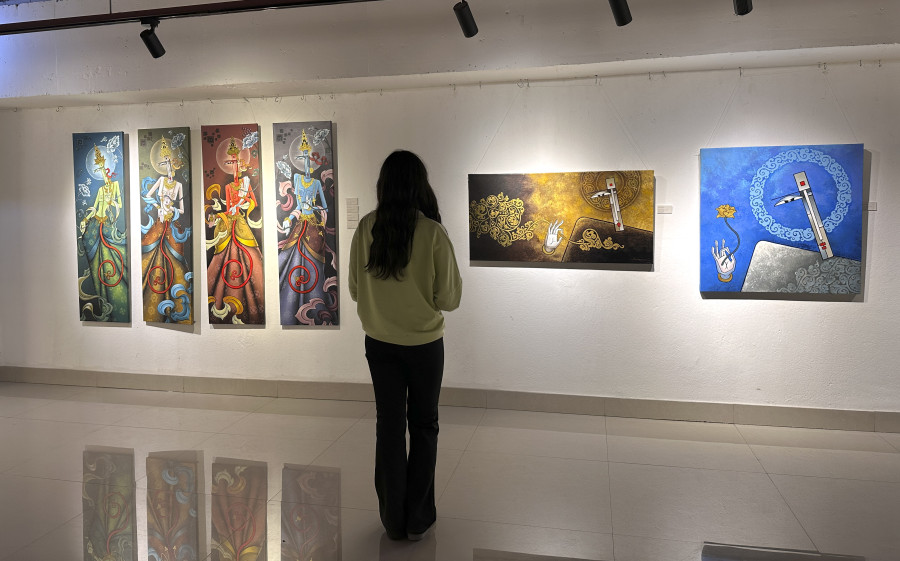
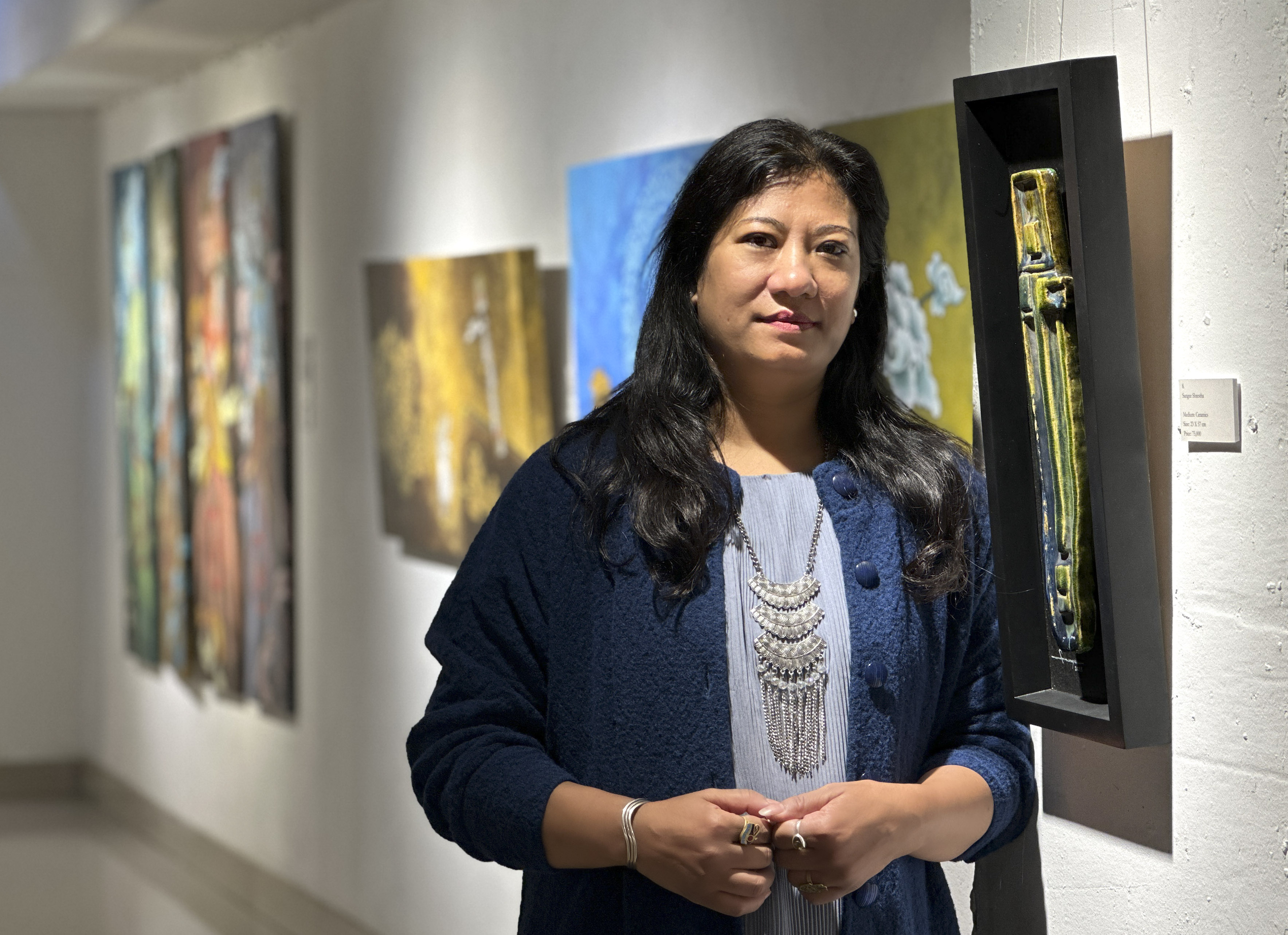
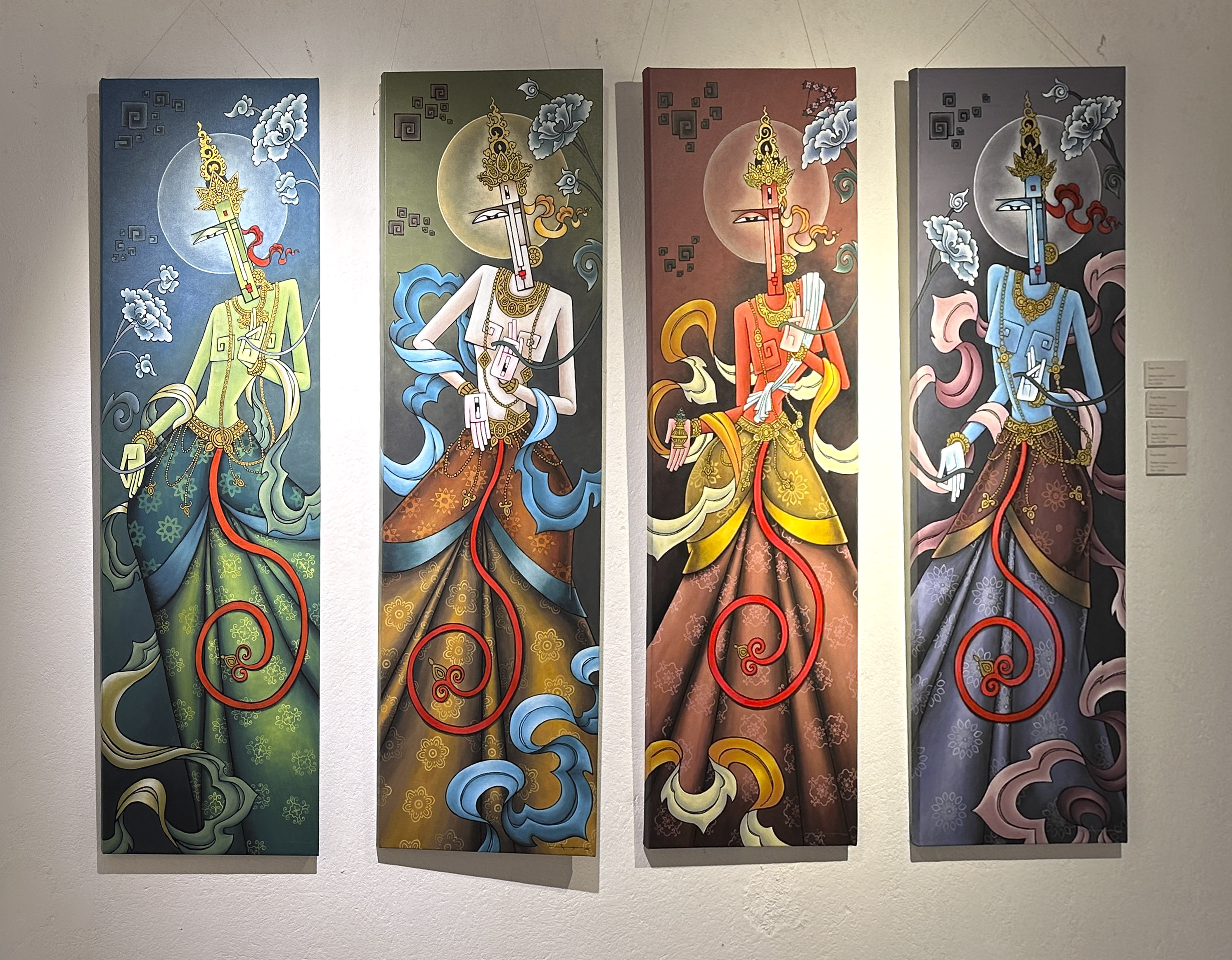
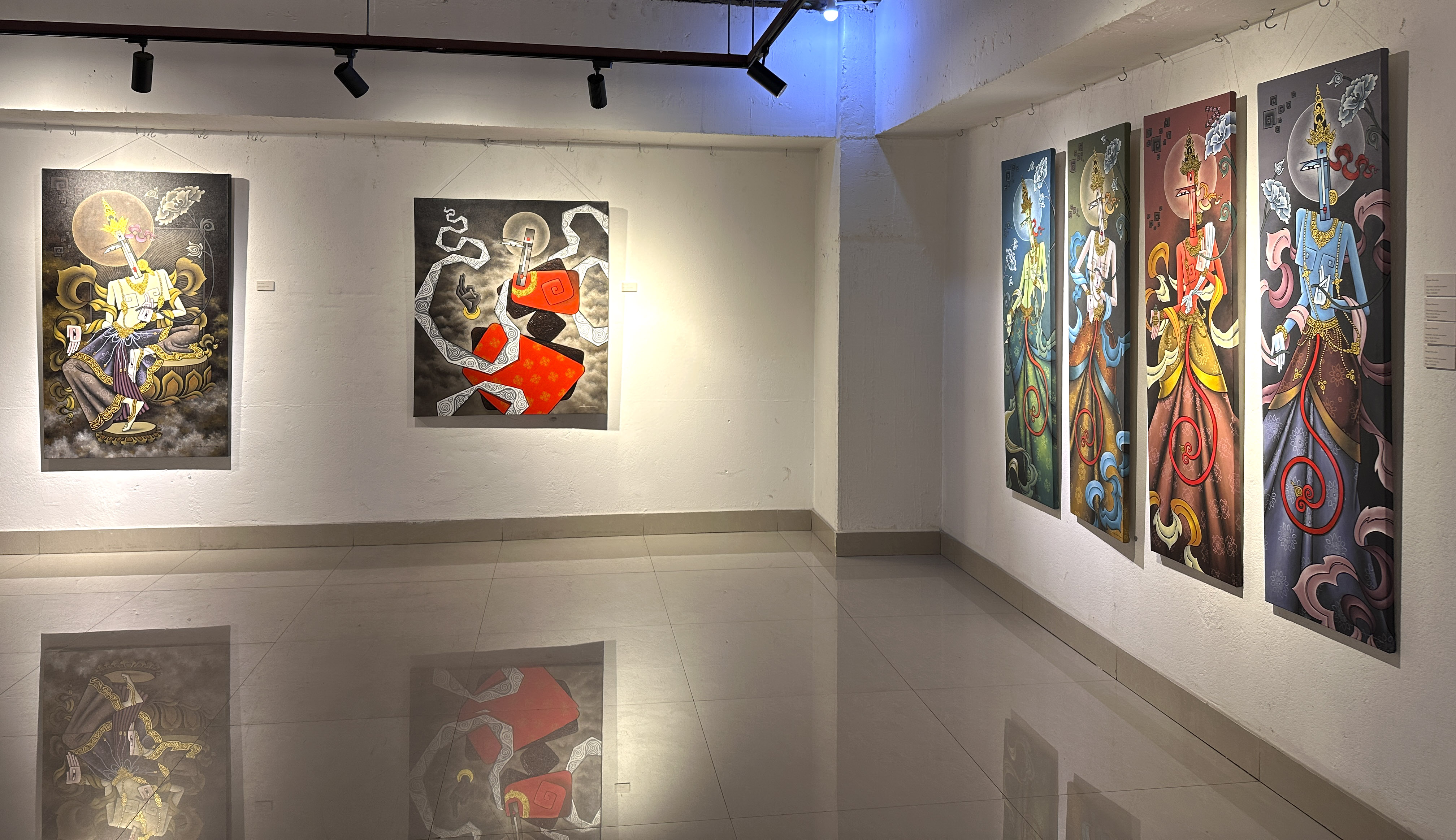
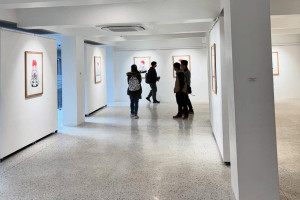
At Kala Salon, Sangee Shrestha’s ‘Antardrishti’ explores memory and spirituality through bold colours, geometry and symbolism. Photos: Courtesy of Sangee Shrestha
The nimble waves of Thamel transcend the quiet utterance of Sangee Shrestha’s paintings at Kala Salon—a vivid interplay underscored by subtlety, memory, geometry and colour.
With more than three decades of practising this artform, Shreshtha now believes that art begins where words end. Incredibly, her artworks do not depict a static moment in life but rather a fluid journey of self-exploration, driven by a universal tone.
Geometry emerges as a striking element in Shrestha’s paintings. With most subjects depicted within the rectangular, square and polygonal outlines, she articulates how emotions deluge within the boundaries of being. “This is to break up the visual surface and express the depths of mechanised modern life,” she writes. ‘Antardrishti’ (Inner vision) is a collection of 116 artworks, including ceramics, each crafted to evoke visceral experiences. As an observer, one inevitably finds the artworks a vantage point for understanding Shrestha better and an impetus for a quiet discovery of self.
Having worked predominantly across social issues, ‘Antardrishiti’, for Shrestha, is a rather personal utterance. “I believe, to understand the society and to create an impact, we must reflect upon ourselves, view ourselves from within,” she says.
Her muse, primarily women, anchors experiences of femininity, motherhood and divinity. A striking vibrancy of red tika and lips emerges in her paintings. Eyes, too, are a subject of wonder; mostly one closed and another sparsely open. “Oftentimes, we must, simply, close our eyes to elude negativity, and when we do observe, scrutiny must overflow; hence the narrow eyes,” Shrestha says.
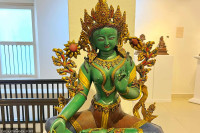
Drawing inspiration from Hindu mythologies—not merely imitating but rather absorbing what resonates—Shrestha presents her artwork to depict how generational wisdom is a foundation of human existence. The exhibition’s showstopper is a piece that conveys powerful symbolism and a restorative effect—a woman with seven eyes, a crown suggesting divinity, a lotus—both flower and bud suggesting generational nurture and continuity —and a background of the mist that covers our vision when we close our eyes. The art responds to her odyssey of navigating her mother’s absence.
The exhibit is a collection of 116 artworks, including ceramics, each crafted to evoke visceral experiences.
Grief is fierce, overwhelming and powerful. In Shrestha’s use of colour, deep shades of red recur across several paintings, evoking a sense of loss.
Shrestha gently observes the audience interacting with her artworks, “a reward,” she assures. “My work becomes a mirror: a silent, sacred conversation between artist and observer, soul to soul,” she writes. By providing no distinctive descriptions of the artworks, Shrestha allows the audience to weave their own narratives about the art.
She also revisits earlier artistic experiments (from her time as a fine arts student) through collages, attaching new meaning to fragments of her earlier work. She reconstructs her past, demonstrating how it continually reshapes the present. Through the collage, she particularly addresses climate change and its consequences, which are also depicted in the ceramics.
The ceramics hold the postures of life. Letting spontaneity flow through her hands, she shapes her ceramics accordingly—extending her exploration of human experience into three-dimensional space. “The kiln is not just a tool; it is a collaborator. I fire with a sensitivity of how heat transforms texture and tone, allowing the kiln’s alchemy to speak alongside my own hands,” she writes.
Her muse, primarily women, anchors experiences of femininity, motherhood and divinity.
For Shrestha, pace does not necessarily determine productivity. She believes in taking ample time with each work, allowing ideas to flow; a rhythm that, among her peers, is considered ‘slow’. Addressing what the medium demands, her artworks—regardless of whether they portray distinctive geometric shapes—are significantly characterised by fluidity, whether in acrylic on canvas or in ceramics.
A series of 12 frames presents Shreshtha’s afterthoughts that linger beyond her primary canvases. Black, red, yellow and solitary strokes distil emotions into a minimal yet striking visual gesture. “When I used to be done with the days, and everybody would fall asleep, the aftertaste of thoughts would still linger within me. This series is not a distinctive style. I let my hands flow, naturally and spontaneously,” says Shrestha.
Another striking, and perhaps satirical, painting is one of a bull depicting human grandeur with feeble legs. Conversely, portrayed in ceramics, animals encompass the gentle features of human beings.
Among the exhibition’s most compelling works are those exploring motherhood and womanhood—reflecting cycles of care, protection, memory and identity. Through layers of colours and textures, she navigates life as a woman in society, finding and embracing dignity amid the chaos.
Shrestha draws the eyes at last. Remnants of religion and spirituality are embroidered in her paintings and her process. Drawing the eyes, at last, is a prominent practice among cultural painters. Hindu mythology’s gunas ‘Trigun’- Sattva, Rajas, Tamas—are also gestured in the subjects’ hands. “The sacred, for me, is not distant or abstract. It is the thread that flows through all creation, the force binding us to each other and to something greater,” Shrestha describes.
‘Aantardrishthi’ is an intimate meditation of reverberation and revival of Shrestha’s memories and emotions. “It is a result of almost two years of hard work and deep self-reflection—an exceptional showcase of her power as an artist,” writes Sophia L Pande, curator of Kala Salon.
Without demanding an explanation, Shrestha’s work simply asks for presence—a quiet invocation to observe the self from within.




 16.76°C Kathmandu