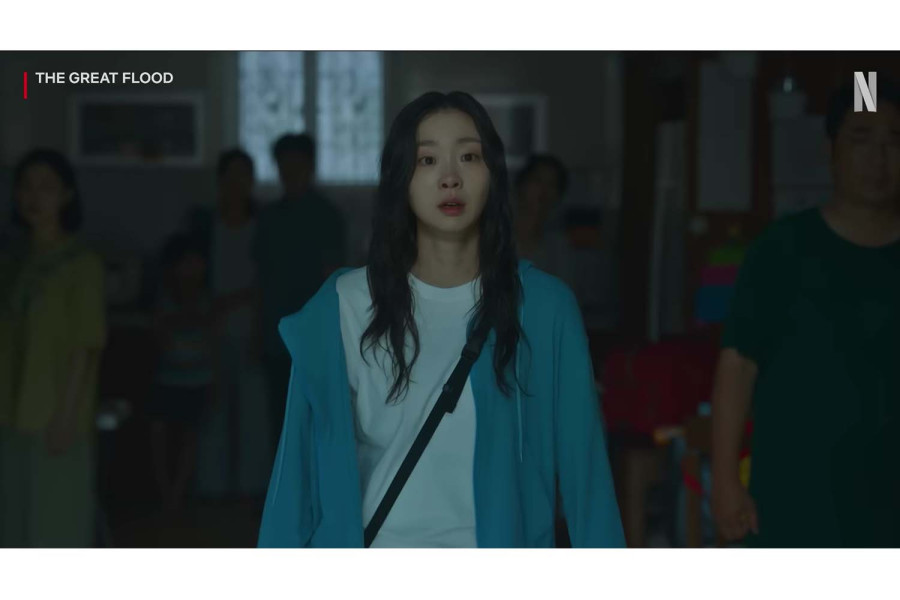
Director Kim Byung-woo blends disaster cinema with philosophical inquiry in ‘The Great Flood’, where memory and AI blur the boundaries of human experience. Screengrab Via YouTube
Directed by Kim Byung-woo and streaming on Netflix, ‘The Great Flood’ was first screened at the 30th Busan International Film Festival, 2025. Unlike most other disaster films that showcase a wide range of damage, ‘The Great Flood’ is more focused on the emotional trauma inflicted on an individual post-flood. The film starts off looking like your typical science fiction disaster, but it slowly reveals an introspective core that is way more complex and ambitious.
On the surface, this premise sounds very familiar. A massive flood occurs when a long-burning asteroid strikes Earth. In a thirty-story apartment building, An-na, a widow and a researcher who has been studying Artificial Intelligence for years, fights for her life along with her young son as the waters rise, the buildings crumble around them, and she makes one attempt after another to make it out alive from the rooftops.
At first glance, the action and drama seem to follow the same beats as many other survival movies. However, Kim Byung-woo is more interested in how people endure such instances than in the mechanical ways in which the environment is destroyed. The flood serves not just as an environmental disaster but also as a metaphorical ‘plot device’ in which all the secrets that have been kept locked away come to the surface.
What sets the film apart right from the start is that it does not provide spectacle for the sake of providing spectacle. Kim Byung-woo, the director, doesn’t chase big explosive moments. Waves smash buildings, glass explodes outward, yet the lens pulls back before the chaos grows too loud. The water moves like memory, not just force. Waves rise, yet they’re more than water; they carry An-na’s sorrow, the grief over her husband’s earlier death due to a submerged car accident, which really shapes every decision she makes during the flood. The movie shows the desperation of someone who has lost too much and is holding on to the only thing keeping her afloat: her son.
What holds the movie together emotionally is Kim Da-mi's performance. Instead of making An-na someone who charges forward through fights, she shows depth by holding back. Fear lives beneath the surface, seen only in quick glances and tight silences. It’s in those small moments that the character becomes real. Inside, her fear stays quiet, shown through quick glances, held breaths, never loud cries.
Opposite her, Park Hae-soo portrays Hee-jo, a UN operative assigned to pull people out. Park avoids turning the character into a conventional action saviour. Instead, Hee-jo carries quiet moral tension. He operates within a system that has already decided who deserves to survive, yet his empathy for An-na suggests internal conflict. Though his screen time is limited, his presence stabilises the narrative whenever it edges toward abstraction.
Halfway into the movie, things stop being just about staying alive. Instead, choices made by scientists and leaders take centre stage. When An-na uncovers the truth, she finds out officials were aware of the coming asteroid years before it hit. They did not warn anyone. Hidden projects got funding, space habitats rose quietly, and tests on copying human minds moved forward without oversight. What seemed like fate now looks planned. The end of people was not a surprise; rather, it was handled carefully behind closed doors. Who lives depends less on chance, more on decisions made in silence.
The most interesting twist arrives when Ja-in is revealed to be an artificial child shaped from An-na’s own digital experiments. A weaker version would have used that fact just to stun. This one lets it sink deeper, shaping everything beneath. Suddenly, it isn’t about rescue anymore; it’s about feeling real affection for someone made entirely of code. Still, nothing breaks between them. Her care stays solid, no second thoughts. The narrative insists that emotional authenticity is not determined by biology but by lived experience. If the feelings are real, their origin becomes secondary.
As the flood intensifies, the film introduces a time loop structure in which An-na repeatedly experiences variations of her final escape attempt. Each timeline ends in separation or destruction. These repetitions initially generate suspense and confusion, but gradually they reveal a deeper purpose. The ultimate explanation that only the first timeline truly occurred, and the rest are simulations designed to refine artificial emotional intelligence, transforms the narrative from an apocalyptic thriller into an existential inquiry. An-na’s suffering becomes part of an experiment, her grief converted into data.
This twist is both bold and risky. For some viewers, it may feel emotionally distancing once the mechanics are revealed. Yet the film cleverly preserves its impact by centring An-na’s subjective experience. Even if the repetitions are simulations, her pain within them feels real. The story raises unsettling questions. If artificial consciousness experiences suffering indistinguishable from human emotion, does its artificial origin invalidate that pain? Can humanity be preserved in memory and code rather than flesh?
Technically, the film supports its themes with strong craftsmanship. The cinematography emphasises reflections and distortion, visually echoing the instability of reality. The editing handles nonlinear transitions with clarity, preventing the audience from becoming lost despite repeated timelines.
The film is not without flaws. Certain exposition-heavy scenes slow the pacing, particularly when explaining the logistics of consciousness transfer and space-station survival plans. Side figures feel thin, pushed forward mostly to move things along rather than breathe like real people. Those craving nonstop motion might wrestle with how much it dwells in heads rather than chasing thrills.
Despite these weaknesses, ‘The Great Flood’ succeeds because of its ambition. It refuses to settle for simple thrills. Instead, it asks whether humanity can survive transformation.
Ultimately, ‘The Great Flood’ stands out not for the height of its waves but for the depth of its questions. It challenges viewers to reconsider what defines life, motherhood, and identity in a world where memory can be digitised and emotion engineered. In doing so, it delivers a disaster film that is not merely about the end of the world, but about what remains when the waters recede.
____________________
The Great Flood
Director: Kim Byung-woo Cast: Kim Da-Mi, Park Hae-soo Duration: 115 minutes Year: 2025 Language: Korean Available on: Netflix




 28.31°C Kathmandu