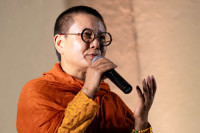
UNESCO representative to Nepal, Jaco du Toit, reflects on reading Nepali literature to understand the country beyond policy frameworks, and how stories reveal emotional truths that reports often miss. Dipen Shrestha/TKP
UNESCO representative to Nepal, Jaco du Toit, previously served as the chief of the Universal Access to Information and Digital Inclusion Section at UNESCO’s Communication and Information Sector.
Before that, he was a programme specialist, providing support to the UNESCO Information for All Programme, and served as a regional adviser for UNESCO’s Communication and Information Sector in Eastern, Southern, and North Africa.
In this conversation with the Post’s Sanskriti Pokharel, Du Toit discusses discovering Nepal through literature and the role of artistic freedom. Since arriving in Nepal, have you had the chance to read works by Nepali authors?
Yes, I have made a conscious effort to read literature connected to the country. I read ‘The Woman Who Climbed Trees’ and ‘The Wake of the White Tiger’.
In ‘The Woman Who Climbed Trees’, one scene stayed with me. Meena, newly married and far from home, tries to understand her new life through the stories and folklore shared by the women around her. That image of women gathered in a courtyard, talking, remembering, passing down knowledge, felt deeply intimate. It offered me a human window into how tradition, identity, and belonging are negotiated within a Nepali household. Through it, I began to sense not only women’s roles, but also the emotional landscapes people navigate when they move from rural to urban life.
I was also moved by how vividly the novel captures Kathmandu’s transformation. Through descriptions of changing neighbourhoods and fading rhythms, the city felt alive. Many people had spoken about these changes, but in the novel, they breathed and carried memories. It echoed my own first impressions of Kathmandu in a way that felt personal.
From ‘The Wake of the White Tiger’, what lingered was the way history unfolds through individual lives. The book traces Nepal’s political shifts, social hierarchies, and cultural transformations through the experiences of ordinary people. It reminded me that history is not abstract. It is lived. Through those lives, I felt I understood more clearly how the country’s past continues to shape the pulse of its present.
Do you read differently now as a UNESCO official compared to earlier in your career?
I would say yes. I do read differently now as I travel to more countries. Every book feels like a journey into the complexities of a society, and I look for the details of that journey in the books. It helps me understand issues, how they are framed in different countries, and people’s aspirations. But at the same time, literature also reminds me of what we all share as humans: love, family, identity, and the desire to belong.
In societies with limited media freedom, can novels and poetry sometimes say what journalism cannot?
Yes, absolutely. Creative writing, through metaphor, symbolism, and intimate storytelling, can reveal social tensions, political realities, and private fears that may be too dangerous to name directly.
South Africa under apartheid offers a powerful example. Writers such as Nadine Gordimer, Mongane Wally Serote, and Zakes Mda captured injustice, racial oppression, and the courage of everyday resistance at a time when the press was tightly censored. Through fiction and poetry, they safeguarded voices the state sought to silence. Their words became a moral force, helping readers both inside and beyond the country feel the human truth behind official narratives.
This is why UNESCO continues to stress the importance of artistic freedom. When journalists are constrained, writers and artists often carry the burden of truth. Literature allows societies to look at themselves honestly. It keeps memory alive. It opens space for dialogue and empathy.
Protecting that creative space matters deeply. Even in restrictive environments, people must have room to tell their stories, to express hope and fear, and to question power in ways that endure long after headlines fade.
You worked across Eastern Africa, from Kenya to Ethiopia to Madagascar. When you arrived in Nepal, what similarities struck you between Eastern African countries and Nepal?
I worked across Eastern Africa from 2011 to 2018, in countries including Kenya, Ethiopia, and Madagascar. When I arrived in Nepal, I was surprised by how familiar certain things felt.
In Kenya, you encounter a rich layering of cultures—African, Arab, and South Asian influences woven into everyday life. Nepal’s diversity gave me a similar feeling. Different communities, languages, and traditions overlap naturally, shaping daily rhythms in ways that feel both complex and harmonious.
In Madagascar, I was always struck by the highlands and the warmth of the people. In Nepal’s hill regions, I felt that same gentleness and strong sense of belonging.
Ethiopia taught me how rituals anchor society. Coffee is not simply a drink but a ceremony that brings people together. In Nepal, too, I sense the importance of shared spaces and rituals, including the growing pride in its own coffee culture. These everyday practices create connections.
Professionally, there are similarities as well. Kenya, like Nepal, offers a comparatively open environment for journalists within its region. In Madagascar, I worked closely on professional codes of ethics, and I see a similar commitment in Nepal to accurate reporting, even in difficult circumstances.
In Ethiopia, journalism education has been expanding with strong ambition. I observe that same energy in Nepal’s universities, including at Tribhuvan University, where institutions are investing in the future of the profession.
You worked on reinforcing archives and libraries in Eastern Africa. Why are archives often neglected in developing regions?
Archives are often neglected in developing regions because they are undervalued and underfunded. There is also a common misconception that everything important is already digital. Their significance is easily overlooked until the day they are urgently needed.
Yet archives matter. They safeguard identity, protect rights, and preserve evidence that enables societies to function transparently. I witnessed this firsthand in one of the countries where I worked, where an individual reclaimed family land after decades of dispute because a forgotten archival record confirmed their legal claim. Without that single surviving document, justice would have remained out of reach.
I have also seen the opposite. During the recent Gen Z movement in Nepal, government buildings were set ablaze, and public records were destroyed. What vanished was not only paper but proof. Proof of property, of education, of citizenship, of existence. When records disappear, entire life paths can unravel.
This is why archives, libraries, and records must be protected not merely as technical infrastructure, but as human rights infrastructure. They make the right to information tangible. They enable justice, accountability, and dignity. When records are lost, rights can fade with them. When archives endure, societies stand stronger.
Is there a South African book you would recommend to Nepali readers interested in politics or society?
There are many South African books one could recommend, but two writers stand out for readers interested in politics and society.
One is J M Coetzee, particularly his novel ‘Waiting for the Barbarians’. It is a powerful meditation on how societies construct “the other”. The novel gently but firmly asks readers to reflect on fear, suspicion, and the ways we project our anxieties onto those beyond our borders. It also challenges us to look inward at our own communities and moral responsibilities. That invitation to self-examination feels relevant anywhere, including Nepal.
I would also recommend Nadine Gordimer. Through her fiction, she explored how societies create boundaries, racial, political, and psychological, and how those very limits eventually shape and constrain the people who build them. Her work encourages readers to see the larger forces at play beneath everyday life and to question the systems they take for granted.
Both writers offer more than political commentary. For readers curious about how literature can illuminate society, they remain profoundly relevant.
Jaco Du Toit’s five book recommendations
The Famished Road Author: Ben Okri Publisher: Jonathan Cape Year: 1991
Okri portrays the birth of a spirit child, opening a window into the meeting of the spiritual and political worlds.
Les Mémoires d’Hadrien Author: Marguerite Yourcenar
Publisher: Librairie Plon, France
Year: 1951
It captures, with extraordinary intimacy, how someone reflects on life, power, and mortality as they approach death.
Birth Author: Peter Harris
Publisher: Penguin Random House
Year: 2011
In ‘Birth’, Harris provides firsthand experience of how political processes such as elections can go wrong.
Kompoun Author: Ronelda Kamfer
Publisher: Kwela Books
Year: 2021
Written in a variation of my mother tongue, the novel celebrates linguistic identity and the experiences of marginalised communities.
A Tale of Two Cities Author: Charles Dickens
Publisher: Chapman & Hall
Year: 1859
A historical novel that explores revolution, justice, inequality, and the struggle for dignity in society.
Sanskriti Pokharel, a former reporter and sub-editor at the Post, is a final-year student of Journalism, Mass Communication, and English Literature at St. Xavier's College, with experience in media, research, and communication.




 15.41°C Kathmandu