On Valentine’s Day last year, Anshu Dhakal, 22, from Chitwan, wore red.
It was her first proper date. The restaurant was glowing with lights, couples leaning close across tables. She remembers thinking that this is what it must feel like to be grown up.
Then she saw her school teacher. He was sitting three tables away with his wife.
For a few seconds, she tried to convince herself it was someone else. It wasn’t. Their eyes met. The music continued, people laughed, but for Dhakal, the moment turned unbearably awkward. That encounter reshaped how she would celebrate Valentine’s Day again. This year, she and her boyfriend planned their date a week early, choosing safety over the social spotlight.
It is a small adjustment that many young couples in Nepal understand instinctively. Love is not forbidden outright, but it exists under surveillance. A cafe can turn into a courtroom if the wrong relative walks in.
Roshan Shrestha (name changed), 20, from Lalitpur, learned that the hard way. He had gone to Patan Durbar Square with his girlfriend, thinking an open public space would feel safer than a restaurant. They were sitting on the steps, not even holding hands, just sharing earphones and listening to a song. A neighbour happened to be passing by. By evening, Shrestha’s mother received a call.
“Your son is roaming around with girls,” the uncle reportedly said. “He is getting spoiled.”
There were no details about what they were doing. The idea of being seen was enough. Shrestha’s phone was checked that night. His outings were restricted for weeks.
This phenomenon is not just common in Nepal but in the entire South Asia. As the Guardian writes, casual relationships are still uncommon, and those who choose to date often have to deal with gossip, ostracism and moral judgment.
On the other hand, dating is absolutely common in Western countries. For instance, America has a distinct dating way of life than other countries. Americans are very likely to embrace informal dating and hooking up. Shraddha Rai (name changed), 18, from Dharan, says, “You never know who you might run into. In smaller towns, especially, familiar faces are everywhere. A simple walk can become a risk.”
Public affection remains a delicate matter. A couple holding hands on the street can still draw long stares from older passersby. Nothing may be said out loud, but the message is clear. Because of that, many relationships remain invisible to the outside world.
The secrecy requires creativity.
Saurav Shrestha, 25, from Butwal, and his partner have mastered what he jokingly calls “parallel scheduling”—morning walks and cycling sessions as dates. Grocery shopping becomes quality time. A visit to the tailor stretches longer than necessary. “As long as we are together, it counts,” he says.
At home, he takes turns naming friends when he is heading out for a date, and he does so so frequently that his mother believes he has an unusually vibrant social life. Once, he announced there was a friend’s house puja to attend. It was not entirely untrue. There was devotion involved, just not the kind his mother imagined.
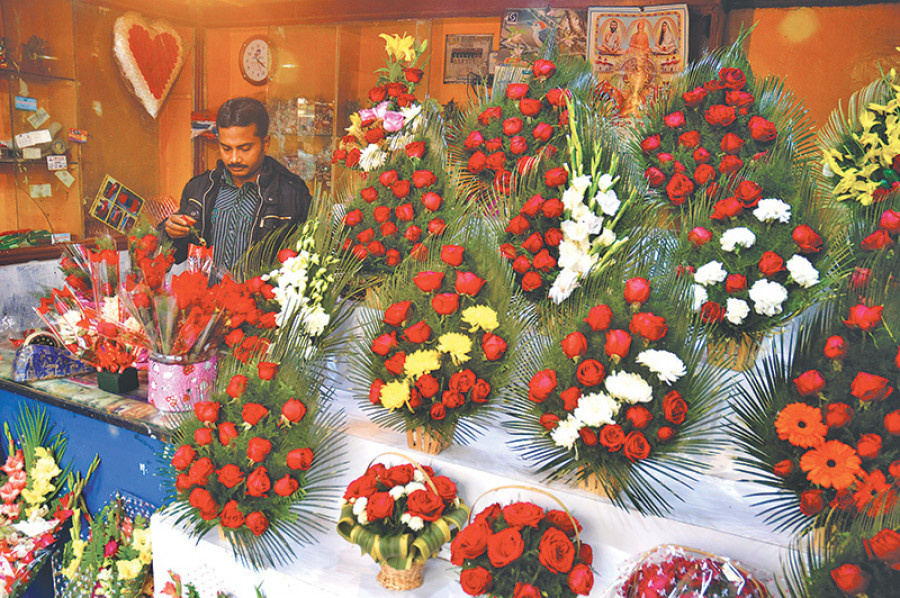
Gift-giving requires equal strategy. Flowers are particularly complicated. Diya Regmi, 21, from Kathmandu, says the object itself carries gendered suspicion. A girl carrying flowers can dismiss questions easily. A boy holding a bouquet attracts attention instantly. “We are not used to seeing boys casually carrying flowers,” she says. “It becomes obvious.”
So gifts are exchanged days earlier. Or they are small enough to slip inside bags. Or they are delivered through friends who act as intermediaries.
The irony is that while couples hide, the city advertises loudly. Weeks before February 14, shop windows fill with red hearts. Restaurants announce a couple discount. Social media feeds flood with romantic offers. Parents scrolling through Facebook see the same promotions their children see. Suspicion grows alongside the marketing.
Yet, urban spaces provide slightly more anonymity. Cafes in Thamel or Jhamsikhel are filled with couples who appear unbothered.
Aditya Jha, 24, from Biratnagar, remembers how tense he felt at the beginning of his relationship. Expressing affection in public felt unnatural, not because he did not want to, but because he was constantly scanning the surroundings. Over time, he grew more comfortable. His girlfriend, however, still struggles to relax fully during dates. “She is always alert,” he says. “Like someone might appear suddenly.”
POST FILE PHOTO
Sociologist Alisha Paudyal says that although dating culture is growing among young people in Nepal, families still seem uncomfortable with it. There are many layers to this issue.
First, according to her, many families have not fully accepted that love and marriage are personal choices. Even among young people, there is pressure to find someone of the same caste, religion, and similar family status, because there is always the fear that the family will not accept the relationship otherwise.
Second, a family’s honour is often tied to a daughter’s love life and marriage. There is a common belief among Nepalis that honour is preserved only when she marries a man chosen—or approved—by the family. Although young women are stepping out more than ever before, society’s invisible “CCTV cameras” continue to monitor them. The question remains: how many of them truly have the freedom to cross the family’s so-called Lakshman Rekha (red line)?
Another important factor Paudyal points out is control over young people’s sexuality. The idea of “no love before marriage” still dominates many Nepali households, often as a way to regulate relationships and sexual expression.
That constant vigilance shapes the emotional experience of young love. A date is not just about enjoying the moment; it is about planning exits, choosing corners, keeping phones on silent, and preparing explanations in advance.
And yet, despite all this, they continue.
They continue because meeting one week early still feels special. Morning walks can carry the same warmth as candlelight dinners. A hidden gift can feel more meaningful because of the effort it took to give.
Sanskriti Pokharel, a former reporter and sub-editor at the Post, is a final-year student of Journalism, Mass Communication, and English Literature at St. Xavier's College, with experience in media, research, and communication.




 15.41°C Kathmandu