Once taken for granted, the Valley’s traditional stone spout system are now drawing renewed public attention as residents begin to recognise their cultural value and practical role in a water-stressed valley. Two to three decades ago, the hiti system was regarded as an outdated remnant of the past, whereas modern concreteconstruction was viewed as a sign of progress. POST FILE PHOTO
A place called Bhotahiti has no hiti, and Sundhara no longer carries the flowing water that once defined it. Sukedhara has no visible source either, and across Kathmandu Valley, names that once pointed to water now point mostly to memory.
These places were not named by accident; water once shaped everyday life there. Today, the absence of that water tells another story, one about urban change, neglect, and a slow rediscovery of value.
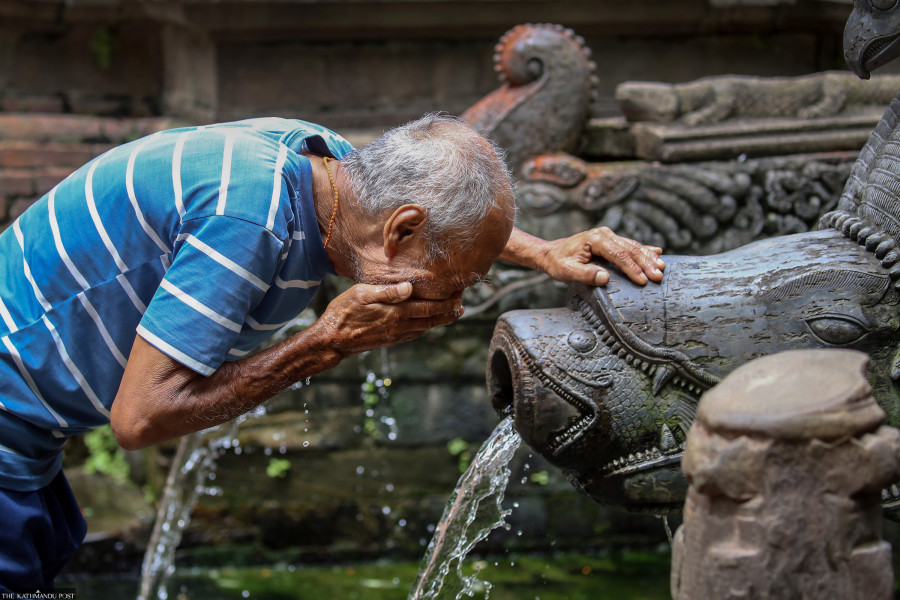
Hitis were once woven into the daily life of the Valley. People collected water for drinking, washing, and rituals, and communities collectively maintained the structures. Now, many hitis stand dry, while others are damaged or buried, and only a fraction still function as they were meant to. Yet concern for their survival is growing, as water scarcity and cultural loss are increasingly difficult to ignore.
“Hitis are in a deteriorated condition for several reasons, not just one,” says Padma Sundar Joshi, a civil engineer and author of ‘Hiti Pranali’, a detailed study of the Valley’s traditional water systems.
Joshi has long studied how traditional infrastructure and modern cities intersect. “The only slightly positive aspect,” he says, “is that awareness has increased compared to the past. People now understand that hitis should not be destroyed but conserved.”
That change in awareness is not driven solely by nostalgia, as the Valley continues to face a persistent water crisis. Municipal supply is irregular, tanker water is expensive, and groundwater levels are falling. In this context, even a modest flow from a traditional hiti can make a difference. Hitis may no longer be the primary source they once were, but they still serve practical needs in many neighbourhoods.
“Most hiti users today are from lower-income groups,” Joshi explains. “Apart from religious purposes, hitis remains a practical source of water for them.” In several areas of Patan and Kathmandu, people continue to collect water from functioning hitis for household chores and small businesses.
Public attitudes toward hitis, however, have not always been supportive. According to Joshi, two to three decades ago, the hiti system was regarded as an outdated remnant of the past, whereas modern concrete construction was viewed as a sign of progress. As a result, several hitis and ponds were damaged or erased during urban expansion.
Bhota Hiti, for instance, was buried and a building constructed over it; similar fates befell other historic water sites in different parts of the Valley. These decisions reflected a mindset that separated development from heritage, with long-term consequences.
Changing attitudes alone cannot revive a broken system, because hitis depend on maintenance, and that maintenance once camefrom community institutions that have weakened.
“That mindset has changed now,” Joshi says, “and there is now more respect for our traditional knowledge, architecture, and cultural practices.” This shift did not occur overnight; it developed through heritage activism, research, and visible water shortages. As taps began to run dry more often, people started to look again at older systems that had sustained dense settlements for centuries.
According to Heritage activist and documentarian Alok Siddhi Tuladhar, Patan has more running hitis than Kathmandu. Examples of hiti revival are in abundant numbers in Patan. One of them is Alko Hiti. It stands as a 15th century Hiti situated within the urban landscape of Patan. Alok says, “This hiti which was in a bad state was revived probably a decade back. Now it overflows with water.” The local community of Ikhachhen, Patan, manages water from the Alko Hiti that serves around 250 households via pipe systems.
Still, changing attitudes alone cannot revive a broken system, because hitis depend on maintenance, and that maintenance once came from community institutions that have weakened.
In the traditional Newa urban system, guthis managed land and resources, and the income supported temples, rest houses, ponds, and hitis. These trusts ensured regular cleaning, repairs, and rituals, and they tied physical upkeep to social responsibility.
Over time, however, many guthis lost land, authority, or financial stability, and regular maintenance declined. “Because guthis deteriorated, regular maintenance of hitis also stopped,” Joshi says. At the same time, household water habits changed, as piped connections spread and families grew smaller. Fetching water from a communal spout became less practical, and many migrants of the Valley did not grow up with hiti culture. As social ties to these structures weakened, neglect became easier.
Urban growth also brought another serious problem: water pollution. Hitis depend on groundwater, but unplanned construction, leaking sewer lines, poor drainage, and widespread use of pit latrines have contaminated underground sources. As a result, water from many hitis now contains harmful bacteria. “Earlier we used to drink directly from hiti water,” Joshi says, “but now it is unimaginable.” This decline in water quality has reduced daily reliance on hitis, even where the structures remain physically intact.
Understanding what a hiti actually is also matters, because many people think only of the carved stone spout. Joshi emphasises that a hiti constitutes a complete water-management system, and that the visible spout is merely the outlet. The system includes the source, underground channels, ponds that help recharge groundwater, distribution paths, the sunken courtyard structure, and the drainage outlet. If one part fails, the rest is affected, and a damaged drain can turn a flowing spout into a stagnant pool. Conservation, therefore, cannot focus on surface repairs alone, because the hidden network is just as important.
Under the Licchavi rule, the Valley experienced a remarkable flourishing of art and architecture. This was made possible by the skills and technical knowledge of the indigenous people, who carefully studied the Valley’s geography and used its natural resources to their fullest potential.
Amar Sundar Tuladhar, the secretary of Chiva Chaitya Organisation, says, “The hitis of the Licchavi period are the most ornate and beautiful”.
Explaining the system, Amar notes that it begins at the foothills. “A Rajkulo, or de:dha, functions as a canal that diverts water from a distant perennial river and brings it to a pond,” he explains. “From there, the water is distributed to different destinations, much like today’s water transmission pipelines.”
Beyond engineering, hitis also hold deep cultural and artistic value, and these layers of meaning shape how people relate to them. Building a hiti was considered a major public service, often compared to the mythic effort of King Bhagirath bringing the Ganges to Earth. Carvings near the hitis often include figures believed to represent Bhagirath or yakshas, guardians of underground water, and the spouts themselves are frequently shaped like makaras, mythical creatures associated with river deities. Nearby shrines may feature both Hindu and Buddhist imagery, because the Valley’s cultural landscape has long been shared and interconnected.
These artistic and religious elements are not merely decorative accoutrements; they help explain why hitis were treated with respect for generations. They were not only water taps, but also sacred and social spaces, and this combination of utility and meaning gave them a central place in urban life.
Today, however, the numbers tell a story of loss. A recent study documented 812 hitis across the Valley, although Joshi believes the original number exceeded 1,500. Of those recorded, less than half still have some water flow during the wet season, while many have disappeared entirely and survive only as place names. Others remain but are in poor physical condition. Each non-functioning hiti represents not just the loss of a structure, but also the weakening of a decentralised system that once supported dense populations without modern pumps and pipelines.
In response, efforts to raise awareness are coming from different directions, and artists are now part of that conversation. A three-day Hiti Art Exhibition held at Patan Museum in January explored the cultural, historical, and environmental significance of traditional water systems. Organised by E-Arts Nepal in collaboration with the Rotary Club of Yala and the Chiva Chaitya Organisation, the exhibition brought contemporary art into dialogue with heritage conservation.
Twenty Nepali artists presented works inspired by hitis, and their pieces interpreted water, memory, and urban change in different ways. One of the artists, Erina Tamrakar, drew inspiration from Tusa Hiti in Sundari Chowk at Patan Durbar Square.
“I have admired this hiti since childhood,” she says, pointing to its golden spout and intricate carvings as examples of extraordinary craftsmanship. Her work, like others in the exhibition, encouraged viewers to see hitis not as obsolete structures, but as living heritage connected to identity and survival.
Sanskriti Pokharel, a former reporter and sub-editor at the Post, is a final-year student of Journalism, Mass Communication, and English Literature at St. Xavier's College, with experience in media, research, and communication.




 14.72°C Kathmandu

.jpg)