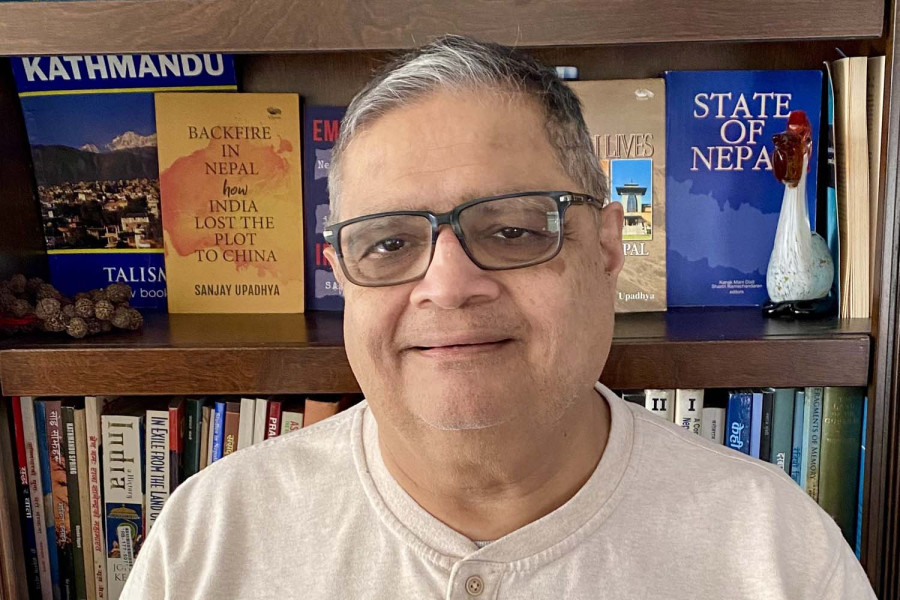
Journalist and author Sanjay Upadhya reflects on writing beyond deadlines, understanding Nepal from abroad, and tracing the country’s political journey in his books. Photo: Courtesy of Sanjay Upadhya
Sanjay Upadhya is a journalist, author and analyst. His latest book is ‘Democracy in Turns: A Political Account of Nepal’ (2023). His previous books include ‘Empowered and Imperiled: Nepal’s Peace Puzzle in Bits and Pieces’ (2022), ‘Backfire in Nepal: How India Lost the Plot to China’ (2021), ‘Nepal and the Geo-Strategic Rivalry Between China and India’ (2012) and ‘The Raj Lives: India in Nepal’ (2008).
Upadhya has worked as a correspondent for The Times of London and BBC Radio’s Nepali Service. He also contributed to Inter Press Service as a freelancer. At Khaleej Times, Upadhya served as a copy editor and editorial writer based in Dubai. Moreover, he worked for the United Nations Secretariat as a press officer at its headquarters in New York City and, separately, as a remote editor for the United Nations Development Programme.
In this conversation with the Post’s Sanskriti Pokharel, Upadhya discusses democracy, global shifts, and the novel he is quietly shaping. What are you currently reading, and what drew you to it?
I am enjoying ‘China & Russia: Four Centuries of Conflict & Concord’ by Philip Snow, which offers a fascinating glimpse into their complex and rich history. Snow takes us back to the 17th century, showing how politics, religion, trade, and culture have shaped their evolving relationship.
What I find especially captivating is how he balances stories of conflict with moments of cooperation, all driven by geography and necessity. By highlighting the experiences of traders, missionaries, soldiers, and others, Snow shows how their lives have intertwined with historical events.
You’ve worked with international media and institutions like the BBC, The Times of London, and the UN. How has writing from outside Nepal shaped your understanding of the country?
This has helped me see the changes around me more clearly. Exploring different political systems, engaging in rigorous debates, and understanding diverse economies have helped me recognise what makes each place distinctive and what it shares with the rest of the world.
This new perspective helps me analyse Nepal by considering both its unique local aspects and the broader global picture. Nepal’s politics, economy, and social fabric are shaped by its history, institutions, and culture. At the same time, I have grown more aware of how global trends, such as shifting geopolitical landscapes, economic challenges, and evolving ideas about governance and identity, can significantly influence Nepal. This enhances my ability to observe keenly, ask meaningful questions, and understand how Nepal fits within a connected world in which local choices are part of larger global forces. Do you find more freedom in writing books than in daily journalism?
I do. Daily journalism is characterised by tight deadlines, which shape how stories are assembled. This entails deciding which details to include, which to highlight, and what to omit. The main focus is on acting quickly, capturing people’s attention, establishing credibility, and keeping things clear.
There is often little room for doubt, since there is usually no time to question or analyse ongoing events.
In contrast, books tend to explore ideas in depth and revisit themes through memory and personal experience. They encourage embracing doubts and contradictions. While news aims for neutrality and speed, books offer a space for reflection and profounder insights. What can books say that news reports often cannot?
News reports give us quick updates. But they can sometimes miss the stories behind the headlines. Books, on the other hand, offer a more thoughtful approach, delving into tough questions and exploring the roots of events. Journalism can simplify complex situations into clear-cut heroes and villains, but books tend to uncover multiple truths and inspire greater reflection.
What inspired you to write ‘Democracy in Turns’?
Nepal’s political history has been tumultuous, with seven constitutional systems emerging over seventy years, often fueling blame and mistrust. Power struggles began before the 18th century, when modern Nepal emerged, underscoring how deeply these conflicts run.
While many focus on particular individuals or institutions for opprobrium or applause, a broader view reveals underlying factors. Exploring such a view could help identify patterns and recurring issues, guiding us toward meaningful change. Adopting this perspective could encourage us to move beyond blame, fostering a deeper understanding of Nepal’s political journey and hopes for stability.
In ‘Backfire in Nepal’, you write about India and China’s roles in Nepal. How has Nepal’s position between the two neighbours changed over the years?
India and China’s relationship is becoming increasingly complex, shaped by their distinct histories and interests. Although the two aspiring superpowers collaborate on shared goals such as regional and global stability, their divergent strategic ambitions and mutual mistrust often create tension. For Nepal, caught in this evolving landscape, finding a way forward means balancing these competing influences with greater care as the situation grows even more complex.
What are you hoping to write about in the future? Nepal’s politics or something beyond it?
For some years, I have been working on a novel that connects Nepal’s political upheavals with broader regional and international events. Over time, the story has begun to take shape, influenced by my personal goals, time, and distance. It began as a mix of historical moments and imagined characters. Coming from a nonfiction background, I am mindful of how delicate the balance in fiction must be. The truth is no longer the main focus. Instead, my characters carry the weight of history, and the settings need to feel vivid and alive, not just accurate. As I review my draft, I constantly consider how much of the world I should explain directly and how much I can convey through voice, emotion, and experience.
Sanjay Upadhya’s five book recommendations
The Golden Road
Author: William Dalrymple Publisher: Bloomsbury Publishing
Year: 2024
Dalrymple presents compelling accounts of India’s valuable contributions to religion, philosophy, science, and technology.
The Great Transformation
Author: Chen Jian and Odd Arne Westad Publisher: Yale University Press
Year: 2024
This volume shows how Chinese citizens shed old beliefs from Mao’s Cultural Revolution and built a different future.
Age of Revolutions
Author: Fareed Zakaria Publisher: WW Norton & Company
Year: 2024
Zakaria takes readers through the major shifts of the past and present that continue to shape our unpredictable world.
One Hundred Years of Solitude
Author: Gabriel Garcia Marquez
Publisher: Editorial Sudamericana
Year: 1967
Marquez’s world is filled with charming characters, each brought to life with honesty and warmth that touch the soul.
The Brothers Karamazov
Author: Fyodor Dostoevsky
Publisher: The Russian Messenger
Year: 1912 (English version)
This classic explores human conflicts—faith and doubt, love and hate, reason and desire, sin and redemption.
Sanskriti Pokharel, a former reporter and sub-editor at the Post, is a final-year student of Journalism, Mass Communication, and English Literature at St. Xavier's College, with experience in media, research, and communication.




 15.41°C Kathmandu