Through paintings and prints, late artist Rick Cummings responds to moments of change, routine and reflection.‘The Nature of Light’ Photos: Courtesy of ‘Resources in Chaos’
There is no doubt that we live our lives in fragments. How we interact with our inner self, the environment around us, with the cosmos of objects, places, relationships, worldly structures and dreams exists within us in multiple forms, dimensions, points of view, and colours. To enter Rick Cummings’ artistic nebulae at Nepal Art Council, shaped by his decades of creations, is to be caught in his fragments.
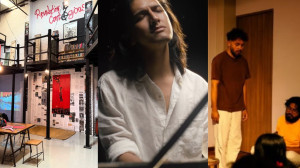
‘Resources in Chaos Life and Vision of Rick Cummings’ captures the visions of Cummings’ inquisitiveness during his visits to Nepal. Through his art, he responds to the natural, political and emotional uprisings, engaging with each element in diverse forms, inspirations and mediums.
Rick Cummings (1949–2025) was an American artist whose life followed an extraordinary path. Spending his earlier life in France, he drew inspiration from its cultural landscape and European Modernism. He walked in the footsteps of the painters who inspired him and ultimately devoted his life to art.
Cummings made Nepal his home in 2011, where he lived and worked until his recent passing after a battle with cancer.
Centred mostly on realist ideas, characters, and movements, the artist allowed himself to experiment with different possibilities within the artistic movement. He found abundant thematic inspiration in Western art history. “He had drawn his inspirations from Renaissance painters such as Albertinelli, as well as American realist painters like Edward Hopper,” says Rahul Maharjan, curator of the show.
Focusing largely on the compositional logic of the works, Maharjan’s curatorial vision felt thoughtfully structured. In Cummings’ absence, Maharjan’s research and interpretive framing played a central role in shaping the exhibition’s narrative. The space carried a strong emotional resonance, inviting viewers to reflect on their encounters with Cummings’ work or to imagine the artist behind the paintings. A corner stands out in the exhibition, designed to imitate Cummings’ workspace in his art studio.
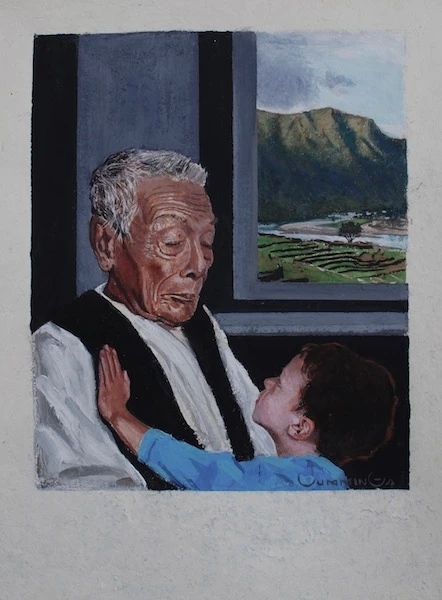
‘Jijuba and Panaati’
Cummings’ heightened curiosity about the culture and lifestyle of Nepal led him to take a pivotal turn in his artistic style and visual language. He began photographing the moments and journeys of his life, later translating these encounters into layered compositions on Lokta paper. The utterance and narratives in his paintings reflect how deeply overwhelmed he was by his surroundings.
His artworks of stray dogs in Kathmandu depict the tangible impacts of negligence in their support.
Working mostly with Gouache, ink and silk prints, Cummings had mastered the process of selecting the relevant one for each idea he had envisioned. Maharjan pronounced this tendency as ‘Purity of different media.’ The strokes and continuity also communicate a sharp visual language in his paintings.
In Junbesi, Solukhumbu, Cummings drew inspiration from the villagers’ everyday lives. ‘Plough III’ illustrates a farmer and two buffaloes in monochromatic light; a keen, yet subtle play with shadows, asymmetry, vacancy and fulfilment. ‘Chicken Chase’, as the title suggests, depicts three women from Junbesi chasing a chicken. Perhaps this counts as a satirical yet earnest concern for the village’s farmers. The duality of regular, subtle chores and spontaneous rush is portrayed in these paintings.
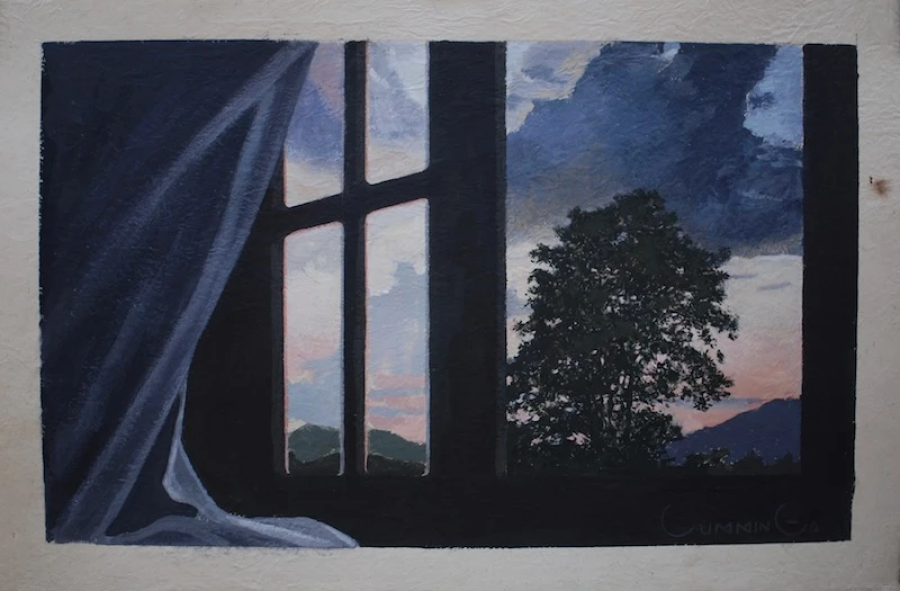
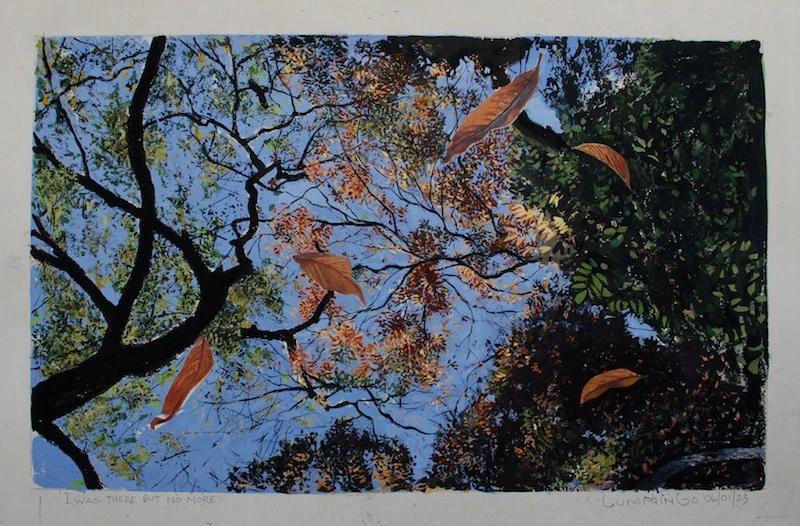
‘I Was There But No More’
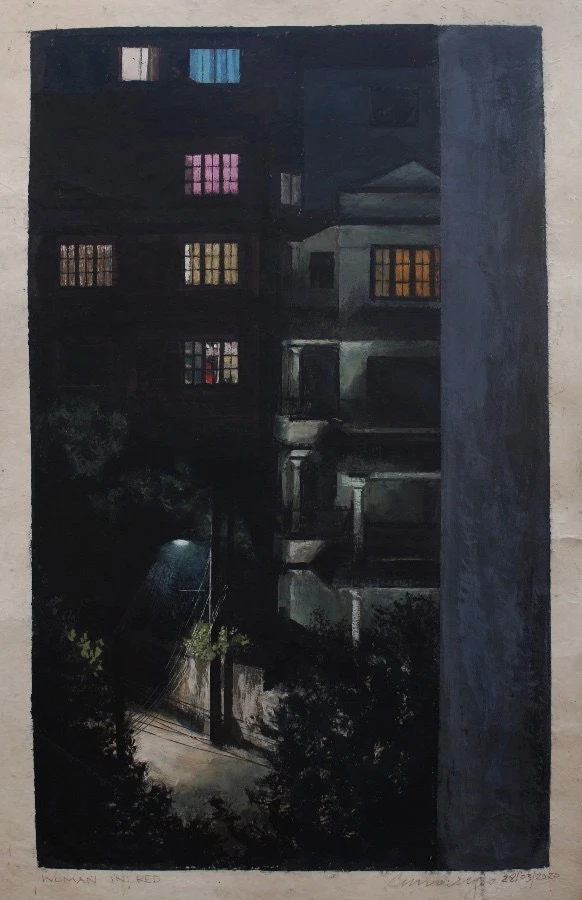
Point of view plays a central role in Cummings’ artwork. He did not merely document what he saw, but rather imagined how the spaces, objects and figures might have experienced their own environments. ‘Friend in Need’ revolves around companionship and quiet solidarity. Cummings was deeply influenced by cinema, particularly its framing and use of lights, portrayed in the painting.
Paintings such as ‘The Last Tree, 2021’, ‘Confinement, 2021’, ‘Batti Aayo’, and ‘Batti Gayo’ position the viewer as a distant observer, highlighting cinematic surveillance and detachment.
The artistic motifs of Cummings lie not in the extravagance of materialistic expression but rather in the recurring embodiment of the gentle, often insignificant elements. ‘I was there-but no more’ is a subtle reminiscence of a hiking trip with his son. His memories of seasons, nature, and solitude are subdued gently in his paintings.
Transcending a singular junction point in his artistic approach, Cummings embraced experimentation, flexibility and instincts. ‘Escape II’ with its distinctive palette, stands out with peculiar intensity. A man, wearing a tuxedo, seems to be running towards the dark, while two stray dogs, one chasing and another barking, form a perceptual narrative for each object. The painting juxtaposes within its own dimensions.
He recounts the frames and mundane objects that each being has possibly seen, yet rarely attached artistic sense to. ‘Batti Gayo’ shows a meat shop in Lalitpur, Nepal, with a bulb unresponsive to the daily chore of the two men inside the shop, cutting and weighing the meat. ‘Water’; Gouache on Lokta Paper, showing a woman watering plants at the edge of her balcony, perhaps carrying out her everyday routine. These paintings were mostly inspired by Edward Hopper.
While in Nepal, he remained engaged in politics. ‘2052 Bikas’ and ‘2070 Bikas’ are prints on Lokta Paper that represent the transformation of the Maoist movement and its ideology from violence to democracy.
“Rick’s life was shaped by feeling and a quiet devotion to seeing the world honestly. He struggled more than triumph but that did not stop him from creating more. He strongly believed that masterpieces came out of hard work,” writes Sofia Pradhan Cummings, wife of Rick Cummings, in the exhibition’s description.
Visions of Cummings are embodied not just in a singular, static stroke of colour. He observed, ruminated, imbibed and explored. Even in his absence, the interpretive possibilities lingering in the atmosphere of his work reflect his presence, visions and observations. “After his passing, his works have been conversations that continue,” expresses Pradhan.
The exhibition is a captivating space for understanding the adventurer that Cummings was, in his heart and in his creations.
________________
Resources In Chaos: Life and Vision of Rick Cummings




 26.19°C Kathmandu