‘Scary and exciting’: Aakriti and Abishek on their debut
The lead actors of the upcoming movie ‘Kumari’, Aakriti Rajbhandari and Abishek Khadka, discuss the challenges of playing complex characters, debut jitters, and the pressure of public scrutiny. Photo: Courtesy of Binod Pokharel
The lead actors of the upcoming Nepali film ‘Kumari’, Aakriti Rajbhandari and Abishek Khadka, pause, smile, and take a deep breath when asked how it feels to make their debut as lead actors. The journey, they say, has been nothing short of unbelievable.
Scheduled for release on February 6, the film recently unveiled its trailer, which has drawn encouraging responses from audiences, particularly for its songs. ‘Doko Bunne’ is nearing 8 million views on YouTube.
In this conversation with the Post’s Anish Ghimire, Rajbhandari, 27, and Khadka, 21, talk about their debut, the challenges of stepping into lead roles, and what makes ‘Kumari’ stand out in today’s Nepali cinema.
Debut movie for both of you as lead actors. How does that feel?
Aakriti: I am beyond grateful. I am still processing everything. Not only is the movie done, but we are now going on promotional tours. Everything is happening fast, but I am thankful for this opportunity.
Abishek: I did not expect to play a lead role so early in my career. I have heard many stories about actors struggling for years to get their first lead role. That does not mean I did not struggle. I started doing theatre when I was 15, and it has been a long and meaningful journey. I am a bit nervous about ‘Kumari’. However, I do not know whether I did good or bad, but I know that I gave my best and worked honestly.
What excited you most when you heard the story of ‘Kumari’?
Aakriti: I had always wanted to play a character close to my own personality. However, when I heard the story and learned about this character, I was drawn to her journey and the message she carries. Even though the character is completely opposite to who I am, that contrast made the role challenging and exciting.
Abishek: In my case, the character is quite similar to my real-life personality. When I read the script, I was intrigued by his journey and how he evolves over time. That curiosity pushed me to explore his backstory beyond what was written in the script.
What makes this movie different from other Nepali romance movies?
Abishek: What makes this film different is the way it portrays how the younger generation views and understands love. It reflects modern ideas of relationships and emotions, making it more relatable to today’s audience.
Aakriti: Each character in the film has their own individual story. Unlike many romance films where characters exist only for love, this movie gives them personal journeys beyond the relationship. It also explores social and personal challenges and shows how they affect individuals, making the story more realistic and relatable.
Was there a scene that scared you the most as a debut actor?
Aakriti: I had many challenges (laughs). I tried to go deep into the character. Whenever she cried, I kept asking myself why she was crying. I wanted to step into her shoes and truly become her, which was difficult at first. If you have seen the trailer, you will notice that the character cries a lot, but in real life, I am a very cheerful person and rarely cry. Playing a character who was completely opposite to me was a big challenge.
One particular scene that stayed with me was shot on a bridge near UN Park. I had to cry while people were watching, which made me uncomfortable. But I gathered myself and did it, even though it was outside my comfort zone and took 15 to 20 takes.
Abishek: I faced many challenges as well. For me, crying in a scene is easier than laughing. I am a sensitive person, which I think is important for an artist. Before a shoot, I had to stay in the zone, and unlike Aakriti, I couldn’t talk or joke with anyone. Even after the director said cut, I would still be in character. That lack of control over my on-and-off switch was challenging.
Another major challenge was shooting late at night. It was physically draining, and the exhaustion showed on our faces. I am still learning how to handle that better.
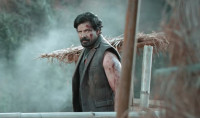
Abishek Khadka and Aakriti Rajbhandari in a scene from ‘Kumari’. Screengrab via Youtube
There is a growing criticism that new actors are chosen more for looks than for acting. How do you respond to that?
Aakriti: It really depends on how people perceive it. In our case, I would recommend watching the film first. If, even after watching it, you still feel the same way, we welcome that criticism. We are ready to learn, improve, and become better. Everyone has the right to express their opinion.
That said, I feel the situation today is actually the opposite. Many filmmakers are now looking for good actors, not just good-looking faces. There is fierce competition, and actors are chosen more for their skills than their looks. Looks have become a supporting factor, not the main one.
Abishek: I agree. Looks are just a plus point now; they are no longer the deciding factor. We can see this shift happening worldwide, and it is a positive change.
Aakriti: Exactly. This change is not limited to films. Even in short projects like music videos, we are seeing strong performances and better storytelling. We are slowly moving away from focusing only on looks and paying more attention to acting and stories, which is a very good thing.
Do you think debut actors in Nepal are given enough time to grow before being judged?
Abishek: Absolutely not. Whenever something new comes up, some people find it hard to accept change and express their opinions without thinking much. We cannot really stop this. However, there is a section of the audience that is patient and gives actors time to grow and learn, even though that group is quite small.
Aakriti: People can be very quick to judge, and social media has made it even easier to pass judgments instantly. Once you are in the public eye, you need to develop a thick skin to deal with hurtful comments. I have been active on social media for more than five years as a content creator, so I am familiar with this.
It affected me a lot at first, but not as much now. Since stepping into film, the audience has grown, which has also meant more criticism. We are always open to constructive feedback, but if someone comments without even watching the film, we will ignore it. That said, there is also a lot of positive feedback, and that makes us very happy.
How has the response been during the promotional tours, and what kind of reaction do you expect once the film is released?
Aakriti: The response has been positive so far. We have received strong support, and much of the credit goes to the music. Many people have said they like the songs. The trailer has also received mostly positive reactions, which makes me hopeful about the days ahead.
Abishek: I feel the same way. Music plays a vital role in South Asian films, and audiences connect with it quickly. I believe the love the music is receiving will also be reflected in the film’s response.




 15.41°C Kathmandu