How Sonagi Blues found its voice through tradition
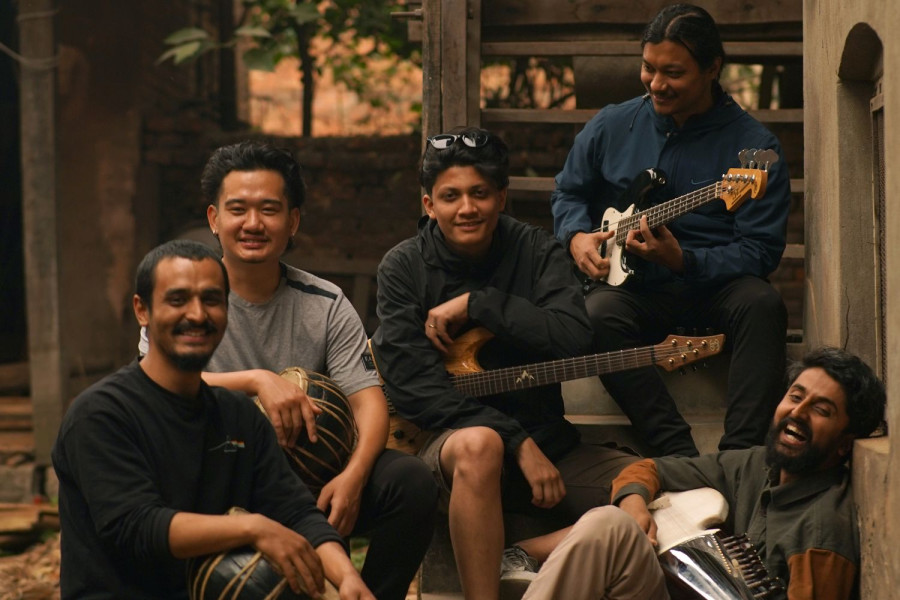
What began as an Ethnomusicology project has grown into a band that bridges folk traditions with contemporary rhythms. The band’s name, initially brainstormed as SWA-NI-GA, a Newa name for the Kathmandu Valley, is now known as SO-NA-GI. So- for sarod, Na- for nagara and Gi- for guitar. Photo: Courtesy of Chakshita
Bridging the gap between traditional music and modern rhythms, Sonagi Blues stands out as a prominent inspiration of how music can envelop introspection, philosophy and lived experience.
What began as a trio for an Ethnomusicology project at Kathmandu University has evolved into a band of five members, Appeal Paudel, Aayush Thapa, Shreejal Sayanju, Nischal Rai and Prashant Shakya, shaped by the collective dhuns of sarod, guitar, nagara, bass and vocals.
Riju Tuladhar, the band’s ensemble teacher at the University, pushed their aspirations beyond their classroom. Tuladhar guided the band towards a deeper understanding of Nepal’s traditional musical landscape, encouraging them to explore and to create.
As they sharpened their instrumental skills through everyday practice, the Ethnomusicology course eventually took on a deeper meaning in their lives beyond academics. Comfort nurtured their creativity, forming a collective and constructive space, less as band members and more as brothers. “If the band were formed based on rigid contracts, we would not have as good a drift as we do today,” says Sayanju.
Adding vibrancy to college life, the band explored collaborative creations with a shared passion for music. The band’s name, initially brainstormed as SWA-NI-GA, a Newa name for the Kathmandu Valley, is now known as SO-NA-GI. So- for Sarod, Na- for Nagara and Gi- for guitar. Redefining the essence of ‘Blues’ in their music, the band recalled their memories of companionship, growth and self-discovery as students.
They smiled when asked about their family’s reaction to their musical journey. Perhaps, this reminded them of their earlier days, how important their passion was to them, and equally, their family’s support. “Sustenance was the primary question,” says Sayanju. “When we started making music weekly as Sonagi Blues, financial legitimacy was guaranteed to an extent. Finally, my family agreed that I was doing something productive.”
Uncertainties served as a medium of electing a common drive for the band, rather than a threat. They navigated their way one step at a time, visualising their aim as a collective effort. Their third-year Ensemble class highlighted reasons to make music. “One of our greatest inspirations was when our professor Riju Tuladhar asked us to outline what was not there in the musical scene of Nepal,” says Sayanju.
“We started tracing through the wide array of the musical ecosystem, expressing our preferences better. This helped us push ourselves from the idea of being just another artist in Nepal,” he adds. Eventually, new ideas started to emerge from a common ground, oozing an identity that defines the band today.
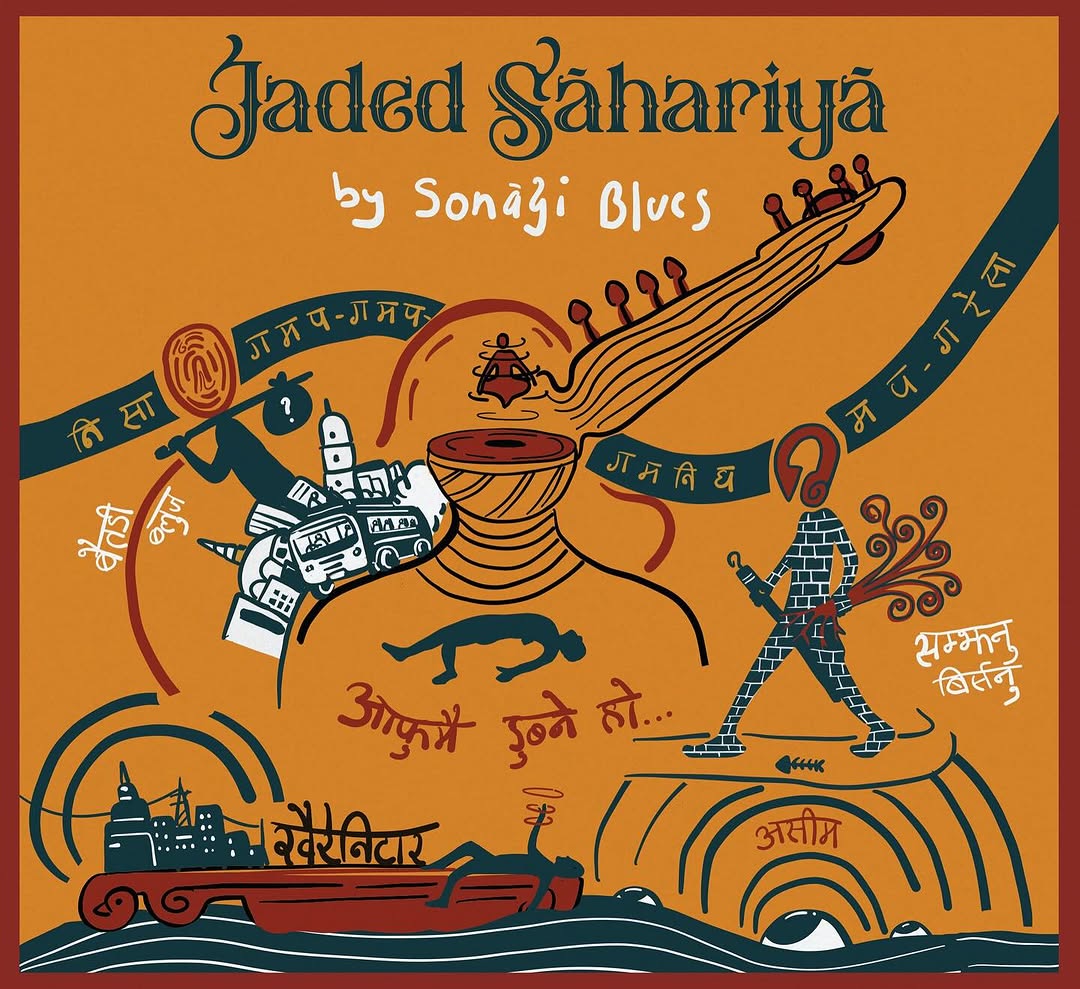
Album cover for ‘Jaded Sahariya’.
The band acknowledges that Poudel’s and Thapa’s professional experiences profoundly shaped their paths. Music was not just about creating new melodies for them; it was about tracing histories and acknowledging the lineages that shaped today’s musical landscape. They visited different libraries in Nepal, scrutinising the works archived there to gather inspiration for the album’s production.
Their dynamics were constructive and driven by covalent bonds rather than hierarchical divisions. They transcend challenges as a way of learning and grabbing opportunities that help them grow.
Forming a band with what seems necessary requires valiant amendments. “The band is constantly looking for areas to improve. When we realised we were lacking proper sound engineering, Shreejal, the former nagara player of the band took the lead,” says Prashant. “With the experience of playing drums, I adapted to the rhythms of nagara, making the beats a backbone of the band’s music,” added Nishal.
As a medium of expression, the instruments hold deeper meaning for musicians beyond their sound. “I believe my instrument is a language; a way to communicate my thoughts,” says Shakya.
The singer-songwriter and sarod player of the band, Appeal Poudel, strives for the perfect words in the songwriting process. “While some music took two days to complete, some took months,” says the band.
Inspirations for them loom over the everyday atmosphere of their lives. They blend introspection, philosophy and vibrations in their music while gathering collective experiences through their observations and conversations.
Poudel once asked his mother, “What should I do to become happy?”
Her answer was simple. “Be immersed in yourself.” He mirrored this concept of sinking in self as the primary medium of hope and happiness in the lines of the band’s music.
Their debut album, ‘Jaded Sahariya’, explores the experiences of a person travelling from a village to the city, capturing dreams, passion and reality. From Ciya Guff to the studio, their ideas followed waves encountering experiments, amendments and endless learning. They ensured a smooth decision-making approach with the practice of ‘Majority Wins’. “It was a democratic process all along,” says Sayanju.
The album launched in August, 2025. This live performance, with a large audience, became a tangible proof of the intimacy felt by the Nepali youth for folk and traditional music, surprising the band itself.
Listening to Sonagi Blues is not a simple experience. A cocoon of vibrations, rhetorical questions and reflections surrounds the listeners, drawing them into an unparalleled experience. Their music also explores how rapid development and micromanagement of authorities affect people and nature. They research, experience, question and make music as their voice for activism.
On the other hand, the band believes that performing live and being in the moment are among the forces that drive them to make music. “Live performance helps us exchange energies with the audience. This feeling cannot be expressed in words,” says Nischal.
While in conversation about their journey, they subtly remembered the people who pushed them forward, even in the gentlest of ways. Binit Shrestha, their former bandmate who helped significantly in the album recording process, Riju Tuladhar, their ensemble teacher, Eric Chandra, a visual artist who took their first picture as a band and supported them in their first commercial gig conduct, Kevin Aspire for designing their album covers, Rajan Shrestha for the album recording guidance, Chakshita and Prasun Regmi for being the helping hand since the beginning of the band. Lazzu Shrestha and Smarika Phuyal for their contributions as back vocalists and Bhusan Shilpaker for his support and guidance.




 24.27°C Kathmandu