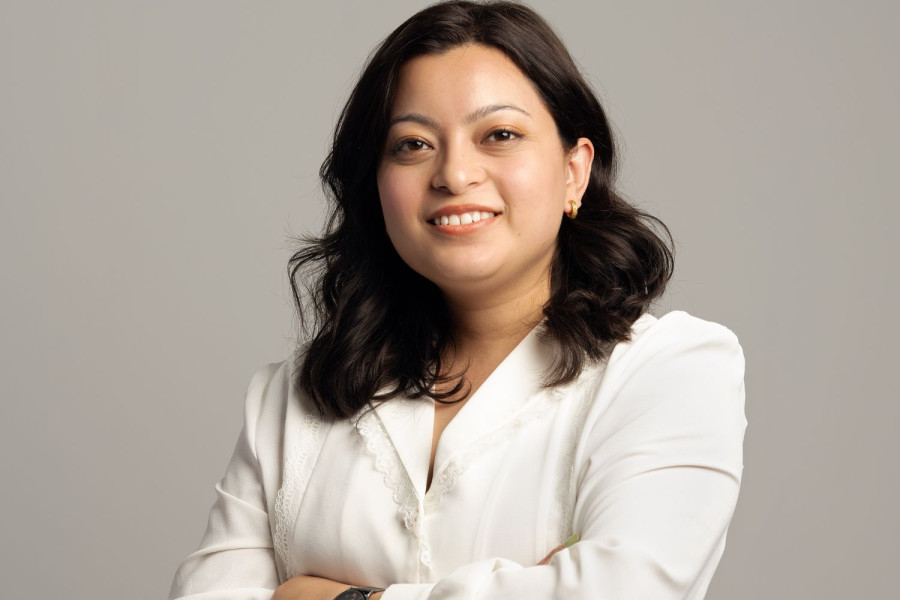
Balancing site visits with story talks, Shristi Shakya, co-founder of Bookverse, and a full-time engineer, is building both electrical systems and a community of readers in Kathmandu. Photo: Courtesy of Nada Bader
Shristi Shakya is a full-time electrical engineer and a part-time bookseller at Bookverse, but above all, she has been a reader since childhood. Reading was one habit she never outgrew. When library classes were boring for most of her classmates, they were the highlight of her school days. Those hours among shelves played a major role in nurturing her love for books.
Opening a bookstore had always lived in her heart. It was something she imagined doing after retirement. However, life had other plans. Being surrounded by a circle of voracious readers strengthened her connection to books and people alike. Reading became a bridge that connected her with many in her community, eventually shaping her journey to become a full-time electrical engineer and a part-time bookseller at Bookverse.
As a child, she mostly read the ‘Goosebumps’ series. Mystery and murder stories fascinated her, and detective fiction quickly became one of her favourite genres. These stories sharpened her curiosity and imagination.
She was always good at mathematics and comfortable with calculations. That strength naturally extended into her professional life and even into designing the space at Bookverse herself. She knew she carried a creative spark within her, but she also wanted a field that demanded logic and precision. Engineering offered her both.
She had always known she would pursue engineering. Her father inspired her to study electrical engineering, often telling her that there was a gap in the field and a shortage of electrical engineers. He believed that choosing this path would not only secure her future but also allow her to contribute meaningfully to society.
In this conversation with the Post’s Sanskriti Pokharel, Shakya discusses Bookverse, reading community, and juggling the roles of engineer and bookseller. Many people see engineering and literature as opposites. Does your work as an engineer shape how you engage with books, as a reader and as a curator?
For me, engineering fuels my mind and books nourish my soul. Although they may seem contradictory, they complement each other in meaningful ways. My work as an engineer trains me to think logically, systematically, and with purpose, and that same approach influences how I engage with books and curate them. I am intentional about what I read and what I offer to others.
Through engineering, I help build reliable electrical infrastructure. Through books, I nurture thought, imagination, and emotional well-being within the community. Being a bookseller allows me to create a space where readers feel connected, curious, and inspired. In that sense, both roles fulfil my ambitions and give me the satisfaction of building not just systems and structures, but also a thoughtful and vibrant reading community.
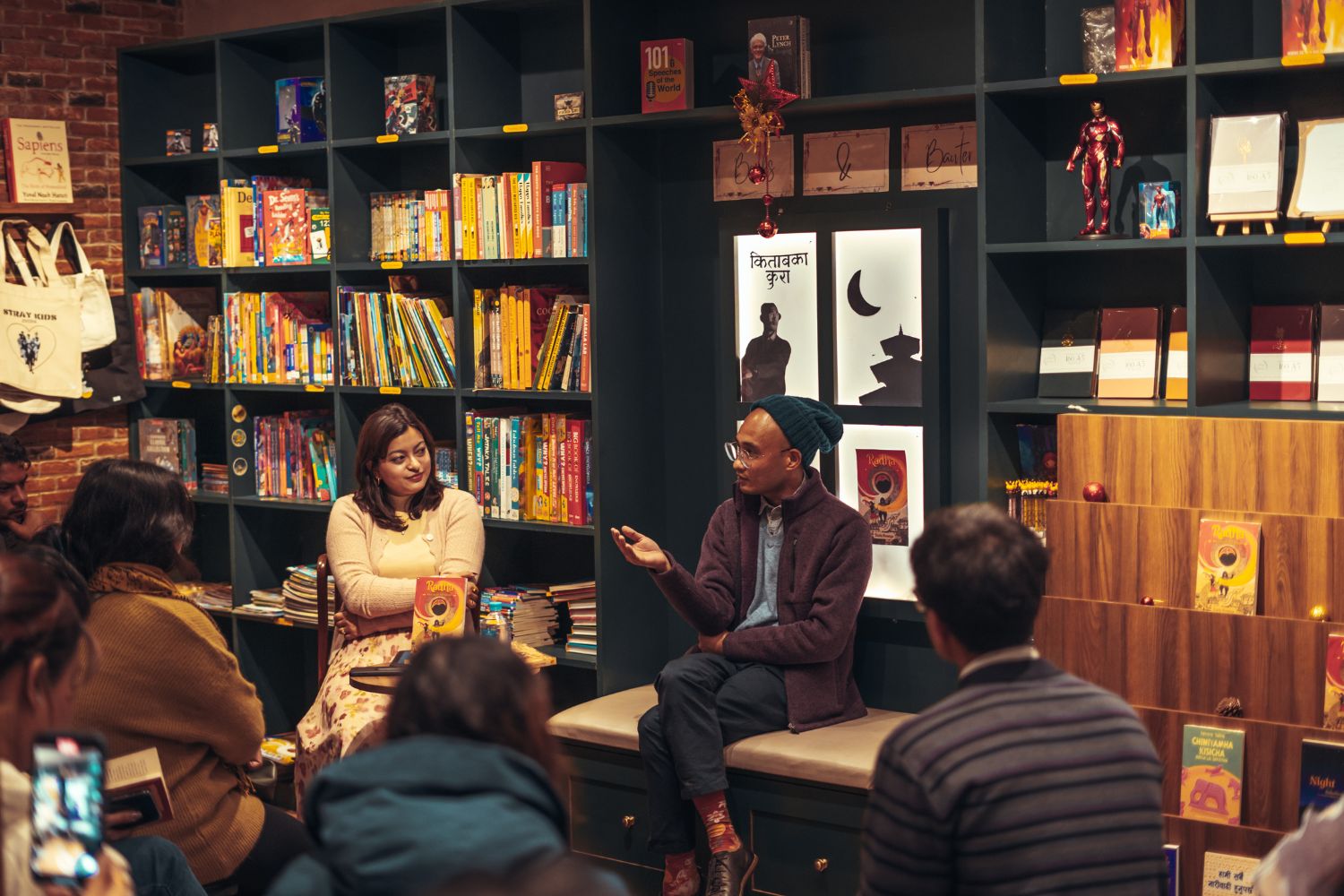
‘Young readers, in particular, lack spaces where they can gather, talk, and feel seen. Bookverse was born from the desire to create that space and that sense of belonging.’ Photo: Courtesy of Jeanus Suwal
Independent bookstores are increasingly rare. What did it take, emotionally and practically, to start Bookverse alongside a full-time engineering career?
I often jokingly call independent booksellers “independent fools.” If you weigh the pros and cons purely as an investor, a bookstore rarely makes sense. The financial returns are uncertain and rarely sustainable. So this decision was never driven by profit.
Emotionally, what pushed me was the absence of a true reader community in existing bookstores. Through Bookstagram and my circle of reader friends, we often talked about how bookstores rarely recognise readers as contributors. Young readers, in particular, lack spaces where they can gather, talk, and feel seen. Bookverse was born from the desire to create that space and that sense of belonging.
Practically, balancing both roles is hectic and draining, but deeply fulfilling. A book that inspired me during this journey is ‘What You’re Looking for Is in the Library’. What keeps me going is the feeling people have when they walk into Bookverse. The calm, warmth, and connection my team creates offer a level of satisfaction that money cannot measure.
I would love to do this full-time, but stepping away from engineering would mean not doing justice to what I am truly skilled at. Right now, I am trying to find balance, because in the end, fulfilment comes from aligning passion with purpose.
How did you decide what kind of bookstore Bookverse would be, beyond the books it sells?
Being readers ourselves was the starting point. Everyone who built Bookverse loves books and understands their power to change lives. From the beginning, we knew we did not want to be just another bookstore. We wanted Bookverse to be a giving space, one that goes beyond selling books.
We aimed to create a place where readers feel seen, where they can get thoughtful recommendations, sit comfortably, and not feel alone. In a society driven by individualism, we wanted to rebuild a sense of togetherness. Bookverse is meant to offer readers a pause from the daily rush and a space to connect with others who share a love of books.
That idea shaped everything we do, from organising author meet-ups and reading events to creative activities like treasure hunts. Our “Love is Love” event, focused on romance books, invited readers to openly discuss and even complain about frustrating fictional characters. It gave people a rare chance to express what they usually keep to themselves.
Seeing readers form friendships and become “book best friends” in this space is deeply fulfilling. That sense of community is what defines Bookverse, beyond the books on its shelves.
You describe Bookverse as a space for slow reading and shared conversations. Why do you think slowness has become so radical today? Slowness feels radical today because we are living in an era shaped by algorithms, short attention spans, and constant scrolling. A book’s essence cannot be captured in 30 seconds, yet we are often forced to present it that way for visibility. If content does not immediately engage, it gets ignored, no matter how meaningful the book itself is. That reality is deeply concerning.
At Bookverse, we try to push back against this by gently forcing people to slow down. We constantly encourage reading, not skimming. By talking about what books can truly offer, such as patience, deeper focus, and emotional grounding, we hope to remind people of the value of slowing down.
Many people are now exhausted by the digital world and craving some form of detox, whether from constant notifications or dopamine-driven content. Books provide a quiet, grounding space where people can pause, be present, and reconnect with themselves.
We see this shift clearly through Bookverse Kids. More millennial parents are actively encouraging their children to read, something many of us did not experience growing up. That tells me slowness is slowly making a return, and books are helping lead that change.
Have there been moments when you felt torn between your professional identity as an engineer and your creative life with books?
Yes, there have been moments when I felt torn. I run my own engineering firm, which demands constant presence, site visits, and physical energy. After long days on-site, reading can feel difficult simply because I am exhausted. When I go too long without reading, though, I sense something missing. At the same time, I have learned not to force it. Every profession comes with its own demands, and rest is just as important.
One conscious choice I make is to limit mindless scrolling when I am tired. Instead of short-form content, I turn to e-books and keep them as a backup. Even a few pages help me feel more grounded.
In many ways, books have enhanced my professional identity rather than conflicted with it. Engineering is not only technical. It requires communication, empathy, and human connection, especially on-site. Literature has helped me develop those skills.
As a woman in engineering and entrepreneurship, what challenges have you had to navigate in the initial phase? In the initial phase, one of the biggest challenges I faced was imposter syndrome. I felt whatever I was doing wasn't enough, which made me question my own abilities.
As a woman electrical engineer, I faced another major challenge: not being taken seriously on-site. Even when I was handling most of the technical work, people would direct their questions to my male partner rather than to me. These subtle but repeated experiences affected me mentally and deepened my self-doubt.
What helped was having open conversations with my partner about how I felt. He consciously made space for me and redirected people to speak to me directly when necessary. It may seem like a small change, but it significantly boosted my confidence. In a society shaped by patriarchal norms, women often have to make extra effort to have their voices heard. Supportive colleagues and honest communication make that journey a little easier.
Sanskriti Pokharel, a former reporter and sub-editor at the Post, is a final-year student of Journalism, Mass Communication, and English Literature at St. Xavier's College, with experience in media, research, and communication.




 28.31°C Kathmandu