‘Bhatti Tales’ uses humour and silence to examine marriage, loss, and unmet emotional needs. The play reflects on how dreams often serve as an escape from reality. Photos: Courtesy of Dgeeraj Adhikari
In his directorial debut, James Dhakal’s ‘Bhatti Tales’ is a quiet yet stirring exploration of home, relationships, and the unspoken distances that exist within intimacy. Set in a modest bhatti(inn or pub) run by Dilpana while her husband, Madhav, spends his days at work, the play unfolds through everyday routines that gradually reveal layers of grief, longing, and emotional survival.
Rooted in realism, ‘Bhatti Tales’ captures the subtle complexities of ordinary lives with remarkable sensitivity.
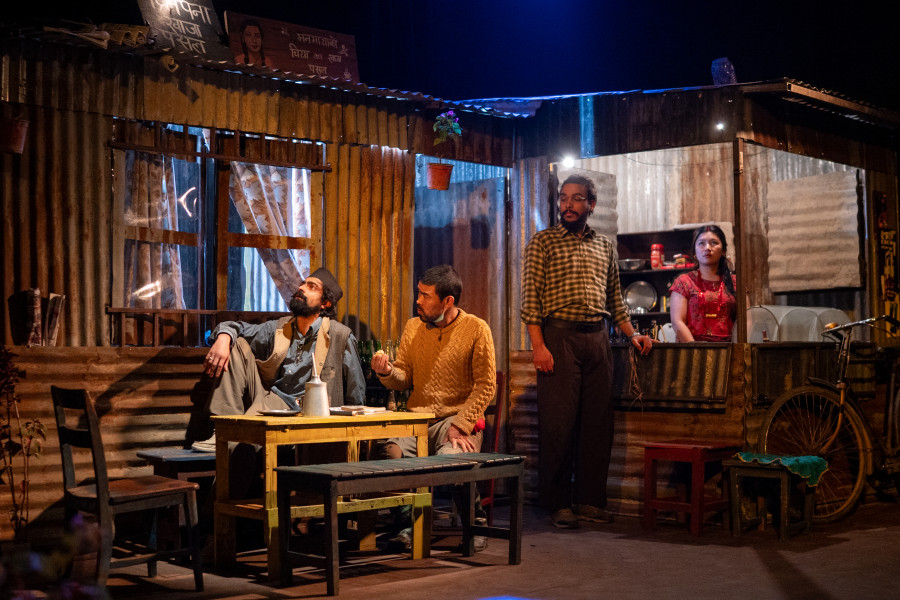
Encapsulating the vibrancy of Dilpana (Bedana Rai) and Madhav’s (Sudam Ck) home, the play opens by showing the regularity of their everyday lives. In the absence of Madhav, who leaves for work each day, Dilpana runs ‘Dilpana Ko Chiya Pasal’, a space for people, especially villagers, to stop by for snacks, lunch, drinks, and carrom board.
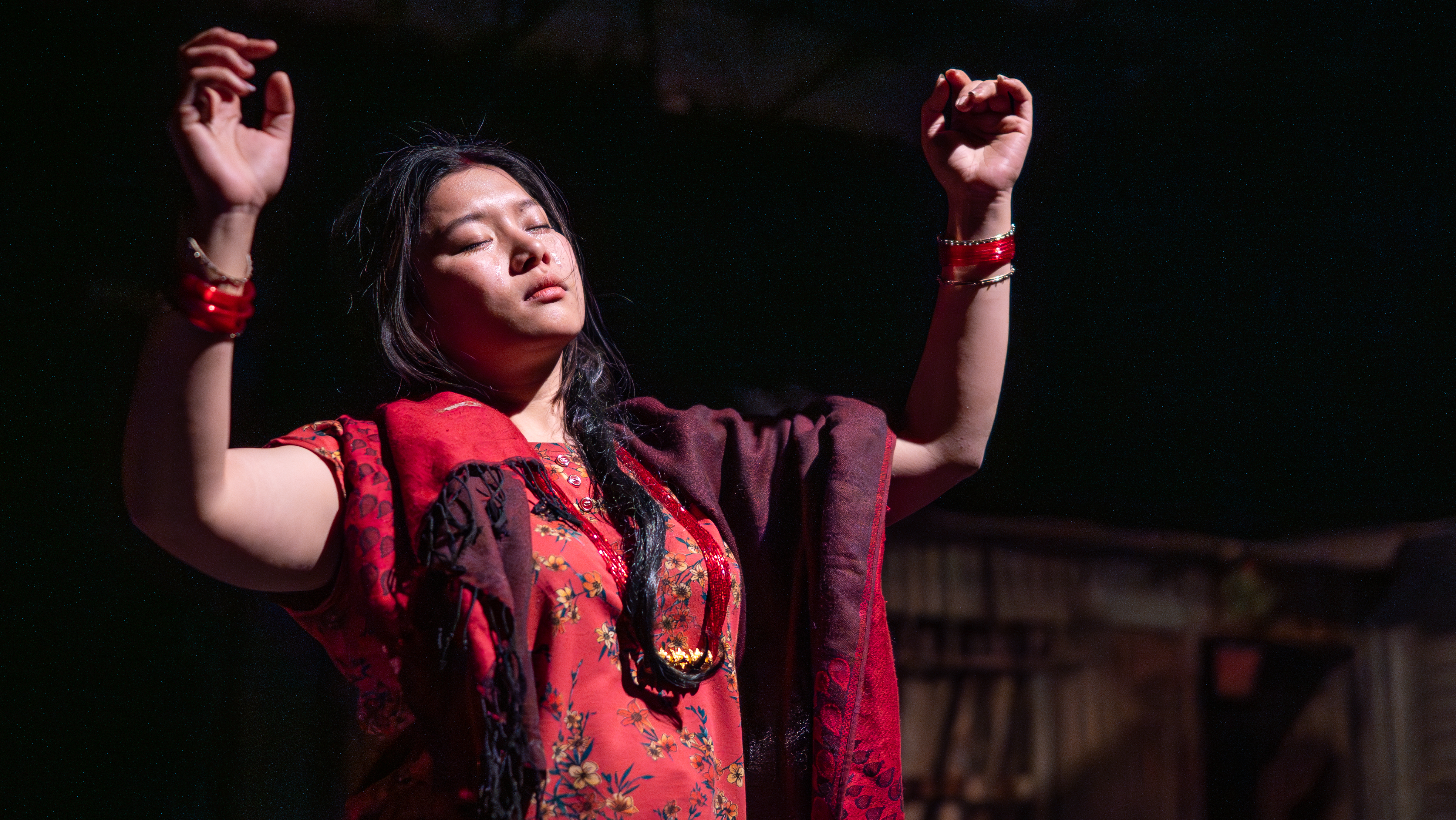
Dilpana lives with a quiet ache—the absence of emotional closeness from her husband.
“Bhatti Tales is about home, relationships, dreams, patience, and most importantly, it is the reality,” says director Dhakal. While the character introduction is initially overwhelming, viewers quickly grasp their personality and follow the storyline with them. Gradually, the theme of attachment and coping mechanisms comes to the surface through these characters.
Dilpana lives with a quiet ache—the absence of emotional closeness from her husband. Madhav remains lost in grief after his father’s death. Mohan, a businessman, confronts his undeniable love for Dilpana. Sambhu, a regular at the shop, struggles to cope with his wife’s absence. Gumsher, full of life and stories, searches for ways to live with his own melancholy.
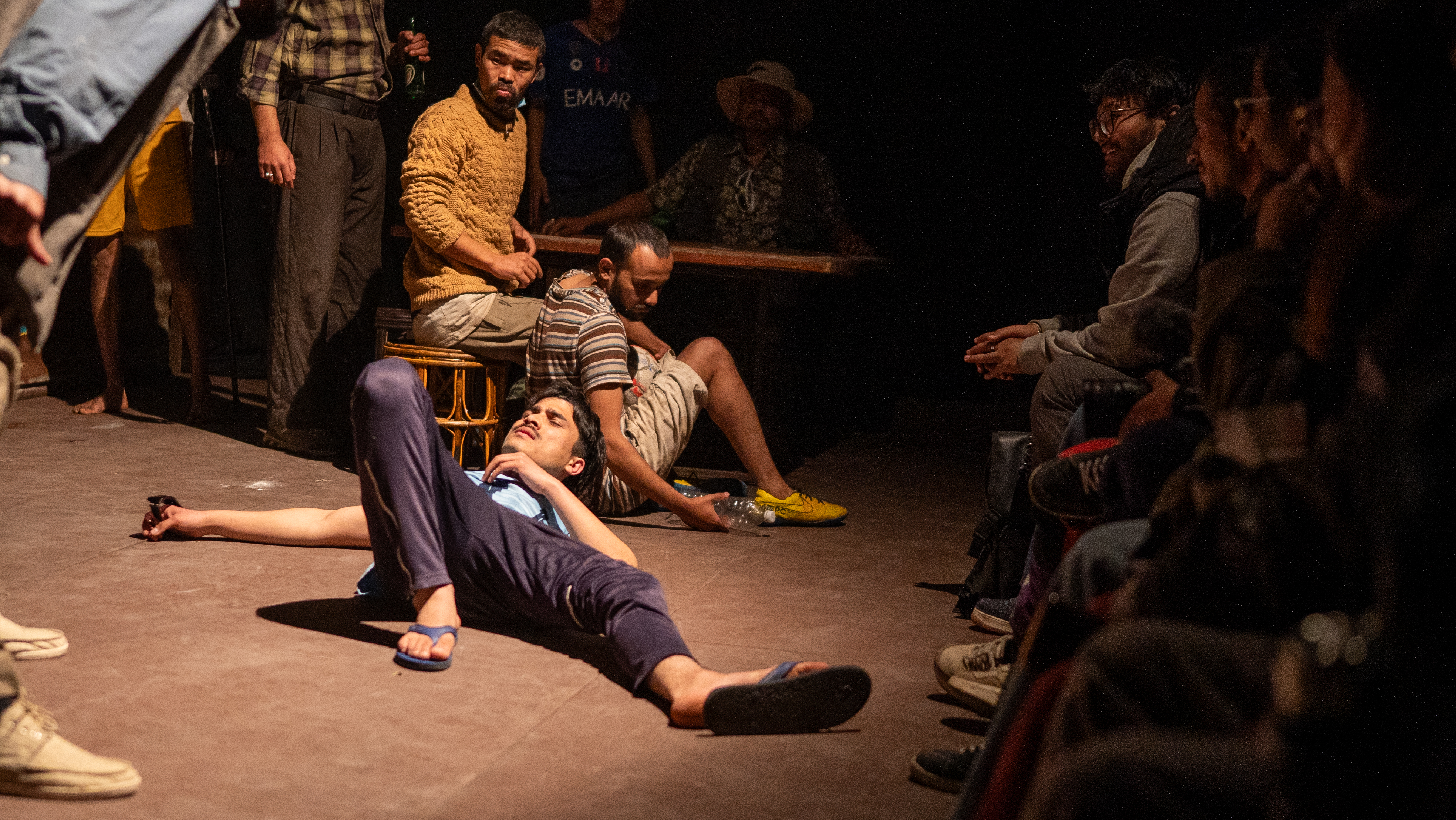
Sukraraj, Mani, Ramila, Uddhav, Talsingh, Dhankumanr and Premdev bring contrast to the alternative moments in the bhatti—filling the stage with conversations, games and chaos. The duality takes viewers on a fickle journey, shifting effortlessly from moments of poignancy to laughter.
Everyone has a story—a reason to live, eat, drink, sing, play, write, and die. For some, the bhatti is an escape; for others, it is suffocating. As Madhav grows distant, the customers begin to fill Dilpana’s emotional void, briefly easing her loneliness. Yet her walls remain firm and unbroken. The tension between comfort and isolation continues to exist around her and within her, as she longs for care from her husband.
‘Ox-Farmer Bond’
‘Bhatti Tales’ reflects on how dreams often serve as an escape from reality. Dilpana’s unfulfilled expectations drive her to form an emotional bond with their pig, Jure—an attachment Madhav deeply resents. She also turns to poetry to cope with her loneliness. Through her words and actions, the play expresses how trapped she feels, confined within a space—and a life—she wishes had been built differently.
‘Bhatti Tales’ mirrors the tangible patriarchal freedom afforded to men. To freely repulse home and spend time elsewhere, while the women are tied to domestic responsibilities. The climax confronts both personal and societal boundaries, forcing Madhav to reckon with his inherited fears. This ignites his confession of how the idea of becoming his father fills him with regret and helplessness.
This fills the void in their relationship to an extent, but it is later shattered on Dilpana’s birthday, when Sambhu gifts her a saree meant for his wife. Madhav aggressively reacts to the situation, inviting a falling action to the play. Denouncement is followed by a hint of magical realism, leading towards an ending that simply felt right.
Dilpana sings these lines towards the end of the play. Dreams carry hope, vision and love. Dilpana’s shared dream with Madhav was simple. A gentle life, woven by the threads of their marriage. But the reality carried a different scent. They were together yet so far away from each other. Two flowers seemed to be on the same journey, but a distant longing resides in this togetherness. A realisation of solitude lingers in her hummings—what seemed infinite, now exists only in the fragments of her dreams and memories.
Dhakal masterfully engages the audience through the characters’ dialogue and movement, along with Sabin Bhattrai, the play’s assistant director. While following a crowd of characters can come all at once, Kshitiz Parajuli frolics with the lights, drawing the audience’s focus.
The stage visualisation by Jeni Sunwar adds real-life essence to the play. The house of a single-layered tin—with windows and furniture—makes viewers feel as though they are in a bhatti, immersed in the atmosphere and conversations. Background music by Naresh Gajurel amplifies the soulful experience behind the dialogues and in the silences.
As audiences, we measure the value of art by how deeply we find ourselves within it. In the uniqueness of ‘Bhatti Tales’, there is an expanse of universality. Some found themselves in the characters, others empathised.
‘Bhatti Tales’ takes viewers on a beautiful journey of emotions, flickers of hope, fun, and laughter, juxtaposed with moments of depth, reflection, and unrequited expectations. It fills the stage with movement, characters, music, props, and dialogue just as much as it fills the audience with an extraordinary experience.
Bhatti Tales
Writer and Director: James Dhakal
When: Until January 17 (Except Tuesdays)
Time: 5:15 pm onwards (1:00 pm onwards on Saturdays)
Where: Sadhanaghar Theatre, Oscar International College, Sukedhara




 24.27°C Kathmandu