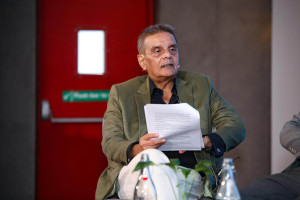
Writer and educator Harihar Timilsina reflects on his early inspirations, the balance between teaching and writing, and the gaps in contemporary Nepali literature. Photo: Courtesy of Sanjog Adhikari
Harihar Timilsina is a Nepali writer, poet, lyricist, and educator at Nepal Police School, Sanga. He was the first runner-up in the National Anthem Writing Competition organised by the Nepal Government.
His book, ‘Kakhara’ (2022), critiques Nepal’s education system and the pressures placed on students.
In this conversation with thePost’s Reeva Khanal, Timilsina reflects on his early influences, the interplay between teaching and writing, the gaps he observes in contemporary Nepali literature, and the themes he aims to explore in his future works.
What inspired you to start writing, and which experiences shaped your early journey as a writer?
My father used to recite the Ramayan, Mahabharat, Devi Bhagavat and the verses of Buddhichaanak at home in a melodic tone. The rhythm captivated me. Because of this, when teachers asked us to read poems at school, I would sing them with a tune, and their appreciation encouraged me further.
By the time I reached Grade four, I had already begun writing poems. My friends enjoyed them, which motivated me. As I grew older, I imagined my poems being published in magazines, alongside my photograph. That marked the beginning of my writing journey.
You are an educator and a writer. How do these two identities influence your daily life and creative process?
There are days when I feel more like a teacher than a writer, and days when I feel the opposite. Sometimes I even doubt whether I am a writer. It often feels as though the teacher within me overshadows the writer, and at other times, the writer overshadows the teacher. Yet somehow, both continue to coexist—perhaps because they care for each other.
My colleagues and students often become the sources of my stories, poems or songs. Sometimes something meaningful emerges from that inspiration; other times, I am dissatisfied.
I often wish to become a full-time writer, but I cannot leave teaching because I feel my students are, in many ways, my true teachers. I learn a great deal from them.
Your works highlight social realities and human emotions. What core message do you hope readers take away from your storytelling?
I do not expect my stories, novels or songs to change readers’ lives entirely. But I do hope they remember me with a small sense of connection. If they find even a tiny part of themselves in my writing—something that makes them feel happy, understood or uplifted—that is enough for me.
What do you think is currently missing in contemporary Nepali literature, and how should emerging writers address that gap?
It is a difficult question. The reading culture in Nepal is declining. Without readers, writers cannot thrive. Another challenge is that young people increasingly prefer English texts, and some even feel proud to say they do not know Nepali well.
To bridge this gap, we need to write fresh, relatable and engaging stories. We must explore ideas that resonate with today’s young readers and create characters they can admire. Just as the West has figures like the Hulk, we should develop characters rooted in our own culture and history, such as the Yeti or other iconic figures.
What inspired you to write ‘Kakhara’? Were there particular experiences that led you to explore the themes of pressure and psychological challenges in a school setting?
Nepal lacks books that appeal directly to teenagers and young adults—works that reflect their emotions and challenges. At home and in school, students are often encouraged to study only for marks. As long as they score well, everyone is satisfied. However, this system overlooks the development of skills, values and connection with the real world.
I believe something is fundamentally wrong with our education system. We have not been able to integrate values, skills, or an understanding of soil, labour and lived experience. When the focus is purely on grades, students may excel academically, yet miss out on many essential aspects of life.
‘Kakhara’ emerged from these concerns. The book advocates for a shift in how we perceive education. It critiques traditional, rote-learning-based systems and imagines an education that values practical aspects of life—culture, religion, language, art and science.
What issues do you want to explore in your future work? Are there new genres or themes you are interested in?
Recently, I have found great joy in writing children’s stories. My career began with poetry and songwriting, but I later realised how limited children’s literature is in Nepal. While the West offers diverse books and imaginative characters—from Harry Potter to Winnie the Pooh—we have very few such options.
Over the years, I have published over a dozen children’s books in collaboration with Room to Read, and I am currently working with Chronicle Books on a children’s literature project. I hope to continue creating stories and characters that young readers can relate to, admire and feel inspired by.
Harihar Timilsina’s five book recommendations
Bhagavad Gita
Author: N/A Publisher: Various classical editions Year: N/A
It teaches that every problem has a solution and helps readers cultivate inner balance and understanding.
The Power of Your Subconscious Mind
Author: Joseph Murphy Publisher: Penguin Publishing Group
Year: 1963
A transformative book emphasising hope, inner strength, and the belief that anything sincerely envisioned can be achieved.
The Good Earth
Author: Pearl S Buck Publisher: John Day Company Year: 1931
Buck’s novel portrays the bond between humans and the land, showing how soil and labour give identity and purpose.




 15.48°C Kathmandu