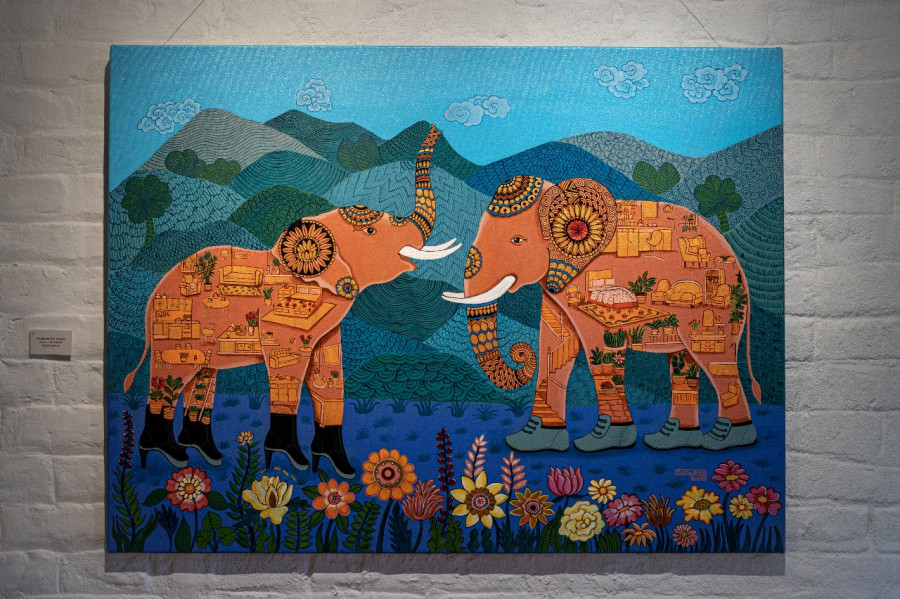
In ‘Aura of Togetherness’, artist Sabita Dangol explores harmony between humans, animals, and nature through intricate patterns and imaginative storytelling. ‘An Elephant In A Room’ Photo: Courtesy of Kathmandu Art Gallery
Walking into Kathmandu Art Gallery feels like entering a space shaped by Romantic-era sensibilities. Poets of that period saw nature as a living companion. They believed every leaf, breeze, and creature held its own quiet truth.
‘Aura of Togetherness’ brings that same atmosphere into visual form. The exhibition creates a gentle, symbolic space filled with companionship, nature, mythology, and balance.
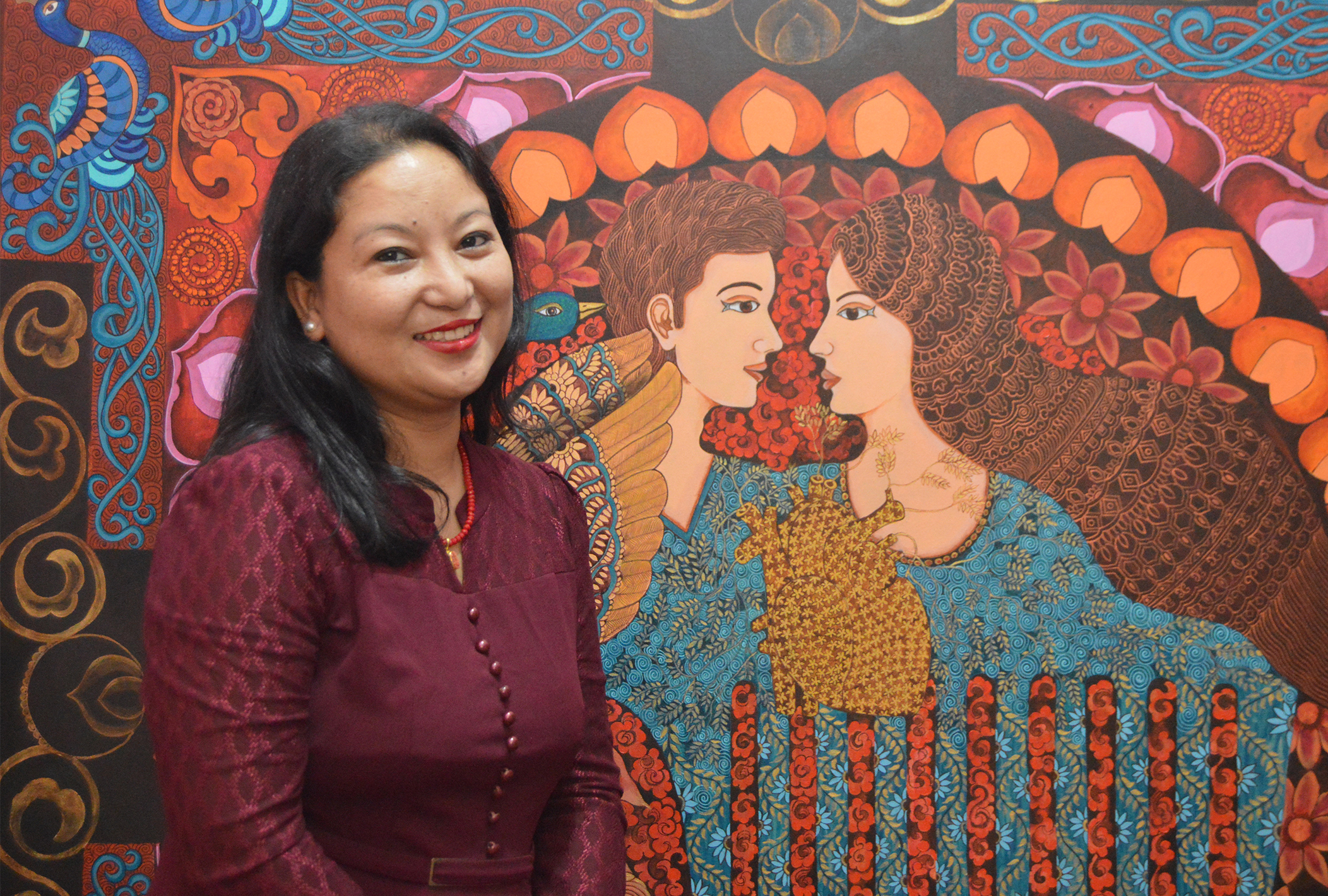
At the heart of the exhibit is Sabita Dangol, a visual artist who consistently places humans, animals, and natural elements at the centre of her practice.
The shift began during the pandemic, a period that prompted her to reflect on nature and its importance. She realised that humans often treat the world as if it exists only for them. Yet animals and plants share it equally. Humans build houses to express safety and comfort. Animals, on the other hand, rely entirely on nature for shelter. Caves, rivers, trees, fields, and the open sky become their homes. Dangol says, “This thought stayed with me and slowly shaped my creative direction.”
Visual artist Sabita Dangol Photo: Courtesy of Ishan Pariyar
She argues that people often overlook that the world functions because of all living beings working together in unseen ways. Her message is simple: it is essential to preserve nature and learn to live in harmony with the creatures with whom we coexist.
Many of the paintings in this exhibition portray paired animals such as elephants, camels, horses, and deer. The animals are dressed in patterned clothing. In several compositions, the male figure wears flats, while the female figure wears heels. These details give the animals a humanlike identity.
Dangol finds joy in drawing repeated patterns and details, a process she describes as calm and meditative. Although she draws on traditional forms, she prefers to create her own visual language rather than imitate cultural art too closely.
One of the remarkable pieces in the gallery is titled ‘Sacred Companion in the Land of Harmony’. This painting is rooted in a story about Shiva and Parvati. According to a myth, they once wished to travel across the Earth and chose to take the form of deer. Dangol imagines how this divine journey would look if it happened today. In her reimagining, the godly figures, in their deer form, wear modern attire. They appear in stockings, boots, and neatly coordinated clothing. Behind them, the architectural heritage of the Kathmandu Valley emerges. The painting becomes a playful blend of myth, present-day imagination, and cultural identity.
Post Photo: Sanskriti Pokharel
Another extensive and captivating work is ‘Whispering Souls of the Sky’. Dangol created this painting while she was building her new home, a period filled with transition. The canvas holds a blue background covered with soft floral patterns. On the right side stands a large tree whose trunk and branches are packed with miniature houses. Some of the houses appear modern, while others are traditional with slanted roofs and small windows. Each house is different. Each roof carries its own pattern. The entire structure feels like an ecosystem of memories and stories living within a single tree.
Toward the left, two peacocks face each other. Their bodies contain human faces that mirror their gentle expressions. Their feathers bloom with vibrant colours and detailed patterns. The upper left corner of the canvas holds both the sun and the moon in one shared space. This combination evokes balance. The painting is dense with detail. From a distance, it feels like a large, unified landscape. When viewed closely, new elements reveal themselves one after another. Dangol mentioned that this piece took three to four months to complete, and the dedication shows in every inch of the canvas.
Another painting titled ‘Sacred Harmony of Nature’ presents two peacocks arranged in a shape reminiscent of yin and yang. One figure carries a light shade of blue and contains a sunflower. The other holds a darker blue and contains a honeybee. The background is filled with floral patterns. For Dangol, the honeybee is a symbol of perseverance. She believes honeybees play an essential role in the balance of the world. She was equally fascinated by the peacock’s ability to consume toxic plants without being harmed. This fact surprised her and inspired the central idea for the painting. She sees the peacock as a symbol of resilience and beauty that coexists with the harsher elements of nature.
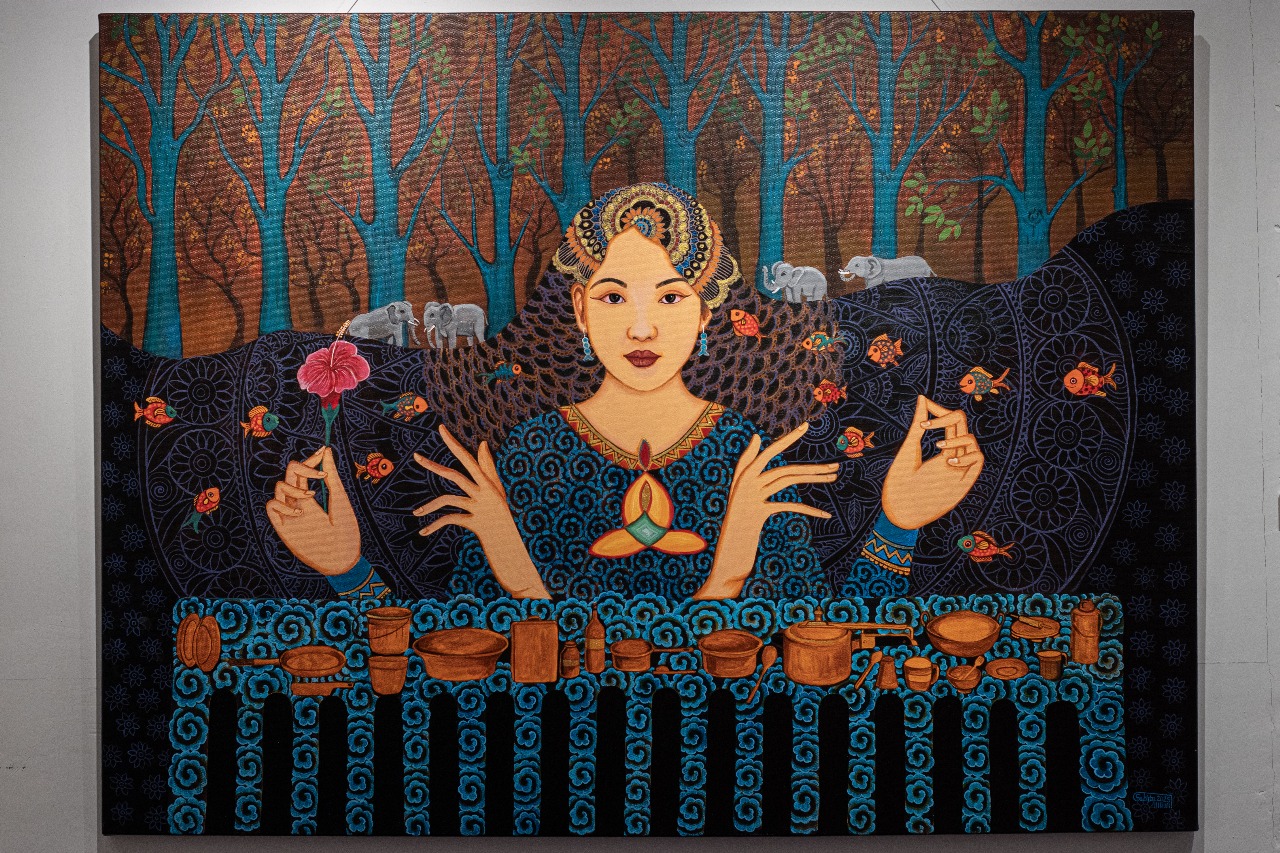
Her long engagement with the motif of the comb is also present in this exhibition. During her master’s degree, she worked extensively on the theme of hair, which led her to explore combs. The comb appears in many of her newer paintings, becoming a recurring object that ties her works together.
One of her whimsical pieces imagines what a house for elephants would look like. The piece feels charming and gentle, as if she were designing a tiny architectural dream for the animals she paints with so much affection.
Photo: Courtesy of Kathmandu Art Gallery
In ‘What Are We Eating’, Dangol experiments with form. The painting shows a couple facing each other. Their bodies are shaped from combs. Forks and spoons extend from the sides of the combs and pierce a momo placed on a plate. Inside the momo, she depicts symbols of popular social media platforms, including Instagram, Facebook, and TikTok. The background is darker, and the tree branches are bare. The mood is sombre. The painting suggests that society has become absorbed in digital consumption to the point of losing connection with nature.
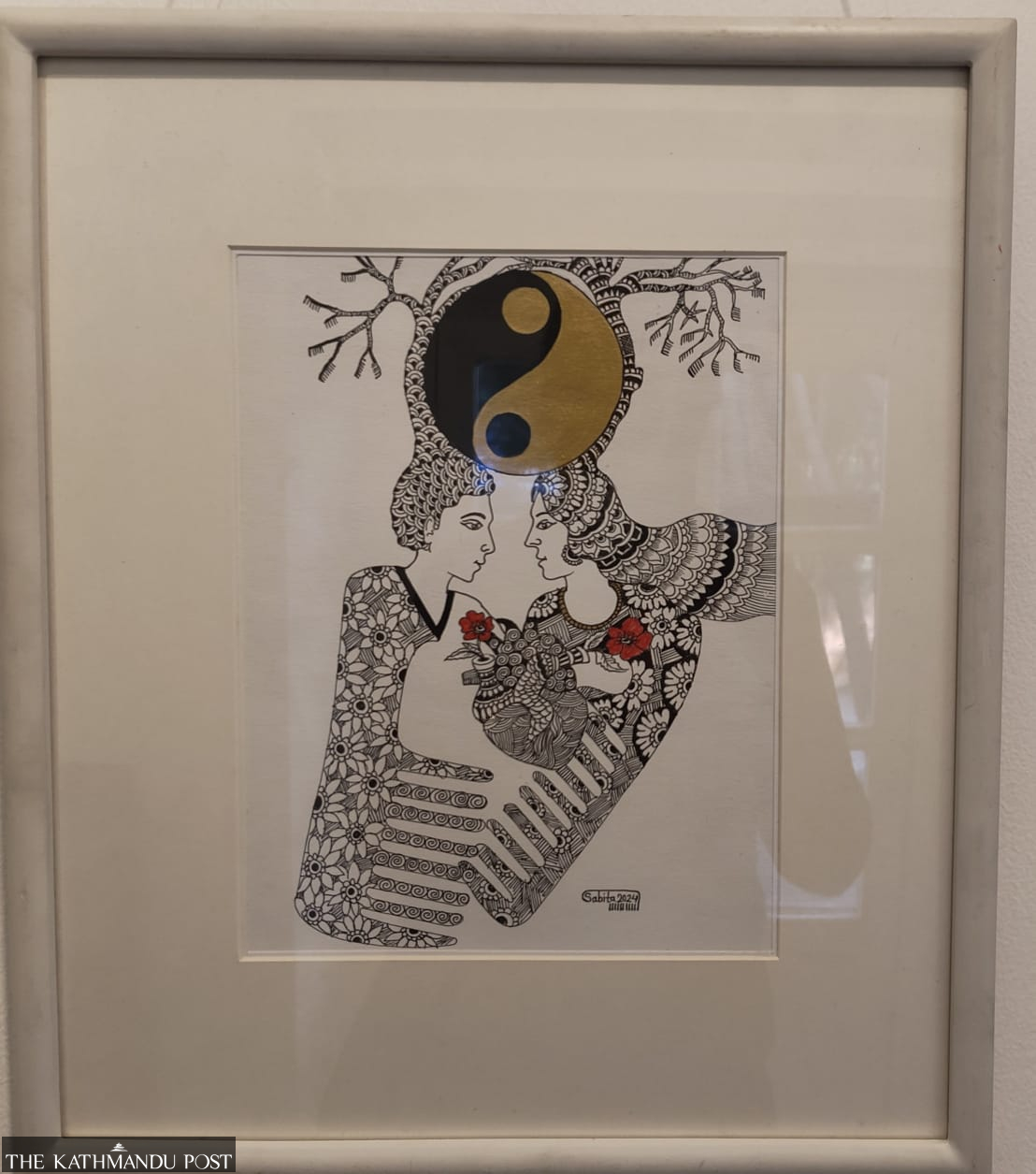
Another notable piece is ‘Eternal Companion’, a mixed-media work on paper. The illustration is mostly in black ink. Two figures stand closely facing each other, their bodies filled with floral and geometric patterns that blend into one another. A detailed anatomical heart lies between them, with red flowers blooming from it. This red is the only bright colour, symbolising life, love, and shared emotional roots. Above them, intertwined branches form an arch that holds a gold-and-black yin-and-yang. The metallic gold glows against the monochrome patterns. The figures appear to be part of a larger universe, connected through the patterns surrounding them. The artwork feels calm and intimate.
‘Aura of Togetherness’
Where: Kathmandu Art Gallery, Babarmahal When: November 26 to December 28 Time: Sunday to Friday: 11:00 am to 5:00 pm, Saturday: 12:00 noon to 5:00 pm Entry: Free
Sanskriti Pokharel, a former reporter and sub-editor at the Post, is a final-year student of Journalism, Mass Communication, and English Literature at St. Xavier's College, with experience in media, research, and communication.




 14.8°C Kathmandu