Nepal-India meet takes up measures to minimise flood hazard from Koshi, Gandak projects
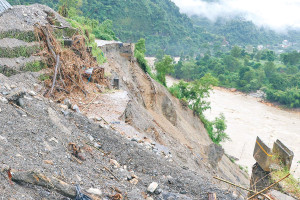
The Indian side is preparing a detailed project report of the Gandak project for carrying out more operational works. Photo: Courtesy of Indian Embassy, Kathmandu
Ahead of the monsoon season, Nepal and India have taken a series of measures to resolve various outstanding operational issues concerning flood forecast and management, among others, in the Koshi and Ganadak river systems.
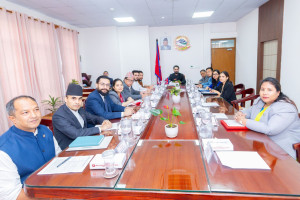
The decisions were taken during the 11th meeting of the Joint Committee on Koshi and Gandak Projects held over two days in Kathmandu, starting Friday.
“We decided to remove encroachment along a 35km stretch of the Western Koshi Main Canal on the Nepal side, mainly by shopkeepers,” Mitra Baral, director general of the Department of Water Resources and Irrigation, who led the Nepali delegation, told the Post.
As per the Koshi agreement, the two sides discussed various operational and cross-border issues being reported along with the Koshi and Gandak canals, Baral said. “We discussed local issues. There are issues on the western canal of Koshi on our side, which has no flowing water. This also figured in the meeting.”
Under Koshi projects, issues related to the security of the project area, maintenance of infrastructure, local taxes on construction materials, erosion of embankments on both sides of the Koshi Barrage, operation of gates of the main western canal, maintenance of service roads on the Nepali side, removal of encroachments, safety of project personnel, and issues related to the Koshi Tappu Wildlife Reserve were discussed, according to Baral.
The Indian delegation was led by Santosh Kumar Mall, principal secretary of Bihar’s water resources department. The meeting reviewed Nepal-India cooperation in Koshi and Gandak projects and created a roadmap for further cooperation, including in flood control and irrigation, according to the Indian Embassy in Kathmandu.
Nepal raised the issue of waterlogging in some areas, and it was decided to conduct a joint inspection. Additionally, an agreement was reached to share satellite imagery and undertake a list of actions, said another Nepali participant.
Work on the construction of a pilot channel and shoal loosening is ongoing to control the flow of the Koshi river, the official added. Discussions were also held on sharing rainfall and water flow data for flood forecasting models during the monsoon.
As per a report in Patna Press, the two sides also committed to clearing encroachments around the Koshi barrage, as well as along the eastern and western embankments and in the Valmikinagar Gandak region, in an effort to ease maintenance and improve canal operations.
In addition, an agreement was reached to remove encroachments on the eastern and western embankments. This is expected to resolve the difficulties faced in the operation and maintenance of the canals, said Baral.
Officials also agreed to relocate electric poles currently situated on the embankment of the Western Koshi Canal, a move expected to facilitate smoother functioning of the canal system and improve access along service roads.
The decision to relocate the electric poles on the embankment of the Western Koshi Canal will help in the smooth operation of the canal and better utilisation of the service roads, said Baral. Both countries have agreed to implement this on a priority basis. Nepal has assured that activities such as fishing and wood collection on the barrage will be prohibited during floods.
This will help clear obstacles to the operation of the barrage.
In a bid to strengthen flood preparedness ahead of the monsoon season, both countries endorsed a joint strategy focusing on anti-erosion work in the Birpur region, said the Indian media report.
The plan includes the use of locally available materials such as sand, soil and silt, along with round-the-clock movement of construction materials and vehicles to accelerate the work. An agreement was reached on erosion control measures in the Birpur area before the 2026 flood season.
Land demarcation linked to the Koshi project will be carried out using GPS technology within a defined timeframe, a step both sides said would help address disputes and improve transparency in project management. This will help in resolving land-related disputes, Baral said.
At the Koshi barrage, structural and non-structural interventions will be introduced to regulate vehicle speeds.
The Indian side raised issues over local taxes being levied on project vehicles, which were said to be inconsistent with existing agreements. Nepali officials will look into the matter, said Baral.
According to a statement by the Water Resources Department, these measures are expected to ease operational challenges and improve maintenance of the canal and its service roads.
Drainage issues raised by Nepal, particularly in waterlogged areas, will be jointly inspected, with India agreeing to undertake necessary remedial measures, said Patna Press. The two sides also agreed to enhance technical cooperation through the sharing of satellite imagery and updates on ongoing works.
According to a communiqué issued by the state water resources department (WRD), India, the meeting discussed resolving long-pending issues regarding flood security, strengthening irrigation arrangements, and ensuring effective regulation of the Koshi and Gandak projects.
Baral said the Indian side is preparing a detailed project report (DPR) of the Gandak project. Once it is made public, more operational works are expected to be carried out as per its suggestions.
In the discussion on the Gandak project, unauthorised occupation of acquired land, waterlogging in agricultural land due to drainage obstructions, maintaining the prescribed water levels and discharge in canals, flood protection and erosion control measures, maintenance of service roads, and silt-laden water flow control were discussed.
For the Gandak project, discussions centred on unauthorised occupation of acquired land, water-logging in agricultural fields due to drainage obstructions, maintenance of water discharge and canal water levels, flood protection measures, and anti-erosion work.
Anil Giri is a Chief Sub Editor covering diplomacy, international relations and national politics for The Kathmandu Post. Giri has been working as a journalist for more than two decades, contributing to numerous national and international media outlets.




 28.31°C Kathmandu