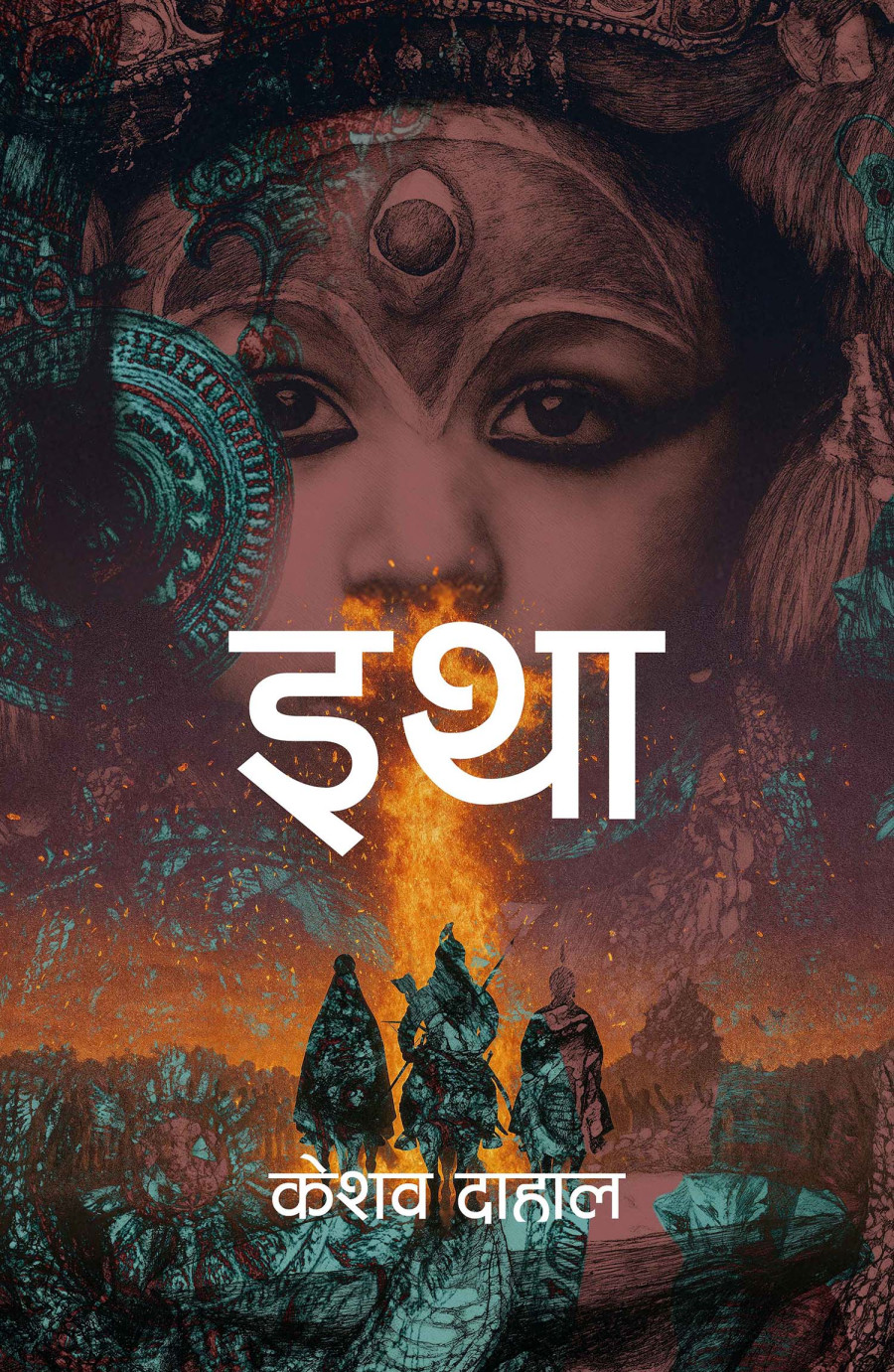
Whenever we come across dramatic and consequential historical events, we always wonder: what must those epoch-making characters have thought, felt and said in the moment? Keshav Dahal’s new novel ‘Itha’ takes us to those moments. It brings to life many historical and imaginative figures, making their experiences and expressions not just accessible but also relatable.
‘Itha’ may be remembered as his magnum opus, adding to the acclaim he has already earned through his earlier works: ‘Mokshabhumi’ and ‘Madhavi O Madhavi’.
The book’s very title is a clever and meaningful construction. The author fuses the “I” of Itihas (history) with the “tha” of Katha (story), and boldly presents the story as a bit of both. Dahal seamlessly moves between the recorded history and his own imaginative reconstruction of it. He fits comfortably in both his roles of recalling history in one moment and being a storyteller in the next. One can be nothing but impressed by his literary acumen on both counts.
The canvas is expansive and almost dreamlike. The story takes the reader to a world where the Kings of Magadh, Anga, and Kashi Janapadas are vying for power. Not very far from them, the Licchavi republics are experimenting with their noble method of governance. North of these polities sits an exotic and sacred city named Manjupattan, ruled by Kiratis, that would change many names before becoming the current-day Kathmandu.
Dahal brings to us a world where Gautam Buddha is still breathing and conversing with mortals. Dahal’s writing does not just describe this world; it makes her smell fill our nostrils, her music soothe our ears. The ancient names of the rivers, hills, streams, and ponds—reflective of their purity and magnificence—give readers a feeling of travelling back to a world our ancestors called home, as if on a time machine.
It is a time of change in what would become the northern part of India. Son Ajatshatru is about to imprison his father, Bimbisara, to take over Magadha. He wants to replace his father’s diplomatic approach with his militaristic campaign. The more egalitarian Licchavis, who would eventually move to Nepal, are at their weakest. Further north, the Kirati kings of Manjupattan—current-day Kathmandu—sit very much within the striking range of this broader political and military flux.
Remarkably, despite their differences in outlook and practices, all these sovereigns claim allegiance to the same or similar Dharma. The truth, however, is trickier than it looks. Beneath the veneer of Dharma lurks a darker reality—court intrigues, conspiracies, and the influence of abhorrent Tantric cults.
In such an other-worldly backdrop, the novel brings its central characters to the fore—almost all of them women. This is when Dahal’s storytelling comes into its true elements. Take, for instance, a part of the novel when Sainendri, an elite courtesan in the Kirati court, begins recounting her tale to Nayantara, the future Licchavi queen mother. Her story becomes a story within a story, within yet another story—all of them epochs apart. It is a tribute to the author’s superlative skills that a reader is not troubled by such complexities but rather enjoys going back and forth between epochs.
The novel, in the most compelling ways, explores the trials and travails of womanhood in our land. Thousands of years pass by, but the power dynamic between men and women remains pretty much the same. Through the journeys of Basudha, Nayantara, and Sainendri, the story reveals a persistent paradox of our society. Basudha is punished for a minor physical blemish, Nayantara simply for her unwavering principles, and Sainendri strangely for a crime committed against her. In each of the cases, the culprits, the powerful men, stand as judges. These are the same men who claim high moral standing. These are the same men who venerate and worship the feminine as Shakti all their lives.
Yet all these women refuse to be mere victims. Armed with intelligence, resilience, and an acute understanding of how power works, they not only navigate but also reshape the world that wants to relegate them to obscurity. Down, at times, but never out of the game, they win back their agency with fierce determination, often emerging not only as survivors but as architects of favourable change. They understand the hard truth—in the theatre of power, tact and strategy reign supreme. Victory outshines immoral acts, often erasing them.
Given an opportunity, why not become history’s headline? Why remain confined to its margins? The female protagonists question themselves. So what if that requires staging a grand philosophical colloquium, bringing together an extraordinary array of thinkers cutting across the belief systems of the time: the Buddha, Mahavira, exponents of Hindu traditions associated with Vyasa, Ashtavakra, and Gargi—alongside the Kirati sage Porokmi Yamphami.
For those practising statecraft, the discourses, at a broader level, underscore the syncretic nature of the nation’s intellectual heritage; but for Nayantaras and Sainendris, they provide the much-needed conviction to embark on dangerous yet just paths.
While these passages occasionally appear to slow down the narrative’s pace, they feel like a deliberate effort on the part of the author to provide legitimacy to the acts that otherwise would appear bereft of morality. Notably, the novel takes the liberty of reinterpreting the key historical transitions of ancient Nepal: the fall of the last Kirati king, Jetedasti and the rise of the first Licchavi ruler, Supushpa; and the transition of the current-day Kathmandu from Manjupattan into Koligram.
For those who have read Acharya Chatursen’s Hindi classic ‘Vaishali Ki Nagarvadhu’ of the early 1940s, ‘Itha’ may appear to be her companion—and yet, in its own way, an extended imagination of those glorious times. The brief appearance of Amrapali, the central character of Chatursen’s classic, serves both as an homage to the old and as a transition to the new story. Let truth be told—‘Itha’ stands firmly on her own feet, rooted in a conception that is uniquely Nepali.
This is a novel that deserves a far wider readership. Translations into Hindi and English would allow its rich tapestry of characters to reach audiences beyond Nepal, reinforcing the millennia-old civilisational connect between present-day Nepal and northern India. In its pages, history does not remain distant; it breathes, questions, and speaks directly to us.




 14.82°C Kathmandu