



 12.72°C Kathmandu
Fri, Oct 23, 2026
Theater
A bird’s cry echoes human guilt in ‘e Thibeu!’
Directed by Bedana Kheresungma Rai, the play revisits an indigenous myth to reflect on maternal sacrifice, environmental violence, and human arrogance.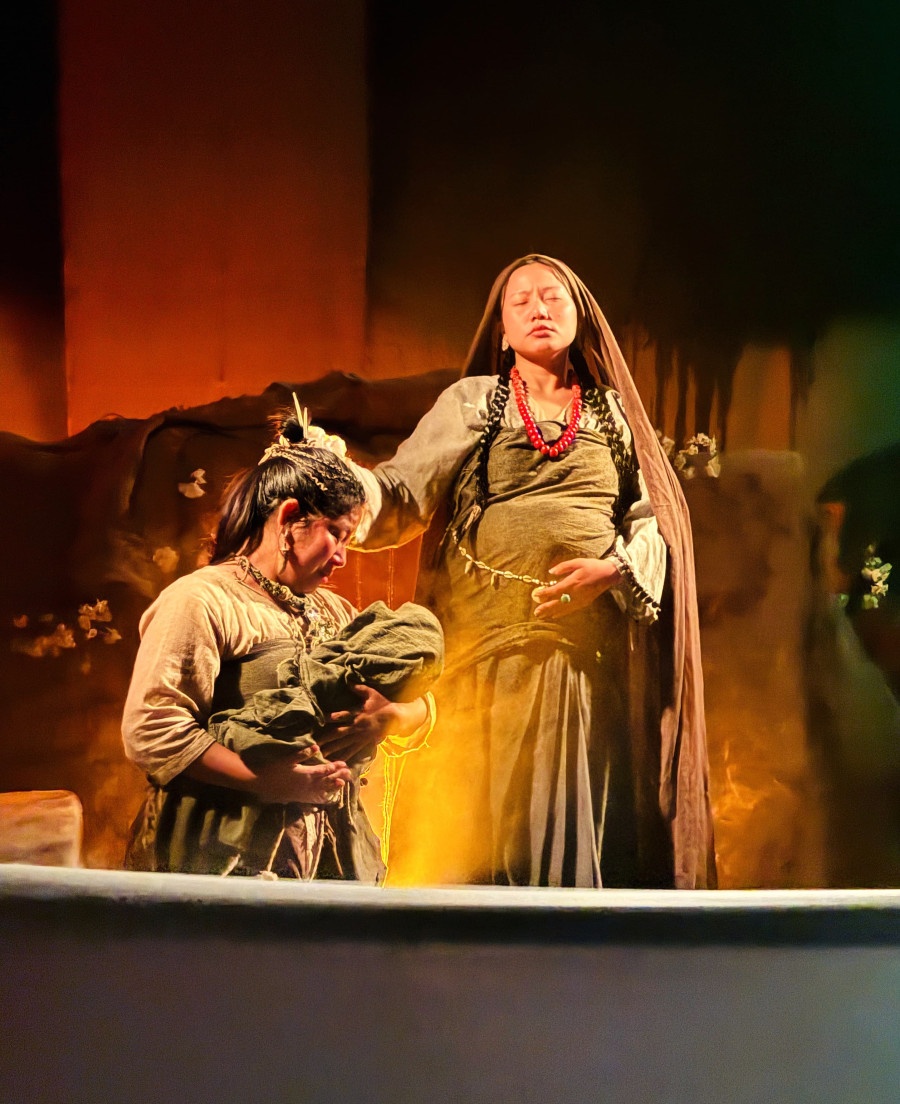
bookmark![]()
‘e Thibeu!’ also reflects on how suffering is inevitable for every being, be it the tree that stands still with a hope for the slightest movement, or the river that flows continuously.
Jony Nepal
Published at : February 5, 2026
Updated at : February 5, 2026 09:00
Kathmandu
Have you ever wondered what birds might be telling us through their chirps?
‘e Thibeu!’ follows a Kirati myth that recounts the story of Thibiyaa, a bird whose hums correspond to the word ‘Thibeu’. Directed by Bedana Kheresungma Rai, ‘e Thibeu!’ explores motherhood while advocating the cost of human superiority in the environmental ecosystem, which often considers the assembly of other natural elements as an insignificant concern.
Rai is an actor and director recently seen in a striking performance in ‘Bhatti Tales’, directed by James Dhakal. Regarding ‘e Thibeu!’, she says, “This work comes from an indigenous way of seeing, where myth is not fantasy but a lived memory. And where nature is not a background but a living witness.”
The pre-show preparation chants echoed beyond the walls of the theatre. Through music, dialogue, light, costumes, props and acting, ‘e Thibeu!’ moulds a remarkable experience for the audience, inviting them to witness the power and delicacy of motherhood and question how they interact with nature individually.
The Kirati myth revolves around a village in Eastern Nepal. The village was overpowered by the patriarchal imperative to bear a son. Thibeu, son of Thibikma, was the only male child in the village’s radar. Other families in the village, especially the men, constantly reprimanded the women for not having an heir, unlike Thibikma.
In response to the domestic oppression and reproductive compulsion, the women came together with a plan to delude Thibikma. They persuaded her into believing that Nahaang, meaning nature in the Kirati language, had called upon every infant of the village to elevate the natural prosperity.
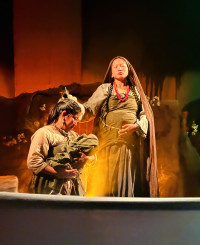
Thibikma, played by Sangita Thapa Magar, while embracing her motherhood, was equally concerned about her village. With an ultimatum to choose between her son and her village, she chose to compromise her child, a part of her that she considered inseparable. She let go of Thibeu in the river, along with the villagers, letting the currents carry their children.
Her journey took a pivotal turn when she realised the villagers’ dishonesty. Instead of their children, they had disposed of bags of grain in the river. Relentlessly searching for her son, Thibikma refused to move from the shore of the river where she had left him. From the nooks of the forest to the depths of the river, she searched for her son.
“Thibeu…Thibeu…”
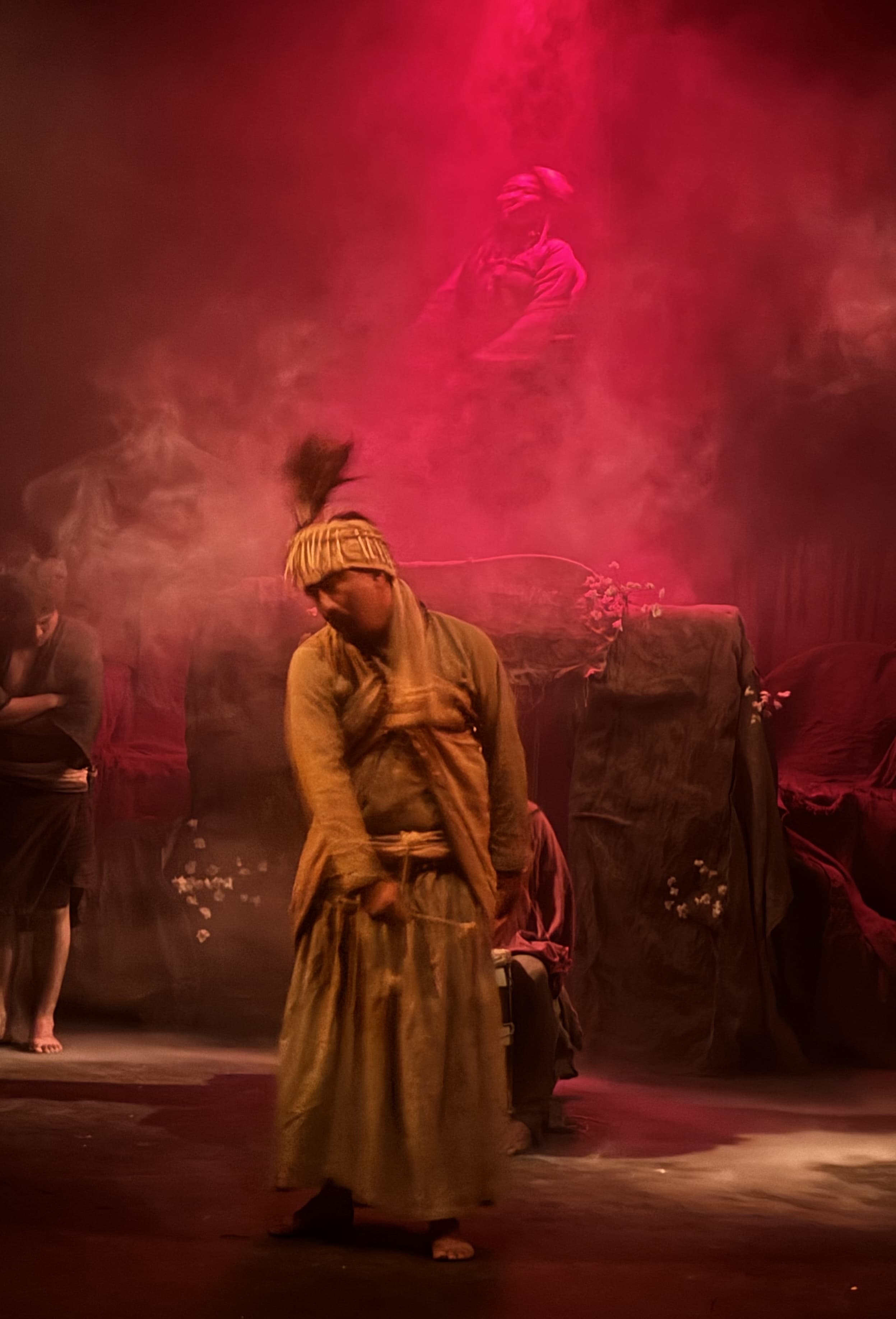
Air, water, and soil, each element heard the echoes of Thibikma. Catharsis loomed in the corners of the theatre when she repulsed and protested against the river and nature for deceiving her. Climax encounters the stage with the renewal of her existence as a bird, Thibiyaa, played by Roshni Karki. A bird that chirps Thibeu. Even in her afterlife, Thibiyaa holds onto the hope of finding her son, tracing through the forest, waiting with the company of her own presence and solitude.
‘e Thibeu!’ also reflects on how suffering is inevitable for every being, be it the tree that stands still with a hope for the slightest movement, or the river that flows continuously, hoping for a moment that allows it to remain dormant. In each life, struggle remains as a core mechanism for survival and adaptation.
Written by Geeli Ratos, the play revisits a myth called ‘Thibiyaa’ grounded in history, blending it with environmental concerns that are relevant in the present.
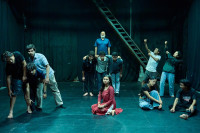
Cavemen are seen roaring the chants of their superiority in the ecosystem, hunting and gathering the lives that once had their own purpose. Vibrations that followed their dance steps rippled across the audience’s seats.
The stage visualisation is rather peculiar, exchanging the linear placement of the characters with a front-to-back dynamics. This abstractness might take the audience a while to trace the lead.
‘e Thibeu!’ starts with a powerful interaction of cavemen with birds. Suspense elevates when the conversation of the birds becomes the least concern for humankind. Warning of humanity’s danger, the birds are urged to fly away.
One of the prominent factors connecting the stage and the audience is the enthralling reverberation of live music. A blend of chyaprung, nagara, dhime, murchunga, ghungru, dhamaru, and ghang carry the suspense, curiosity, and energy between and behind the dialogues. The song ‘e Thibeu!’, composed by Januka Rai, is performed as a lullaby by the performers Cinduka Rai, Prabha Rai, and Pritam Dhakal, making the audience feel as though they were part of the story.
Lights, operated by Prem Chan Pandey, play a significant role in enhancing the play’s ambience, placing the characters and props in their designated spots. Lights also carry a metaphorical significance, denoting the circulation of evil with red.
Costume designed by Akash Rai from Khambu Arts, and props designed by Lahana Rai and Sanjib Rai stood out as an evident element of the play. The river’s visual representation was created manually in the scenes, giving the stage a real-life environmental feel.
This story of Thibiya tackling guilt and different stages of grief has been recited in almost every Kirati household of Nepal. The audience exited the theatre with an experience that would serve as a constant reminder of maternal nurture and sacrifice.
e Thibeu!
Director: Bedana Kheresungma Rai
Writer: Geeli Ratos
Time: 5:15 pm onwards (1:30 minutes)
Saturdays at 1 pm too
Where: Shilpee Theatre, Battisputali, Kathmandu
Entry: Rs300 to Rs1,000
Jony Nepal
Nepal is a culture and lifestyle reporter/sub-editor at the Post. She is also a Psychology and English literature student.
Editor's Picks





E-PAPER | October 23, 2026

×