



 16.76°C Kathmandu
Sat, Oct 10, 2026
Theater
A queen that chases headlines
‘Maharani Ko Jatra’ turns a royal story into a modern satire, showing how those in power chase publicity and perfection.
bookmark![]()
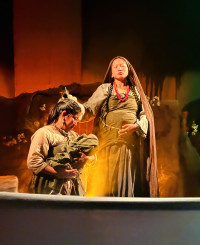
The crown is a powerful symbol in the play. Everyone treats it as sacred. Photo: Courtesy of Kantipur Theatre
Sanskriti Pokharel
Published at : December 1, 2025
Updated at : December 1, 2025 07:04
Kathmandu
‘Maharani Ko Jatra’ begins with a narrator who promises a “once upon a time” kind of tale, only to twist the line by saying it is a story with a modern edge. The contrast between the familiar opening and the unexpected correction creates curiosity.
Directed by Dipal Baral, the play opens with loud, energetic modern music that feels mismatched with a royal setting. The clash between sound and context is intentional. It signals that the story of power, monarchy, and tradition will unfold in a world where modern influence is unavoidable. The opening scene takes place inside the palace’s storeroom, which has old objects and forgotten possessions.
When the Maharani (Queen), played by Usha Rajak, speaks for the first time, the entire theatre is stunned. Her voice booms through the hall, commanding attention with confidence and strength. The performance makes it evident that the actor has put effort into voice projection. Every syllable carries clarity, authority, and theatrical weight. It is one of the first elements that impresses the audience.
Soon after, the queen calls for her personal caretaker, who appears as a lively and humorous presence. The caretaker is assigned a long list of tasks, and her expressions reveal a blend of elegance and stress. Even when overwhelmed, she carries herself gracefully. Her reactions show devotion and frustration. She becomes the emotional support of the palace, the practical hand behind the queen’s grandeur.
The central conflict begins when the queen learns that a neighbouring monarch has been featured in ‘Ramailo Chha’ magazine with an eight-page coverage of her coronation. The queen immediately demands similar publicity. Her desire doubles within seconds, and she declares that her feature must cover sixteen pages. She does not request. She commands. This moment becomes the foundation of the entire narrative.
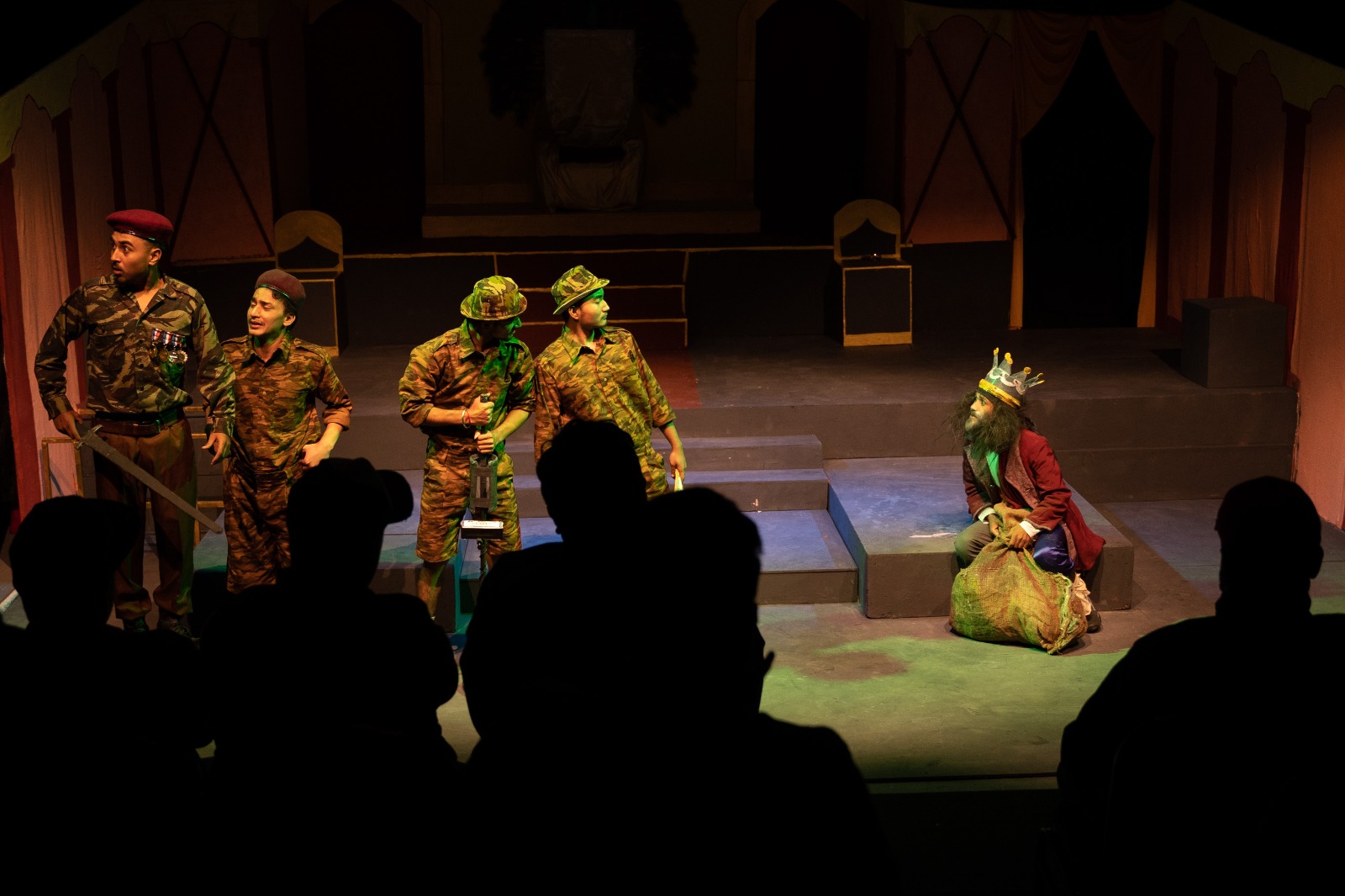
Through this scene, the play comments on the relationship between power and journalism. Those in authority often shape the press to suit their personal wishes. Headlines bend toward influence. Critical issues are sidelined. Public image becomes more important than genuine relevance. The comedy softens the message, but the message remains sharp.
Several jokes throughout the play land beautifully. One such moment occurs when the caretaker tries calling the editor-in-chief. The editor does not pick up the call. In the following scene, he appears wrapped inside a bora (bag). When he nervously asks why he is wrapped like that, the prime minister replies, “You should have picked up the call.” The audience bursts into laughter.
The prime minister, played by Raj Neupane, is one of the play’s funniest characters. He constantly mispronounces words such as ‘sampadak’, calling it ‘padak’. He confuses ‘celebrity magazine’ with ‘selroti magazine’. The errors are delivered innocently, creating laughter.
Another comedic moment takes place when a doctor arrives to check the prime minister’s health. She says, “PM, please take it off.” The prime minister is shocked and asks if he must do so in front of everyone. The doctor sighs and clarifies that she is referring to his glasses. The dialogue is simple, but the delivery and timing make it hilarious.
Similarly, the pandit’s entrance is one of the best-designed comic scenes. His physical appearance is exaggerated to the point of absurdity. He is skinny, draped in a dhoti (long piece of cloth worn by men in the Indian subcontinent) and a white shawl (a large piece of fabric worn over the shoulders), adorned with a big tilak (a sacred mark on the forehead) and a long upright tuppi. The tuppi is long, thick and 90 degrees erect. It looks like a straight horn.
The moment he steps on stage, the audience breaks into laughter. His requests are even funnier. He insists that the magazine must dedicate a whole page to him. His demand becomes a subtle commentary on the state of society. People who preach detachment often crave validation as much as anyone else.
Another subplot reveals that the queen is supposed to get married on the same day as her coronation. She has already rejected more than 600 candidates. The editor then explains that gossip about romance and relationships attracts attention. If no wedding happens, the queen’s magazine coverage will lose appeal. The line criticises how Nepali media often rely on sensational stories rather than meaningful reporting.
One of the play’s strongest aspects lies in its performances. Every actor delivers exceptional work. Even those standing in the background maintain expressive body language, shifting eye movements, and thoughtful gestures. Their attention to detail makes the entire stage feel alive. If the audience intentionally looks away from the spotlight and focuses on the background, they will still find captivating performances. This level of ensemble acting elevates the production.
An interesting detail about the production is its structure. Most of the play is scripted, while the remaining scenes rely on improvisation. During the show, a prop had been placed slightly off balance and was about to fall. The prime minister quickly pointed it out and began scolding the caretakers, reminding them to take care of the palace and fix things before they fall.
The line blended so smoothly with the scene that the audience watched without realising it was a genuine accident. The prop had not been positioned that way on purpose, yet the cast handled the moment with confidence and humour. This minor incident showed how comfortable the actors are with spontaneity and how well they adapt to unexpected situations.
Another praiseworthy element is the careful use of costumes and lighting. The costumes capture the royal atmosphere, and the lighting adds rhythm and clarity to each scene. Still, the production has a few limitations. Since the story revolves around a queen and her palace, the props and set design could have carried more grandeur. A slightly richer visual setup would have strengthened the play’s world and matched its narrative scale.
Although ‘Maharani Ko Jatra’ delivers consistent humour, it carries substantial symbolic weight. The story explores the search for genuine humanity in a society that prioritises glamour and recognition. The queen’s obsession with magazine coverage mirrors the growing pressure for visibility in the digital age. People chase headlines, likes, and impressions much more than personal truth.
The crown is a powerful symbol in the play. Everyone treats it as sacred. It represents authority and prestige. As the story progresses, its real value is questioned. It is simply metal.
___________
Maharani Ko Jatra
Director: Dipal Baral
Cast: Usha Rajak, Suhana Acharya, Bimal Yadav
Duration: 1 hour 20 minutes
Venue: Kantipur Theatre, Gairidhara
Showtimes: Every day at 5:00 pm except Wednesday, and an extra 1:00 pm show on Saturday until December 6
Sanskriti Pokharel
Sanskriti Pokharel, a former reporter and sub-editor at the Post, is a final-year student of Journalism, Mass Communication, and English Literature at St. Xavier's College, with experience in media, research, and communication.


Editor's Picks

Constitutional Bench caught in seniority, ‘pick and choose’ dispute

A Dom boy’s long road to becoming a doctor

From blankets to handmade dolls, two foreign women bring comfort to flood survivors

News Analysis: When institutional defence exposes institutional fault lines

It’s a bird … it’s a plane … it’s the Indian ambassador’s farewell tweets
E-PAPER | October 10, 2026

×