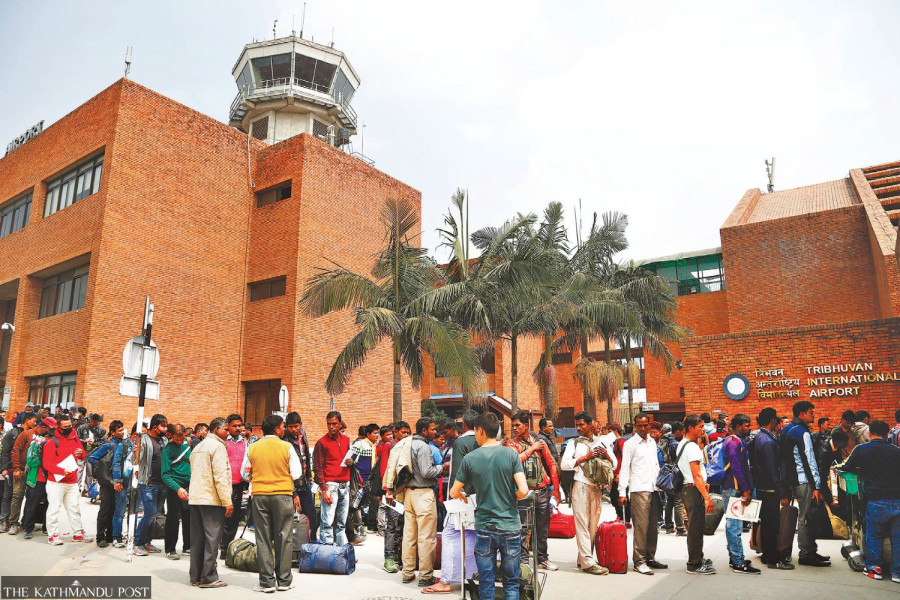
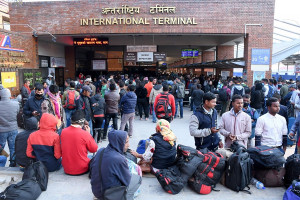
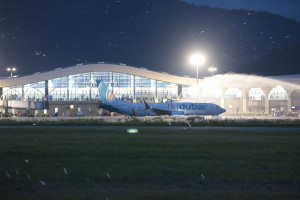
Experts warn prolonged conflict may fuel inflation, disrupt remittances, and heighten risks for migrant workers. Nepal currently issues around 2,249 labour permits each day, of which approximately 1,800 are for the Gulf countries. POST FILE PHOTO
Nepal’s economy could face a myriad of problems—from rising inflation and slower economic growth to declining household income—if geopolitical tensions in West Asia prolong, experts warn.
Nepal, a country heavily dependent on imported food and fuel and with around 40 percent of its migrant workforce based in the Persian Gulf, is particularly vulnerable, economists said at an event titled “Problem in the Middle East and Impact on the Nepali Economy”, organised by the Society of Economic Journalists-Nepal in Kathmandu on Friday.
A prolonged conflict could hit remittance earnings and tourism revenue while also affecting the agriculture sector due to rising chemical fertiliser costs and increasing inflation triggered by higher fuel prices.
The weakening demand for workers in conflict-affected areas could also affect Nepal’s labour market.
“We have estimated that four to five areas will be severely impacted. The first is inflation,” said Gunakar Bhatta, former executive director of Nepal Rastra Bank, the country’s central bank.
“Many studies have shown that if the price of oil per barrel increases by 10 percent, inflation rises by 0.4 percentage points, while economic growth declines by 0.15 percentage points,” he said, explaining oil prices’ link to inflation and economic growth.
Inflation disproportionately affects low-income households because they spend a larger share of their income on basic necessities such as food, transportation, energy and rent—items that often experience the steepest price increases.
These households have limited capacity to substitute goods or services when prices rise, resulting in greater financial stress and declining purchasing power.
The conflict could also weigh on economic growth as various sectors face disruptions.
From construction and transportation to wholesale and retail trade—activities that account for a large share of Nepal’s economy—multiple sectors could be affected. Tourism and fertiliser imports are also expected to feel the pressure.
If economic activity slows in Middle Eastern countries, where about 40 percent of Nepal’s migrant workforce is employed, remittance inflows could be significantly affected.
A decline in remittances would also weaken Nepal’s foreign exchange reserves, reducing the country’s bargaining capacity with international partners, lenders and multilateral institutions, Bhatta said.
“If foreign exchange reserves decline, our economic strength also declines,” he said.
Every year, around 500,000 people enter Nepal’s labour market. If overseas job opportunities shrink and migrant workers begin returning home, it could create social and economic pressures.
Labour experts say tens of thousands of undocumented Nepali workers are employed in the Middle East. Many of them do not figure in official government records.
According to the Ministry of Foreign Affairs, an estimated 2.5 to 3 million Nepalis—including undocumented workers—live in the Gulf region, particularly in countries currently affected by the conflict.
The Gulf Cooperation Council (GCC) countries—Bahrain, Kuwait, Oman, Qatar, Saudi Arabia and the United Arab Emirates—have long relied on Nepali workers for large-scale infrastructure projects, while millions of Nepali households depend on remittances sent by family members working there.
Rameshwar Nepal, a labour expert, said researchers are currently conducting a study on the impact of the conflict on Nepali migrant workers.
Preliminary findings based on conversations with workers suggest that many migrants and their families in Nepal are in a state of panic.
“We have communicated with a number of migrant workers and it appears that safety-related information has not reached them properly,” said Nepal, South Asia director at Equidem Research, which specialises in migrant worker protection, forced labour and recruitment exploitation in the Gulf and Malaysia.
For example, he said that one worker described how the building where he was staying shook after a missile strike nearby.
“When I spoke to one worker in the affected region, he said they were sleeping in their room and it started shaking just like during the 2015 earthquake in Nepal,” Nepal said. “The missile had fallen some distance away, but the tremors felt like an earthquake.”
Many workers reported that they were unsure how to respond in such situations—whether to run outside to open areas or remain inside buildings.
“They are extremely frightened. Safety information has not reached them,” Nepal said.
Another issue identified in the preliminary study is what researchers describe as discrimination between nationals and migrant workers.
“For citizens of those countries, safety measures such as information centres and warning systems appear well organised, including SMS alert systems,” he said.
However, such systems were not implemented to the same extent for migrant populations.
“There seems to be a ‘nationals first, migrants later’ approach,” Nepal said, adding that such practices fall short of international labour and human rights standards.
“Treating the very people who help build the country as second-class is unacceptable.”
Workers are also uncertain about whether they would be able to return home if the situation deteriorates.
Another concern relates to freedom of expression.
“Workers are not allowed to post anything on Facebook or other social media platforms except information verified by authorities,” Nepal said.
Nepal currently issues around 2,249 labour permits each day, of which approximately 1,800 are for the Gulf countries.
“Now those departures have stopped. If this continues for months, nearly 1,500 people per day could remain stuck in Nepal,” experts said.
“These people were planning to go abroad as a last resort because they lacked employment opportunities in Nepal. Many had already taken loans to finance their migration,” Nepal said.




 15.26°C Kathmandu