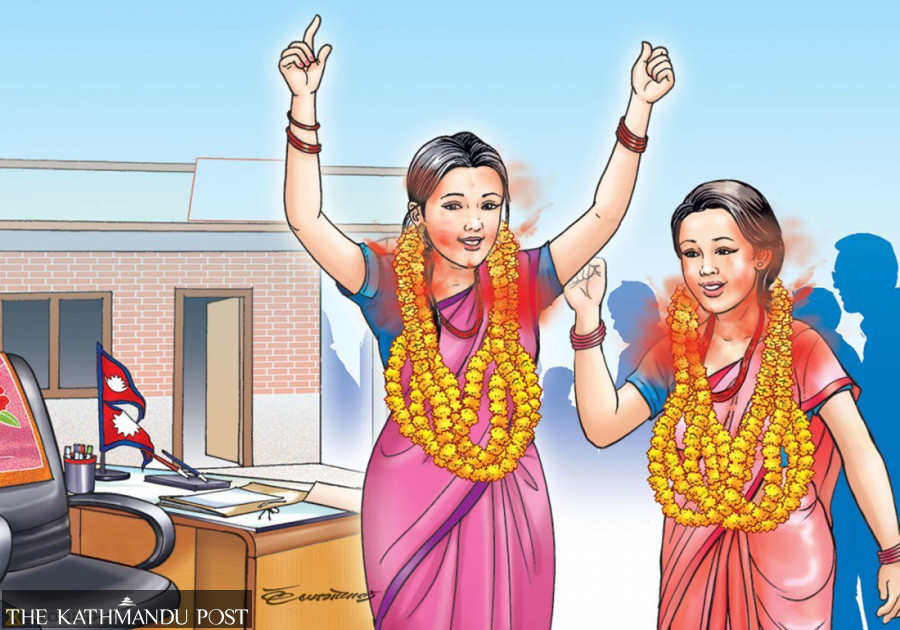
Madheshi women rarely contested direct elections, despite the constitutional guarantee of 33 percent women representation in Parliament. Political parties have often fielded them in highly competitive constituencies or placed them on the proportional representation list.
In this light, contesting direct elections itself is an act of courage for Madhesi women. Election presents them with both challenges and opportunities.
However, the recently concluded parliamentary election was a different case. Three Madheshi women candidates from the Rastriya Swatantra Party (RSP) have secured victories by wide margins in the polls.
Asha Jha emerged victorious from Morang-5, while Pushpa Kumari Chaudhary won from Saptari-1 and Gauri Kumari from Mahottari-4.
For Jha, 42, a new face in Morang-5 that has a mixed population dominated by the Madheshi community, the victory was significant. She defeated veteran candidates from established traditional parties.
Jha secured 30,434 votes while her nearest contender Phool Kumar Lalbani of the Nepali Congress received 9,415 votes.
Other candidates in the race included Nepali Communist Party’s Shiva Kumar Mandal, Yogendra Mandal, who had won the 1999 elections as an independent candidate, and Raj Kumar Yadav of Janata Samajbadi Party (JSP), Nepal.
Active for about 16 years in various social and public health campaigns, Jha built a reputation as a woman leader closely engaged with the community. Her involvement in women’s empowerment, health awareness, youth employment, and social mobilisation helped her establish a distinct identity among voters, paving her way to Parliament.
“Because I worked in the social sector, I did not face many questions or criticism from voters,” Jha said. “I heard that it is difficult for Madheshi women to contest direct elections, but I did not feel that way.”
Affiliated with the “Gayatri Pariwar”, a non-governmental organisation operating in Morang, she has been conducting programmes related to moral and cultural education. She has organised various social and spiritual awareness programmes and played an important role in volunteer management and community coordination.
Her active participation in social reform, environmental protection, and community awareness initiatives has been visible. Through the “Madheshi Mahila Nagarik Samaj”, a non-governmental organisation, Jha has raised issues of the rights of Madheshi women, legal awareness, and citizenship.
With a bachelor’s degree in education, Jha pledged to strongly raise the concerns of Madheshi women in Parliament.
Mahottari-4 struggles with basic needs
Mahottari-4 has its own narrative. This constituency, covering the south-western rural area of Mahottari, remains at the bottom in terms of basic needs compared to other areas of the district. It includes Samsi Rural Municipality, Sonama Rural Municipality, all wards of Ramgopalpur Municipality, and parts of Aurahi and Manara Shisawa municipalities. The constituency also lags behind in infrastructure development. Education, health, and employment remain major challenges in this region, the basic facilities that the entire Madhesh province is struggling to get.
The constituency having a total of 107,606 registered voters was considered a stronghold of established parties.
JSP Nepal’s Surendra Yadav was elected in the 2017 elections from the constituency, and served for a long time as minister of state for health in the federal government. Congress leader Mahendra Kumar Raya, who won in 1999 and again in 2022, previously served as assistant minister for industry, commerce, and supplies. CPN-UML’s Saroj Kumar Yadav, elected from Mahottari-4 (A) to the provincial assembly, also briefly served as the chief minister of Madhesh Province.
But the scenario for the recently concluded elections was different. Gauri Kumari won, defeating candidates from established parties by a wide margin. She received 30,132 votes against 8,742 votes garnered by Surendra. NC’s Mahendra Kumar managed to receive 6,944 votes and CPN-UML’s Nilam Adhikari, though a new face, garnered 6,192 votes.
Bharat Prasad Sah, who resigned from the provincial assembly to contest from the Nepali Communist Party, received 5,336 votes.
Gauri, 54, a resident of Sangrampur in Samsi Rural Municipality, Mahottari, grew up in the local environment. Her experience of being closely familiar with the social structure, geography, and the daily life of the region has helped establish her as a leader who understands local problems. Having obtained a certificate-level education in science, she considers education and social awareness as the foundation of her public life.
“There are many problems in Mahottari-4, of which I am aware,” Gauri said. “There is a mindset that only men can solve problems in Madhesh. I am determined to change that.”
She said she would continuously raise issues of women’s empowerment, good governance, and social reform, and take those agendas to the policy level through Parliament.
Her political journey is linked to a new political trend. She became active in the RSP, which has emerged with slogans of alternative politics and transparency.
Although she had to compete against established and influential party candidates, Gauri said voters trusted her because of her focus on education, social awareness, and change.
“I believe that educated women should take leadership roles,” she said. “That alternative perspective helped attract voters.”
Saptari-1 faces challenge of floods and development
Saptari’s constituency-1, which stretches from Beltar bordering Udayapur district to the southern part of Saptari, faces major problems of flooding, inundation, and erosion from the Saptakoshi river. People in the riverine areas are directly affected by this problem, while illiteracy, poverty, unemployment, and health challenges are equally painful.
Saptari-1, formed by merging Saptakoshi Municipality, Agnisair Krishna Sabaran Rural Municipality, Tirhut Rural Municipality, Kanchanrup Municipality, and Hanumannagar Kankalini Municipality, has 119,043 registered voters.
Since the 1991 elections, various parties have represented the constituency: CPN-UML’s Hiralal Chaudhary was elected in 1991, and Congress’s Jaya Prakash Gupta (Anand) was elected twice in 1994 and 1999.
Similarly, Madheshi Janaadhikar Forum’s Hemraj Tated was elected in 2008, Maoist’s Manpur Chaudhary in 2013, Federal Socialist Party’s Surya Narayan Yadav in 2017, and JSP’s Nawal Kishor Sah Sudi in 2022.
After the restoration of the multiparty system in 1990, almost all major parties have won elections from the constituency. In the recently held elections, however, voters trusted RSP’s Pushpa Kumari with a huge mandate.
Chaudhary won with 38,195 votes. Her nearest rival, Sumit Kumar Sah of the Swabhiman Party, secured 7,847 votes. UML leader Suman Raj Pyakurel came third with 7,652 votes.
Chaudhary, 36, hailing from Kanchanrup Municipality-11 in Saptari, studied for auxiliary nurse midwife. She had previously contested the 2022 elections from the RSP under the proportional representation system. However, ranked fifth on the Tharu list, she was not elected a member of Parliament.




 23.32°C Kathmandu