Displaced and on the edge of forests, families face daily threats from wildlife
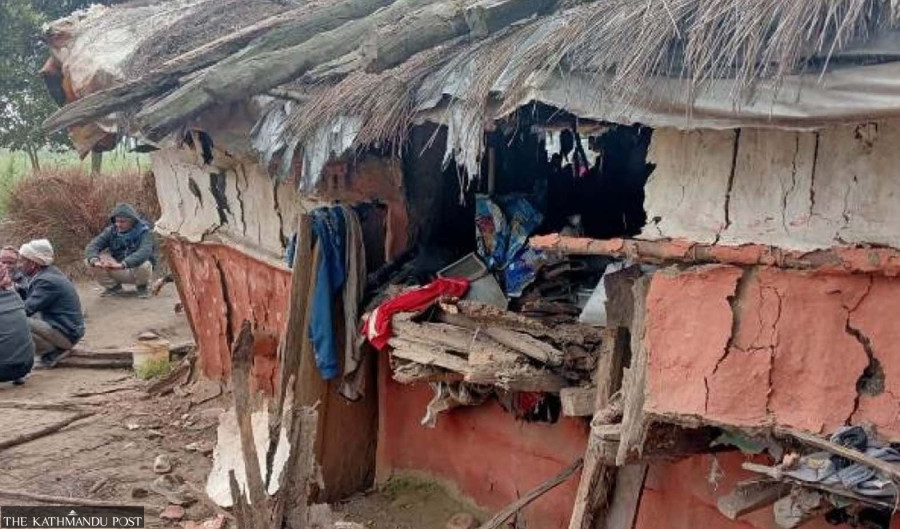
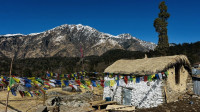
Elephant intrusions, destroyed crops, and occasional deaths are part of daily life for hundreds of families in Dhakka. A home damaged by an elephant in Dhakka, inside the Shuklaphanta park in this undated photo. Post file photo
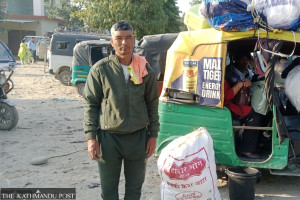
Amar Bahadur Bista stepped out of his house in Dhakka settlement at around midnight on Saturday to check on his wheat field. He saw a wild elephant that had already entered and destroyed much of the crop. The animal did not stop there. Shortly afterwards, the tusker began tearing down his house. His wife and daughter somehow managed to escape unharmed.
Bista alerted fellow villagers, stating that a tailless elephant had entered the settlement. The animal then moved towards another nearby house and began demolishing it. Inside, Parbati Saud was trying to wake her grandchildren and flee. The elder granddaughter managed to escape on her own, while Parbati attempted to run carrying six-year-old Rejina. At that moment, the elephant attacked them. Six-year-old Rejina, who was critically injured, died on Sunday morning while undergoing treatment at Dhangadhi-based hospital. Parbati, aged 55, is still receiving treatment at the health facility.
“It was night and I could not even alert neighbours in time. A life was lost before our eyes,” said Bista. “For us, every night passes like this. We have only been given false assurances for years.”
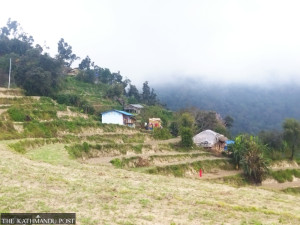
Bista was displaced from the Tarapur area of the then Pipaladi Village Development Committee in 2001 during the expansion of Shuklaphanta Wildlife Reserve, now a national park, on its eastern side. He and many others were forced to relocate without permanent rehabilitation. They have been languishing in Dhakka camp in ward 6 of Laljhadi Rural Municipality.
Residents displaced by the expansion of Shuklaphanta National Park complain that they continue to live under constant threat from wild animals, with a recent fatal elephant attack once again exposing the unresolved plight of families still living inside the park’s core area decades after their displacement.
The displaced families say attacks of wild animals such as elephants and tigers have become frighteningly common in Dhakka settlement, where elephant intrusions occur throughout the year. According to them, elephant attacks have repeatedly destroyed homes, crops and occasionally taken lives.
Four years ago, Khagaraj Rana, another resident of the Dhakka camp, was killed in a similar incident by a wild elephant. “We have become used to living with fear. At any moment, a wild animal may attack and kill us,” said Motilal Dagaura, coordinator of the Park Victims Struggle Committee. “We are still living inside the jungle. Until rehabilitation happens, we will continue to risk our lives every single day,” said Dagaura.
Around 600 families are currently languishing in Dhakka camp, facing not only threats from elephants but also snakes and insects during the monsoon. Residents say the issue of relocation surfaces during every election campaign, yet little progress follows.
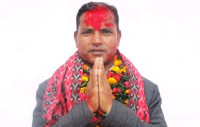
“Many leaders have won elections by exploiting our suffering. We have been their vote banks. They never return after winning,” Prem Shahi, another displaced man, vented his ire. “The election is coming again. Leaders have started visiting, promising that they will ensure our rehabilitation. But we don’t trust them.”
Promised rehabilitation never materialised, forcing many displaced families to build temporary shelters inside forest areas from 2001 onwards. The displaced families have long struggled for recognition, compensation and proper resettlement. The park’s expansion, aimed at conserving Nepal’s largest grassland ecosystem and protecting endangered species, led to the relocation of thousands, but rehabilitation processes remained incomplete and inconsistent.
Government records have varied over time, with different commissions reporting different numbers of displaced families. A total of 32commissions have been formed so far to address the issue of rehabilitation. None have reached a final resolution, primarily because of disputes over the actual number of displaced families. The latest commission, led by Jayananda Paneru, a former judge of the Sudurpaschim High Court, formed in 2024, verified 2,027 displaced households.
An earlier commission in 2014, led by former judge Thakur Prasad Sharma, reported 1,480 verified families eligible for rehabilitation. Commissions before that had listed 2,473 displaced households—the same total the struggle committee cites today.
Locals argue that shifting numbers have delayed concrete action and prolonged uncertainty for affected communities.
The former wildlife reserve covered about 150 square kilometres before its expansion increased the area to 305 square kilometres. The displaced people are still languishing in 14 temporary camps. They are currently scattered across various camps in Dhakka, Tarapur and Lallare. Among these, Dhakka is the largest, with around 600 families, while Tarapur camp accommodates 180 families and Lallare has 13 families. Similarly, many other displaced people have been staying at Bani, Sisamghari and Malubela of Krishnapur Municipality, Simalphanta, Banahara and Baisakha of Shuklaphanta Municipality and Duda of Belkot Municipality among other places in Kanchanpur.
Living in the camps close to the forest is both difficult and unsafe, as residents are left with constant fear of wild animals which not only threaten their lives but also destroy the crops they grow. The displaced people have resorted to encroaching on forested areas for agriculture. This close proximity between humans and animals has adversely affected both.
Conservationists say that while humans live in constant fear of wildlife attacks, the wild animals find their natural habitats disturbed by human activities leading to frequent human-wildlife conflicts. They underscore the need to rehabilitate the displaced families to suitable locations at the earliest to control human-animal conflict. Conservation officials acknowledge the challenges but say relocation requires coordination, land availability and political commitment.
Shuklaphanta National Park, the country’s youngest national park, is located in the southwestern corner of Nepal in the Sudurpaschim Province. As per the latest count, the national park is home to more than 2,300 swamp deer and 44 tigers.




 14.69°C Kathmandu