Tharu voters frustrated as leadership splits overshadow community concerns
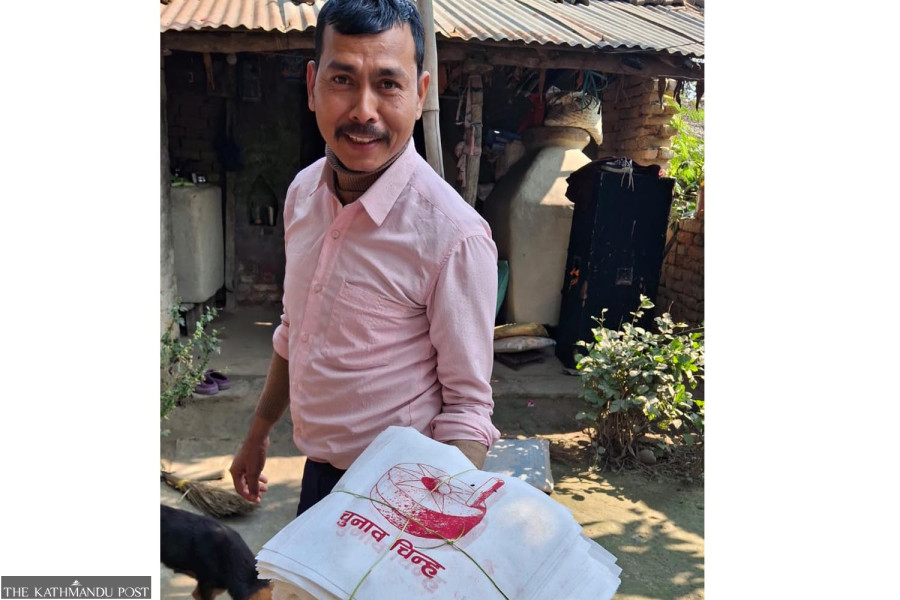
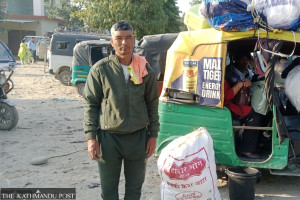
Disillusioned voters vow to support competent and educated candidates who address everyday issues like affordable seeds and fertiliser. Som Bahadur Chaudhary, a Tikapur resident Post Photo
The Tharu community has been taking to the streets for a long time—from district headquarters to the national capital—demanding equal rights, dignity and proportional representation in state institutions. Time and again, they were met with assurances and written commitments. For many Tharus, the outcomes have fallen far short of their expectations.
As the House of Representatives elections approach again, internal rifts among leaders who rose to prominence by championing Tharu causes have left ordinary voters wondering whom to trust and what the future holds.
Som Bahadur Chaudhary, aged 34, of Tikapur Municipality in Kailali offers a telling snapshot of this disillusionment. On a recent Monday afternoon, he sat outside his home, methodically cleaning a screen-printing frame. He had just finished printing thousands of flags carrying the Janto (quern) symbol of the Nagarik Unmukti Party Nepal led by Resham Chaudhary. He was preparing to print flags for the Nepali Communist Party, which recently saw the entry of Resham’s wife, Ranjita Shrestha.
“I’ve already printed 10,000 flags for Resham’s party. Now there are orders from other parties too,” Som Bahadur said, scraping old party names off the templates. What he found ironic, he added, was that after completing work for Resham’s party, he was now printing flags for the party Ranjita (Resham’s wife) joined, despite the couple’s strained relationship and political divergence.
Ranjita was elected from Kailali-1 in the 2022 general elections as a Nagarik Unmukti Party candidate, campaigning on Tharu issues at a time when her husband was in prison over the 2015 Tikapur incident. By projecting Resham as a victim of state injustice and framing his imprisonment as politically motivated, she drew sympathy votes and emerged victorious. At that point, Nagarik Unmukti Party had risen as a key force advocating Tharu concerns in the western Tarai, which also marked a big shift in identity-based politics.
However, the party stands fractured now. Voters in Kailali-1 openly express anger at the conduct of the Chaudhary couple and other leaders. Som Bahadur, who earns his livelihood by printing flags for all parties, complains he is dissatisfied with every political force. “All are the same. Only faces change. Everything else remains the same,” he said. He believes internal disputes within Resham’s family destroyed the party and overshadowed the Tharu issues.
With elections looming, Som Bahadur says he no longer trusts any party that comes asking for votes. His 70-year-old mother Suwansi, sitting beside him, shares the same bitterness. “New parties come, but our problems remain with us,” she said. “No one has even come to ask for votes yet. We struggle to get fertiliser and seeds every year. Whoever comes next must at least address these problems,” she demanded.
Similar concerns echo across Tikapur, the heartland of Tharu community. Fifty-five-year-old farmer Bholarani Chaudhary said every election brings promises of cheap fertiliser. “We buy fertiliser and seeds at high prices, but are forced to sell paddy cheaply. All we want is affordable seeds and fertiliser and fair prices for the paddy we produce.”
Kailali-1 is a Tharu-majority constituency, with around 63 percent of its population belonging to the community among 108,491 registered voters. Despite this numerical strength, locals complain that Tharus are repeatedly treated as a vote bank. Most candidates campaign on Tharu causes, voters say, only to forget their promises after winning the elections.
Nathuram Chaudhary, an associate professor at Tikapur Multiple Campus, says there has been some development work, but core issues related to identity, culture and historical injustice remain unresolved. “Every community expects leadership that understands its culture and heritage. After federalism, parties included identity issues in their statutes and promised to address them. But implementation has been weak,” he said.
The sense of injustice is deeply rooted in the memory of the 2015 Tikapur incident in which nine people including a senior police officer and a child were killed in a violent clash between Tharu protesters and police.
The clash had erupted on August 17, 2015 after a decision to lump Kailali district with other seven hill districts of Sudurpaschim province. Tharus of Kailali opposed the decision. The protest, largely branded as the Tharuhat movement, led by Resham was part of a larger movement that continued for months in several districts along the plains against what they called Kathmandu’s discrimination of a large section of the Tharus, Madhesis and Janajatis.
Rasham and six others were handed life sentences for their involvement in the Tikapur incident. Resham went underground, contested the 2017 election from Kailali-1 through a proxy and won by a wide margin, only to be jailed after surrendering and was then barred from entering parliament.
“Because of that, expectations related to Tharu identity have not been met. Leaders from within the community may have tried, but not in the way required,” said Nathuram. He argues that this constituency also seeks accountable and reliable leadership after the Gen Z movement. Candidates for the upcoming polls, he said, should present clear roadmaps and act with responsibility.
Phirulal Chaudhary, former coordinator of Tikapur civil society, said that people placed enormous trust in the Nagarik Unmukti Party, but that hope had faded. “People were expectant when the party advanced ethnic issues. Now that trust has been broken,” he said, adding that after the party’s merger with the Nepali Communist Party [an amalgam of several leftist parties and groups including Pushpa Kamal Dahal’s CPN (Maoist Centre)] and Resham’s decision to launch another outfit, voters expect little from any of the political parties.
According to Phirulal, widespread sympathy for Resham initially transcended the Tharu community. “That sympathy vote created hope, but that hope has been dashed,” he said. “Many party activists have drifted.” What voters now want, he stressed, is development-oriented leadership that understands identity and inclusion.
Phirulal believes that despite the Nagarik Unmukti Party lacking a strong organisational foundation, Ranjita won the election largely on the back of public sympathy for Resham. “Disgruntled activists of the Nepali Congress, the Rastriya Prajatantra Party (RPP) and the CPN-UML had joined this party, each driven by their personal ambitions. The leaders exploited the situation to seize opportunities elsewhere, and then walked away from the party,” he said.
“People in this constituency have seen the Congress and the UML in power, but neither has delivered much over the years. This time, if a new and capable candidate emerges—especially someone educated—the votes will certainly back them,” he said.
Journalist Yogesh Rawal points out that since 1991, Kailali–1 has rarely elected leaders rooted in grassroots politics. Winners often came from outside or entered politics shortly before elections.
“Tourist candidates have kept winning,” he said. “As ethnic and regional issues dominate campaigns, ideology has taken a back seat, leaving politics unstable. This election will decide whether that instability will get a continuity.”




 14.82°C Kathmandu