Indian district is sterilising menacing monkeys, but Nepal’s border villages have no protection from primates
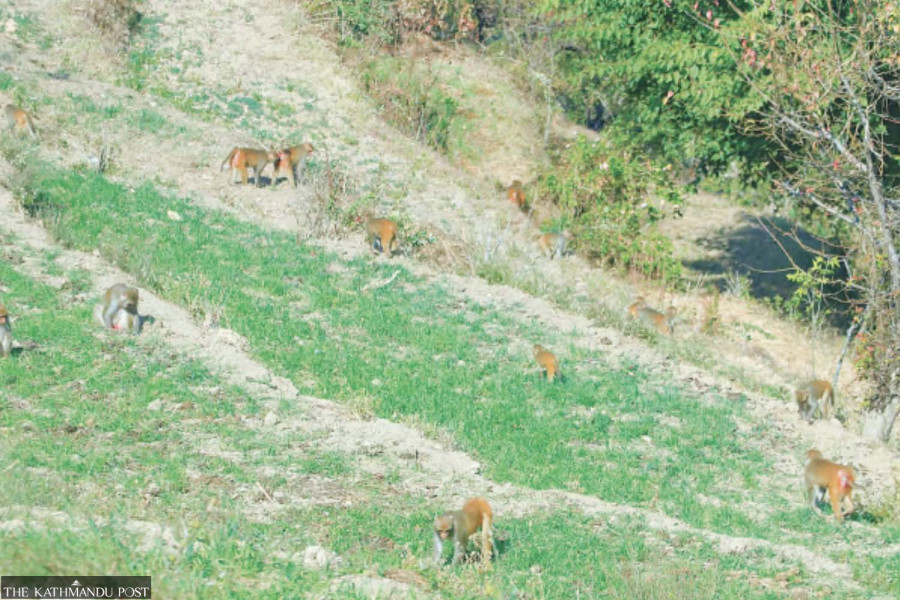
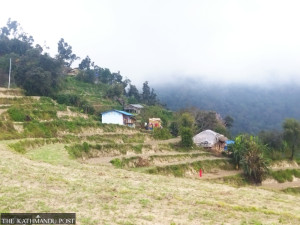
On Nepali side, farmlands lie abandoned, food stocks are raided, and entire settlements are gradually being emptied as people migrate for safety, livelihoods. Monkeys nibble and pick at plants on a terraced field in Dasharathchand Municipality in far-western Baitadi district in this recent photo. Post Photo
As monkey menace continues to devastate farms and force families to abandon villages in the far-western hills of Nepal, neighbouring India has moved ahead with a systematic sterilisation campaign to control the growing primate population. On the Nepali side of the Mahakali river, however, local people say there is still no concrete or coordinated plan to address the escalating crisis.
Across the border in Uttarakhand’s Pithoragarh district, Indian authorities have launched an extensive monkey sterilisation drive in response to rising complaints from rural communities regarding the monkey menace. The campaign targets long-term population control rather than temporary deterrence.
According to Indian officials, hundreds of monkeys have already been captured, sterilised and released back into their natural habitats to curb future population growth.
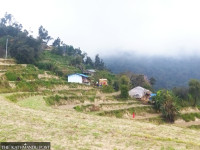
The locals of Dasharathchand Municipality in Baitadi, a hill district of Sudurpaschim province, which lies directly across the Mahakali river, complaints of monkey attacks have reached alarming levels.
Farmlands lie abandoned, food stocks are raided, and entire settlements are gradually being emptied as people migrate in search of safety and livelihoods.
“Monkeys have destroyed everything. It has been more than seven years since most families here stopped farming. Fields that once grew maize, wheat and vegetables are now overgrown with bushes," said Laxmi Nath, a resident of Dasharathchand.
The situation is particularly difficult in areas bordering India, including Jhulaghat and surrounding settlements. According to locals, monkeys regularly cross the river, raid homes and farms, and have become increasingly aggressive. “They now enter houses, break doors and take stored grain,” said Ghanashyam Bhatta of ward 5 of Dasharathchand Municipality. “Many families have already left the village because living here has become impossible due to the monkey menace.”
In neighbouring Pithoragarh district, the Indian government has adopted a systematic approach. According to Ranger Dinesh Joshi of the Pithoragarh Forest Office, more than 565 monkeys have been captured and sterilised so far. “The objective is to prevent uncontrolled population growth,” he said. “Sterilised monkeys are released back into their original habitats after treatment, ensuring long-term population control.”
The operation involves trapping monkeys using iron cages baited with fruit. Once captured, they are transported to the forest office for sterilisation and later returned to their original locations. Joshi said the method does not offer instant relief but would yield results over time by stabilising population growth. Indian authorities launched the programme after farmers began abandoning their fields and monkeys started entering homes in search of food.
The problem is the same, if not worse, on the Nepal side. “The problem reached a level where people felt unsafe in their own villages,” said Pramod Bhatta, chair of the Jhulaghat Traders’ Association. “Some residents were even injured while trying to chase monkeys away.”
Though Indian authorities have initiated the sterilisation drive to control the monkey menace, such institutional intervention is absent in Nepal. Although residents have repeatedly demanded action, no long-term plan has been implemented. Previous efforts were limited to short-term measures such as chasing monkeys with noise, firecrackers or catapults.
In some wards, the municipality even distributed sound-emitting devices, but the results were temporary. Deputy Mayor of Dasharathchand Municipality, Kauishila Chand, said the municipality had tried various measures. “We even hired guards and spent personal funds to drive monkeys away, but none of this provided a lasting solution,” she said. “We now need a long-term strategy, not temporary fixes.”
Although the municipality allocated a budget for monkey control in the current fiscal year of 2025-26, discussions on how to implement it have yet to begin.
According to Bhakta Raj Giri, chief of the Division Forest Office in Baitadi, the office currently has no dedicated programme to control monkey populations. He said that under existing guidelines, farmers can receive compensation of up to Rs10,000 for crop losses, but this does little to address the root problem.
As India advances with sterilisation as a long-term solution, residents and local leaders in Nepal are increasingly questioning the absence of a coordinated response. Without decisive action, they warn, more villages along the border could face abandonment, turning fertile land into empty forests.
People across the country, mainly in the rural parts, have been hugely affected by the monkey menace in recent years. The farmers are hit hardest by the problems. Various studies show that monkey menace is one of the leading causes of migration in the hilly region of Nepal.
Nepal is home to three species of monkeys—the Rhesus macaque (Macaca mulatta), the Assamese monkey (Macaca assamensis) and the Hanuman langur (Semnopithecus entellus).
Nepal is a signatory to the Convention on International Trade in Endangered Species of Wild Fauna and Flora (CITES), the global treaty that regulates trade in species under threat. That rhesus monkeys are listed in CITES means their international trade is restricted. It prohibits the export of wild animals and plants without government permission.
Similarly, the National Park and Wildlife Conservation Act also includes the rhesus monkey on the list of protected animals, thereby prohibiting its export without government permission. However, the act does not mention any measures for controlling protected animals that threaten people and agricultural production.




 16.79°C Kathmandu