Local efforts revive Dadeldhura’s famous but overlooked Alital lake
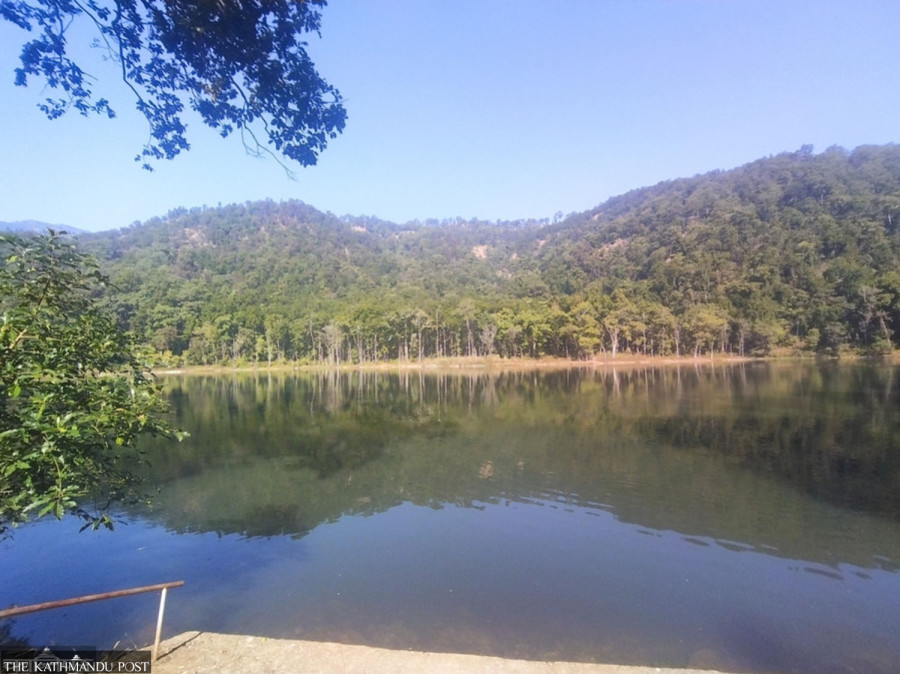
Careful conservation and improvements around the lake are turning it into a tourist stop that draws around 50-60 visitors daily. The Alital lake in Dadeldhura, pictured recently. The local government has allocated Rs9 million in the current fiscal year 2025-26 forreconstruction and additional infrastructure in the lake area. Post Photo
Once largely overlooked despite its natural beauty, Alital lake in Dadeldhura is gaining attention as a tourist attraction in Sudurpaschim Province. Due to sustained conservation, management, and infrastructure development efforts by the local government in recent years, the lake is gaining new life.
Located in ward 3 of Alital Rural Municipality, the lake is known for its tranquil environment, scenic beauty and biological diversity. With the rural municipality prioritising long-term conservation and tourism promotion, both domestic and external tourist arrivals have begun to rise steadily. The rural municipality itself takes its name from the lake, pointing to its cultural and geographic significance.
Alital lies in the inner Tarai region of Dadaldhura at an altitude of about 800 metres above sea level, at the foothills of the Mahabharat range. The lake functions as a natural confluence for water flowing down the Mahabharat hills. The lake stretches around 400 metres in length and 200 metres in width, with a maximum depth of 22 metres. Dense green forests and surrounding hills frame the lake, enhancing its beauty. It is located about three kilometres from Ghumti Bazaar along the Budar-Jogbudha road corridor.
According to the rural municipality, systematic initiatives including waste management around the lake, protection of the watershed area, greenery promotion and improvement of basic visitor infrastructure have gradually transformed the site as an attractive tourist destination. As a result, an estimated 50 to 60 visitors now reach Alital daily, a notable increase compared to previous years.
Sher Singh Parki, chairman of Alital Rural Municipality, said that the lake represents the identity of the local unit and holds immense tourism potential. “Alital is naturally beautiful and symbolises our municipality. In recent months, visitors from neighbouring local bodies have also started coming,” said Parki. “The lake is still in the development phase, but the momentum is encouraging.”
According to Parki, the rural municipality has allocated Rs 9 million in the current fiscal year 2025-26 for reconstruction and additional infrastructure in the lake area. Planned works include construction of a temple, a reinforced concrete wall for improved water outlet management, a landscaped park and aesthetic enhancement of the lake surroundings.
“We are also planning to build a managed vehicle parking area about 500 metres from the lake and create a picnic spot at the same location,” said Parki, adding that Alital is closely linked to religious belief and local mythology. Although five boats were once operated on the lake, services were suspended due to poor management and lack of proper place to moor boats.
“This time, we will arrange a proper boat parking area and purchase new boats to resume boating services,” he said, expressing hope that the initiative would further attract tourists.
According to him, the construction of Samaiji temple was completed last year at a cost of Rs2.5 million and is awaiting formal inauguration. A view tower has already been constructed, while the sky bridge has been developed with both tourism and religious considerations in mind.
Local people say they are happy with the conservation and promotional efforts of the local unit.
Gagan Singh Pun Magar, a local resident, said Alital looked vastly different just a few years ago. “Earlier, the lake area was unmanaged and neglected. Now, because of the rural municipality’s initiatives, structural improvements, cleanliness and temple construction, the entire landscape has changed,” said Magar. He suggested that installing lighting around the lake and setting up eateries would further boost tourism. For Magar, the surrounding forests, wildlife and peaceful environment are the main attractions of the lake.
Tilsari Saru Bohara, who spent her childhood in the Alital area and now lives in Lamki in Kailali district after her marriage, recently visited Alital and said she was struck by the visible transformation. “This is my maternal home area, and earlier the lake was used mainly for grazing cattle. Now, conservation and beautification efforts are clearly visible,” said Bohara. She said inadequate publicity had kept Alital in the shadows for years, but local government initiatives are finally giving the lake the recognition it deserves. She stressed the need to develop Alital systematically as a tourism hub.
Local people believe that by linking Alital’s lush forests with eco-tourism, homestays, observation points and religious tourism, the area could emerge as one of Dadeldhura’s major tourist destinations. According to them, maintaining a balance between conservation and development could help strengthen the local economy, generate employment and redefine the district’s tourism identity.
Local folklore about Alital’s origin further adds to its mystique. According to a legend, the lake was once fertile farmland where paddy was planted. A woman reportedly dreamt of an impending disaster and warned villagers not to go to the area and plant rice, but her warning went unheeded. During the plantation, it rained heavily, flooding the fields, eventually forming the lake.




 13.13°C Kathmandu