



 24.72°C Kathmandu

Sun, Oct 25, 2026
Sports
Nepal conclude ACC Women’s U19 Premier Cup on a high note
A dominant run with the bat and ball secures a third-place finish and Asia Cup qualification, leaving only a heartbreaking Super Over loss to mar an otherwise flawless campaign in Malaysia.
bookmark
Nayak Paudel
Published at : July 19, 2026
Updated at : July 19, 2026 07:39
Kathmandu
Keeping the one loss—that too in a Super Over—in six games aside, emerging Nepali players showed promise with a brilliant display of their skills at the ACC Women’s U19 Premier Cup in Malaysia.
Nepal concluded the tournament with a nine-wicket win over Indonesia on Saturday and finished third among 13 teams. They lost the chance to compete for the title after losing to the UAE in the Super Over in the semifinal played on Friday.
While finishing third was not what Nepal wanted, the youngsters are happy to have qualified for the U19 Asia Cup as one of the four semifinalists.
The Post takes a look at the major highlights, standout individual performances, and the statistics behind Nepal’s campaign:
Dominated the group
The 13 teams were divided into four groups—three of three teams each and one of four. Nepal were in Group D, which had four teams, alongside Qatar, Singapore and Hong Kong.
Nepal started the tournament with a 105-run win over Qatar on July 11. They then defeated Singapore by 151 runs on July 12 and Hong Kong by 181 runs on July 14.
With three wins in three games, Nepal topped the group and faced Japan in the quarterfinal stage on July 15. And a nine-wicket win over Japan saw Nepal book their semifinal encounter with the UAE.
Top order at its best
It is not often that Nepali fans witness a good partnership at the start, be it senior or underage, men’s or women’s. But it was in abundance in the Premier Cup.
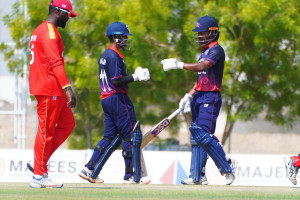
In the first match against Qatar, Nepali openers Sana Praveen and Sabitri Dhami built an 80-run partnership. As the two openers started well in the opening game, expectations were much higher in their second group-stage fixture against Singapore.
And Praveen and Dhami stood up to the expectations in style.
Praveen and Dhami played all 20 overs against Singapore, with other batters left waiting for their turn. Praveen fell short of two runs for a century and was not out at 98 off 70. Dhami, on the other hand, scored 78 off 53.
It is not easy to be consistent, especially for an opener. It seemed so when Praveen departed at 4 off 3 against Hong Kong.
Yet, Dhami, with a new partner in skipper Sony Pakhrin, built a 136-run partnership for the second wicket. Dhami scored 52 off 36 while Pakhrin departed at 90 off 60.
After batting first in all three group fixtures, Nepal batted second against Japan in the quarterfinal.
Nepal were chasing 87 runs for the win. Dhami (41 off 32), alongside Praveen and Pakhrin, who scored 18 runs each, helped Nepal defeat Japan by nine wickets.
However, Nepali batters could not do enough against the UAE in the semis. Bowling out the UAE for 100 runs in 19.5 overs, Nepal needed 101 runs to win in 120 deliveries. But the team could only tie the score as they got bundled out after a run-out on the last delivery.
The batters did not score much in the Super Over. Nepal lost two wickets—Pakhrin (2 off 3) and Anu Kadayat (2 off 1)—and had to leave the score at 6 runs in five balls. The UAE scored seven in three balls, won and advanced to the final.
Meanwhile, the batting prowess was again on display on Saturday as Praveen (25 off 39) stayed not out with Karuna Bista (16 off 24) to chase Indonesia’s 69-run target in 14.2 overs. Dhami got run out at 24 off 23.
Dhami was the top performer with the bat in the tournament. She became the leading run scorer with 255 runs, followed by Thailand’s Aphisara Suwanchonrathi (196 runs in four games), Praveen (189 runs in six games), UAE’s Lavanya Keny (139 runs in four games) and Bhutan’s Ngawang Choden (134 runs in three games).
Nepali bowlers keep opponents in check
Nepal’s top order indeed helped set up good targets while batting first. But they were still chaseable, and if it were not for the Nepali bowlers, the results would have been opposite.
Thanks to the bowlers, Nepal bundled out Qatar for 25 runs in 12 overs. Singapore batted all 20 overs while chasing 200 in the group stage, but could only manage 48/8.
Hong Kong were also 30/9 despite batting throughout the second innings while chasing 212.
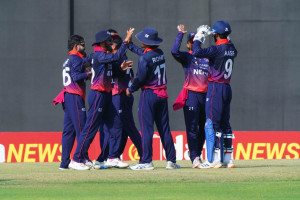
In the quarterfinal, Japan were bundled for 86 runs. It was also the brilliant bowling display from Nepal that had the UAE restricted to 100 runs in the semifinal.
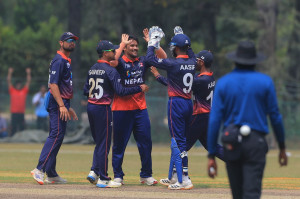
Manisha Upadhayay took a four-wicket haul against Indonesia on Saturday and became the leading wicket-taker of the tournament. Upadhayay bagged 12 wickets in six games.
Out of the five leading wicket-takers of the tournament, three were Nepali. Upadhayay was followed by Kuwait’s Angel Dcosta (11 wickets in four games), Nepal’s Riya Sharma and Anu Kadayat—both had 10 wickets in six games—and Thailand’s Kesinee Kaewjumphol (8 wickets in four games).
Nepal’s third-place fixture at the Bayuemas Cricket Oval in Kuala Lumpur was followed by the final between Thailand and the UAE. However, rain disrupted the game when UAE were 54/6 in 12.4 overs. The match, thus, ended without a result, and the trophy was shared between the two teams.
Nayak Paudel
Nayak Paudel covers sports for The Kathmandu Post. He previously worked at the Post (2018–19) and spent over five years at The Rising Nepal. His reporting spans crime, health, education, and social issues.





Most Read from Sports

Editor's Picks





E-PAPER | October 25, 2026

×