Congress completes conventions in over 6,000 wards in 73 districts
The first stage of the 15th general convention has brought thousands of women, youth and Dalits into local party structures. The party’s rival faction led by former chief Deuba is preparing for a parallel convention. Nepali Congress President Gagan Thapa waves the party flag while kicking off the ward convention on Saturday. Nepal Photo Library
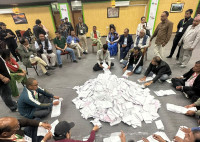
Ward conventions for the 15th General Convention of Nepali Congress concluded in over 6,000 wards across the country on Sunday. The process has advanced despite internal disputes over membership, representation and timing of the general convention.
According to the party’s central election committee, ward-level conventions were completed in 6,132 wards of 73 districts on Saturday and Sunday.
The conventions lay the groundwork for the leadership election process that will culminate in the party’s general convention, despite disputes over membership and divisions within the party.
The process has also brought thousands of women, youths and Dalits into the party’s local structures, reflecting representation requirements under the Congress statute and recent amendments to the party’s rules.
However, conventions in some wards have been postponed due to disputes, problems over active membership and the impact of floods and landslides, the party’s election committee said.
In some wards of Saptari, Morang, Rautahat, Sarlahi and Nawalparasi, conventions are still underway because of internal disputes and other issues.
Election committee member-secretary Raju Katuwal said conventions in the remaining wards would be completed before the scheduled local-level conventions on September 23, except in flood-hit Rasuwa. Nuwakot and Dhading are preparing to begin their ward conventions, while the process has been put on hold in Rasuwa for now.
Ward conventions are the first step in the Nepali Congress convention process. They elect ward committees and regional representatives. Those representatives then elect delegates to the House of Representatives constituency conventions, and those delegates become voters at the central general convention.
That makes participation at ward level crucial for anyone seeking to vote or contest at the party’s central convention. The party establishment faction has also changed the rules this time: the party president, office-bearers and central working committee members must first be elected as convention representatives through the lower-level process.
Previously, sitting central office-bearers and members would automatically become general convention representatives. More than 200 central leaders have therefore taken part in ward-level elections this time.
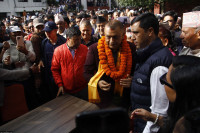
Party president Gagan Thapa became a regional representative from ward 30 of Kathmandu Metropolitan City. Vice President Bishwa Prakash Sharma was elected regional representative from Jhapa, while General Secretary Gururaj Ghimire and Pradeep Paudel were elected from Morang and Tanahun wards, respectively.
Ghimire claimed the ward conventions had progressed more positively than expected despite the party’s divisions. “The convention has been encouraging everywhere,” he said. “Even when there is no dispute in the party, there are occasional disagreements and confusion when conventions begin at the local level. This time, a small group, including the former president [Sher Bahadur Deuba], is outside the process. Given those difficulties, the turnout and enthusiasm are encouraging.”
The process also carries a significant representation requirement. The Congress statute requires women to make up at least one-third of the membership of party bodies from the ward to the central level. One of the two ward vice-president posts must be held by a woman.
Across the 6,743 wards, the party says at least 43,353 women will enter ward committees, including 6,743 women as vice-presidents. Amendments made after the Gen Z movement have also guaranteed representation for people below 30. At least 10,270 young people below 30 are expected to enter ward committees, while the statute guarantees at least one Dalit representative in every ward, producing a minimum of 6,743 Dalit representatives.
The composition varies according to the type of local government. Ward committees in rural municipalities have 18 members including the chair, while those in municipalities, sub-metropolitan cities and metropolitan cities have 20, 22 and 24 members respectively. The rules provide progressively higher numbers of women and young representatives in larger urban units.
The ward-level process, however, is taking place amid a deeper dispute over the legitimacy and timing of the 15th general convention. The Supreme Court’s decision to review its earlier ruling on the party’s special convention revived the dispute between the faction led by Thapa and dissidents led by Deuba, the former party president.
The Thapa-led Congress has scheduled its 15th general convention for October 2–5. The Deuba faction has announced a separate convention process, with its central gathering planned for December 7-9.
More than 40 leaders recently ditched the Deuba camp and joined the Thapa-led central working committee, dealing a major blow to the group preparing for a parallel convention. Deuba and some of his key supporters remain outside the process.
Deepak Kuikel, a leader of the Deuba faction, said his side had tried to avoid a split process but felt compelled to proceed after the establishment faction began its own conventions. “We tried our best to have a single convention, but after they started the process, we had no choice but to proceed as well,” said Kuikel.
The Congress now faces the challenge of completing the remaining lower-level conventions while keeping its rival factions within the broader organisational framework.




 25.89°C Kathmandu