RSP elects new leadership in convention marred by delays, rifts
Convention ends after six days with dwindled delegate numbers, leaked WhatsApp voting lists and open displays of divisions despite party’s anti-factional stance.
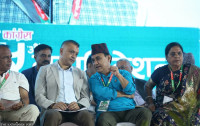
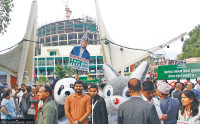
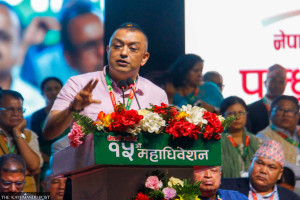
The Rastriya Swatantra Party (RSP) has elected its new leadership after a drawn-out national convention marked by logistical breakdowns, delayed proceedings and visible factional realignments.
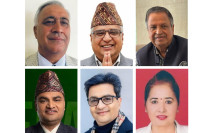
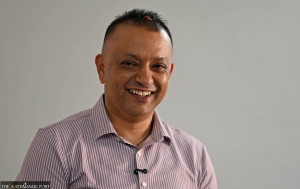
While party chair Rabi Lamichhane and vice-chair Swarnim Wagle were elected unopposed, contested races for key posts ended with Sobita Gautam winning the vice-chair position and Bipin Acharya securing the general secretary post.
Both Gautam and Acharya have been with the party since its formation. Gautam, who currently serves as Minister for Law, Justice and Parliamentary Affairs, has a background in social activism from her student years. Acharya, previously a joint general secretary, has worked closely with the leadership and led the party’s statute amendment committee.
In Friday’s voting, which combined electronic voting machines (EVMs) at the venue with online participation from diaspora delegates, Gautam secured 789 votes, defeating Toshima Karki, who received 572.
In the race for general secretary, Acharya won 673 votes. His closest rival, former spokesperson Manish Jha, secured 346 votes, followed by Ganesh Karki with 169 and Sagar Dhakal with 139.
For the two open joint general secretary positions, Asim Shah (471 votes) and Hari Dhakal (410 votes) were elected from a crowded field that included Ramesh Prasai, Achyut Mani Neupane, Sulav Kharel, Ashok Kumar Chaudhary, Milan Limbu, Pukar Bam, Rajeev Khatri, Bijay Jairu and Himesh Panta.
The reserved women’s joint general secretary post went to Nisha Dangi, who secured 727 votes, defeating Juli Yadav, Jamuna Sharma, Kamini Kumari Chaudhary and Rima Bishwakarma.
What was originally planned as a three-day convention stretched into six days, with repeated delays and procedural disruptions. By the time voting for office bearers concluded on Friday, only 1,289 delegates out of over 4,000 remained present to vote.
This contrasted sharply with the central committee elections held between Wednesday midnight and Thursday noon, when 2,959 delegates cast votes through EVMs.
Frequent changes to schedule, procedural confusion and rising accommodation costs led many delegates to leave Chitwan early, meaning the final leadership outcomes were decided by less than half of the initial delegate strength.
The general secretary race became the central point of intra-party contestation, initially drawing ten candidates: Kabindra Burlakoti, Pramod Neupane, Rajunath Pandey, Manish Jha, Jagdish Kharel, Ranju Darshana, Ganesh Karki, Ganesh Parajuli, Sagar Dhakal, and Bipin Acharya.
As delays mounted, efforts were made to forge consensus and avoid elections. While some candidates withdrew, a full agreement did not materialise. On Thursday evening, Foreign Minister Shisir Khanal also withdrew from the race in an attempt to support consensus-building.
When negotiations stalled, an informal grouping of leaders moved to consolidate support. On Friday, Kabindra Burlakoti, Pramod Neupane, Ganesh Parajuli and Jagdish Kharel jointly withdrew and announced their support for Acharya. Foreign Minister Khanal also backed him.
Although senior leaders had repeatedly said the RSP would avoid factional alignments, remarks made during the announcement of the withdrawal publicly exposed internal grouping. Ganesh Parajuli said delegates wanted the “establishment camp to stand together so votes would not be split”, adding that they had agreed to back Acharya.
The open reference to an “establishment faction” triggered criticism within the party. Manish Jha, who remained in the contest, said such coordination contradicted the party’s founding principles.
He also recalled a late-night meeting in which party chair Lamichhane and leader Wagle urged him to step aside for consensus. Jha said consensus should not always require one-sided withdrawal and argued that all candidates deserved a fair opportunity to compete.
Following his election, Acharya issued a clarification over remarks made about the “establishment” camp. He said all participants of the convention collectively represented the establishment and that there was no intent to alienate anyone.
Leaked WhatsApp lists and internal tensions
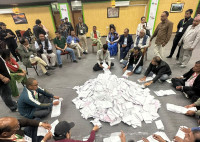
Separate controversy emerged during the central committee elections when delegates received a leaked WhatsApp list containing 56 preferred candidates, circulated from anonymous numbers shortly after voting began.
A senior party leader said most names on the list were associated with individuals who had joined the RSP from Prime Minister Balendra Shah’s camp. The leak sparked immediate protests among delegates.
An RSP lawmaker told Kantipur that the party was beginning to mirror factional practices seen in old guard parties such as the CPN-UML and Nepali Congress.
“The party must investigate this properly. We cannot ignore attempts to influence or discredit the process,” the lawmaker said, speaking on condition of anonymity.
Candidates also raised concerns about the sequencing and indexing of numbers on the EVM system, saying it created confusion during voting.
Despite internal friction, the election commission completed the process with the inclusion of overseas votes. Commission chief Bhuwan KC said diaspora delegates used the party’s mobile application to vote in both the central committee and executive elections.
Under recent statute amendments, the RSP has expanded its executive structure from 12 to 19 positions. The leadership now includes one chair, one senior leader, three vice-chairs (including one reserved for women and one nominated), two general secretaries (one nominated), five joint general secretaries (including one woman and two nominated), one spokesperson, three joint spokespersons (including one woman), one treasurer and two joint treasurers (including one woman).
Party insiders said the increase in nominated positions was intended to accommodate leaders from Prime Minister Balendra Shah’s camp, with Sunil Lamsal tipped for a nominated vice-chair role and Bhoop Dev Shah for a nominated general secretary position.
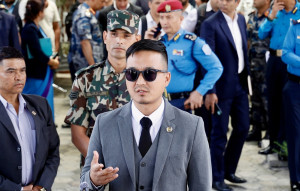
Of the 26 individuals who initially joined the RSP from Shah’s camp following a pre-election understanding with Rabi Lamichhane, 16 did not contest the central committee elections. Several prominent figures, including Sunil Lamsal, Bhoop Dev Shah, Laxman Tharu, Ramesh Paudyal, Santosh Giri, Sarita Gyawali, James Karki and Laxmi Bardewa, stayed out of the race. Home Minister Sudan Gurung, elected to Parliament on an RSP ticket, also did not contest.
Despite organisational turbulence, the convention adopted the party’s ideological direction, with Chairman Lamichhane announcing that the RSP’s guiding ideology will be “social democracy”.
He said the earlier concept of “constitutional socialism” was being replaced as party doctrine, arguing that the Constitution should be viewed as an evolving document rather than a fixed ideological framework. He stressed that this did not imply rejection of the Constitution.
The party’s manifesto also proposes converting the National Assembly into a non-partisan house of experts and making the country’s Vice-President its ex-officio chair. It further supports a directly elected executive head.
However, execution of the convention itself drew criticism. The event, held in 36-degree heat, faced repeated delays, poor logistical arrangements and errors in delegate registration. Suspended members were found on the voting list, while several sitting MPs were missing from it.
Voting processes were also slow due to manual verification before digitisation. Delegates queued for hours to complete registration, leading to protests at the venue. Prime Minister Shah left for Kathmandu before voting began, citing frustration over delays.
Internal democracy was also questioned after the political report was passed by acclamation, with only a brief round of applause, rather than structured debate. Critics said the process resembled the top-down practices the party often criticises.
Analysts said the convention exposed a gap between the party’s reformist image and its organisational reality. Rabi Lamichhane acknowledged administrative shortcomings after being re-elected chair, attributing them to inexperience and promising improvements in future conventions.




 20.51°C Kathmandu