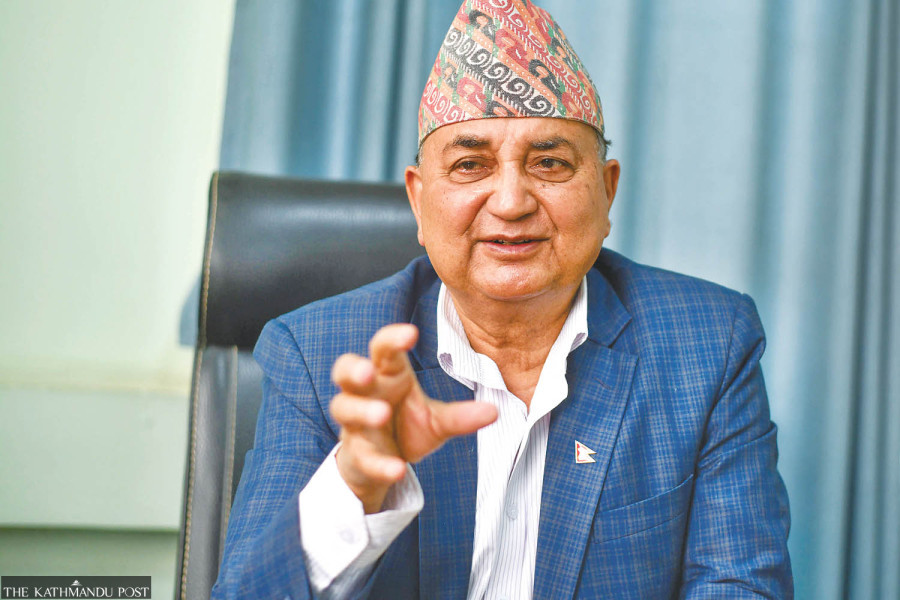
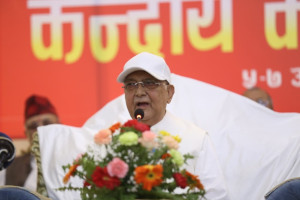
Rival Ishwar Pokhrel camp accuses party chief KP Oli of stifling internal democracy and centralising power. Ishwar Pokhrel, senior vice-chairman of the CPN-UML Post file photo
Finally, there has been a formal acknowledgement in the CPN-UML of the legitimate demands raised by the Gen Z protestors. Until now, the second biggest party in the recently dissolved lower house, and especially its chair KP Sharma Oli, had been dismissing the protests as nothing but anarchy.
The UML dissidents led by the party’s senior vice-chair Ishwar Pokhrel on Monday made public a ‘concept paper’ countering party chair Oli’s characterisation of the Gen Z movement as a regression.
After making the paper public, they registered it at the party head office, calling for structural reforms to safeguard intra-party democracy.
The dissident faction opposed Oli’s view on the Gen Z uprising as Pokhrel prepares to contest for party chair, challenging Oli, who is itching for a third term. The UML is electing its new leadership from the 11th general convention, scheduled for December 13-15 in Kathmandu.
A group of senior leaders from the Pokhrel faction handed over the concept paper to party general secretary Shankar Pokhrel at the UML head office in Chyasal.
The paper has concluded that constitutionally, the Gen Z uprising of early September cannot be considered a regression. Rather, it was an expression of public despair and anger stemming from the state’s failure to deliver, persistent frustration with disorder and lawlessness, and political opportunism.
The Pokhrel camp’s interpretation of the Gen Z movement is in stark contrast to that of Oli and his loyalists. The Gen Z revolt that erupted on September 8 had ousted the Oli-led UML-Congress government on September 9.
The Oli faction describes the Gen Z movement as a regression and also claims external factors’ role in the protests without providing categorical proof.
Pokhrel’s concept paper admits that protests on September 9 were destructive. “That unruly behaviour has left a deep scar on our collective psyche and in our history,” it says. “After this movement and the destructive attacks, two types of extremist schools of thought have surfaced.”
“One extremist narrative places the entire blame on the then prime minister and UML chair KP Sharma Oli, and also includes comments targeting major political parties and leaders, such as the CPN-UML and the Nepali Congress,” the concept papers reads. “They have stated things like: political parties have done nothing; nothing has happened in the country; all political leaders are corrupt and alike; even Parliament, the supreme institution for exercising the people’s sovereignty, has become meaningless.”
It states that by exploiting the leaders’ weaknesses, this narrative is trying to undermine the constitution and the system. “Weakening of our constitutional system also weakens Nepal’s independence, sovereignty, national unity, and dignity. This school of thought represents extremism against our nation, constitution, and political system,” it says.
But the paper also describes the party establishment’s narrative as an extremist one.
It admits that claiming “everything we did was right, our economic indicators were gradually improving and physical infrastructure was being built rapidly” was not realistic. “Claiming that all the achievements today were the result of our actions is therefore misleading and simplistic,” the paper further states.
The paper says that without critically reviewing the current situation and historical reality, it is impossible to chart a right path for the future.
“Claiming ‘everything we did was right’ is not stability but the beginning of decline. The incident of September 8 and 9 should be evaluated objectively and factually, and legal action must be taken against those found guilty,” the concept paper demands.
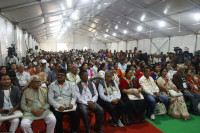
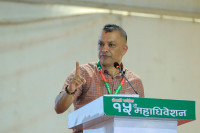
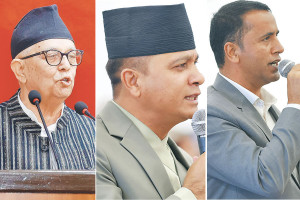
During the Monday event, UML Vice-chair SurendraPandey alleged that party chief Oli’s leadership is fostering individualism in the party.
Pandey claimed that there is an attempt to turn the UML into an “individual-centric organisation,” dependent on the decisions of a few individuals. He stressed that substantive reforms have become essential to safeguard internal democracy.
“This democratic party is being transformed into an individualistic one,” Pandey said. “This practice is contributing to the narrowing of the UML public base.”
According to him, such trends have reduced the party’s appeal among the younger generations. “The new generation can see it too. Why would they join a party where there are no fair elections, where they cannot compete, where lists are imposed from the top,” Pandey said while bringing up the leadership selection process during the 1oth general convention held in November 2021.
Pandey argued that imposing a two-term limit on the party chair has become essential in order to make the UML more competitive and democratic.
Not only Pandey, Karna Thapa, who was once a trusted lieutenant of Oli, also lambasted the party chief.
Thapa criticised Oli for his working style as party chief, adding that the party cannot progress under Oli’s leadership in the changed political context.
Thapa appreciated Oli for his role in the party’s democratisation during the 7th general convention held in Janakpur, noting that the party held the 8th and 9th general convention in line with the same principles.
“However, during the 10th general convention he instructed delegates to select the leaders in line with his directive, which itself was a breach of the party discipline which he once fought to establish,” Thapa said.
He said the goal was to create a situation where they can debate issues openly, and that has not been possible under Oli. That made them fight for a leadership change, according to him.
“There was a lack of proper representation in the decision-making process. For example, the First National Statute Convention had decided that provincial chairs would be ex-offico members of the central committee. However, later they were even made the politburo members based on favouritism,” Thapa said.




 20.85°C Kathmandu