



 12.97°C Kathmandu
Sun, Oct 11, 2026
Politics
A total of 120 parties seek to contest March 5 elections
Over a third of parties are new and registered after September protests.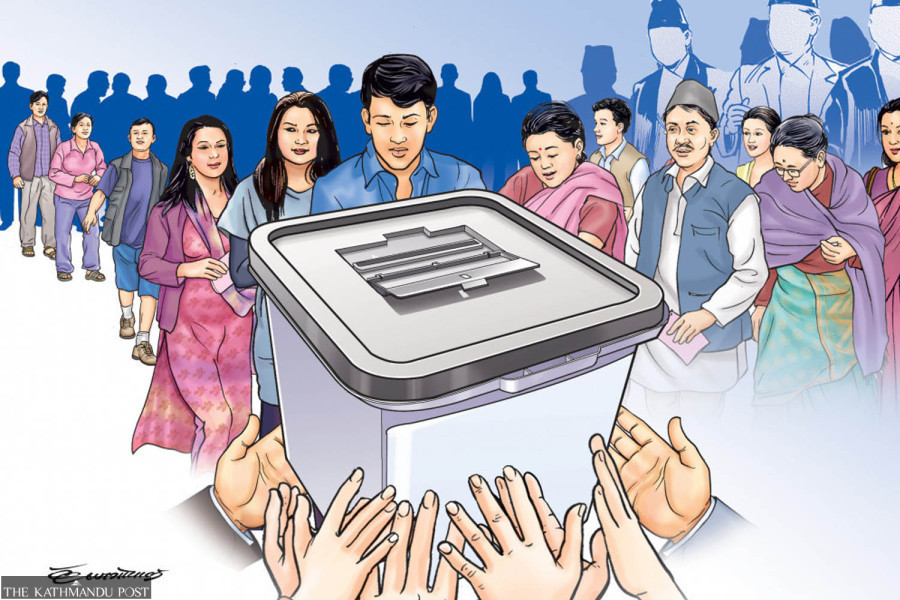
bookmark
Binod Ghimire
Published at : December 1, 2025
Updated at : December 1, 2025 06:43
Kathmandu
A record number of political parties are contesting the midterm elections for the House of Representatives scheduled for March 5.
As the registration deadline ended on Sunday, 120 political parties applied with the Election Commission to contest the polls three months away. Of the 143 parties registered, 23 did not aspire to try their luck in the elections that are being held after Gen Z protests toppled then KP Sharma Oli government and subsequently led to the dissolution of the lower house.
The commission first called on political forces to be registered as parties and then asked them to apply to contest the March 5 elections.
“A record number of political parties have applied to contest the March 5 elections,” said Yagya Bhattarai, chief of the legal and political party department at the commission, adding the final tally might change slightly after the final verification. A total of 86 parties were in the race to contest the November 2022 elections even though 116 parties were registered with the commission.
The commission’s records show that all 14 parties represented in the dissolved lower house are contesting the upcoming elections, though several have merged and others have fractured since. Notably, more than a third of the parties entering the race were registered in the aftermath of the September protests.
Those taking part in the upcoming elections by forming parties are Gen Z leaders, businessmen, lawyers, lawmakers of the dissolved House of Representatives, and social activists, among others. The Gatisheel Loktantrik Party led by Dinesh Prasai, a professor of sociology, and backed by Buddha Air boss Birendra Basnet, was among the first to get registered.
Ujyalo Nepal Party of Anup Upadhyay, supported by Energy Minister Kulman Ghising, and Dalit rights activist Khagendra Sunar’s Hamro Party Nepal are other parties that have emerged as new players. These two parties are contesting under a single electoral symbol.
The Nawa Nirman Party led by Kishori Karki, a Gen Z activist, Hira Prasad Seti’s Rastriya Gen Z Party Nepal and advocate Raman Karna’s Janadesh Party, which have some Gen Z leaders as members, too have got permission for the elections.
Likewise, the Swabhiman Party led by Satyawan Kumar Singh, the Nagarik Unmukti Party Nepal led by Kabir Sob and backed by Tharu activist Resham Chaudhary, and the Rastriya Pariwatran Party Nepal led by Rajesh Portel too are the new forces challenging the old parties. The Rashtra Nirman Dal Nepal led by Akbar Khan, the Nagarik Bachau Dal, led by Madhav Prasad Khatiwada, a personal aide to Durga Prasai, are also in the race.
Political analysts see both the upsides and potential pitfalls of having so many parties contesting.
Chandra Dev Bhatta, a political analyst, says the registration of a large number of parties portrays the country as having a democratic space. There is a frustration with the old parties, and people are looking for promising new forces. However, except for a few, most parties do not have a clear vision as to why they are in politics, he says.
“Unlike in the past, the new parties can make their space even if they don’t have strong political ideology. Yet, people are looking for a vision for economic prosperity and reforms rather than core political ideology. We see more of short-term programmatic agendas aimed at immediately appealing to people than the long-term political ideology,” he said. “Whichever party has such an agenda and youths in leadership could fare better.”
Bhatta, however, fears that with more parties in the race, the country could face greater political instability, with leaders focused more on making and unmaking governments.
But other political analysts argue that instability arising from a hung parliament stems more from a weak political culture than from the number of parties. They say that if parties are sincere, coalition politics can still produce stable governments.
“Look at India, where Narendra Modi’s government is backed by more than a dozen parties. His predecessors from the Indian National Congress also completed full terms while leading a coalition government. Why can’t the same happen in Nepal?” said Sanjeev Humagain, who teaches PhD-level courses at Tribhuvan University and Nepal Open University.
Binod Ghimire
Binod Ghimire covers parliamentary affairs and human rights for The Kathmandu Post. Since joining the Post in 2010, he has reported primarily on social issues, focusing on education and transitional justice.

Most Read from Politics
Home Minister Sudan Gurung to visit India next week
Nepal’s climate diplomacy faces a test of delivery
Uproar in Nepal parliament over former chief justice’s unexplained detention
From the Himalayas to the islands, Nepal calls for a united climate response
Gagan Thapa wins Congress presidency with 94 percent of the vote
Editor's Picks

Constitutional Bench caught in seniority, ‘pick and choose’ dispute

A Dom boy’s long road to becoming a doctor

From blankets to handmade dolls, two foreign women bring comfort to flood survivors

News Analysis: When institutional defence exposes institutional fault lines

It’s a bird … it’s a plane … it’s the Indian ambassador’s farewell tweets
E-PAPER | October 11, 2026

×