RSP will have to navigate a maze of foreign policy challenges
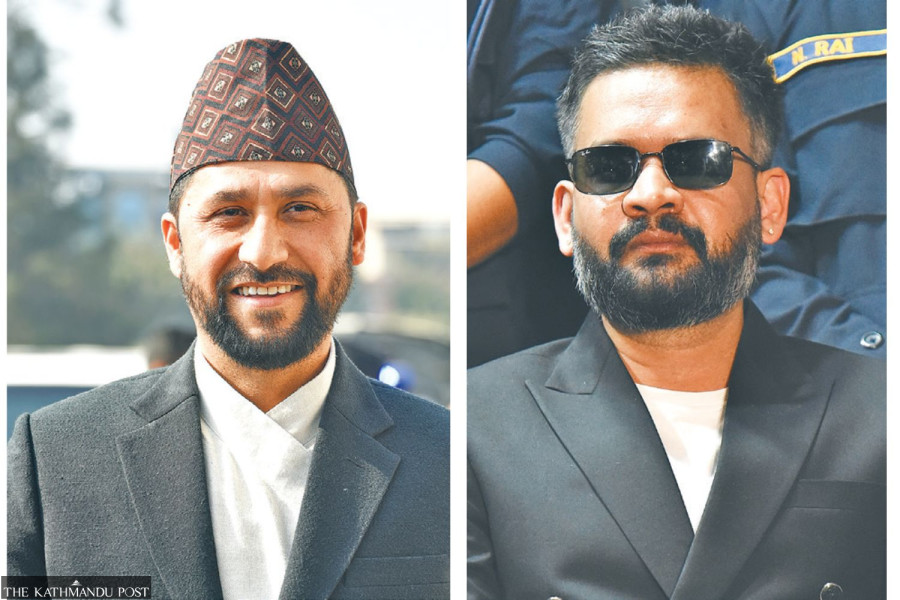
Balancing ties with India, China and the United States, and adapting to global shifts will test the Rastriya Swatantra Party’s promise of development diplomacy, say experts. Rastriya Swatantra Party leaders Rabi Lamichhane and Balendra Shah. Post File Photos
If things go as planned, the Rastriya Swatantra Party (RSP) will form a majority government within two weeks.
Even before the government takes office, there is widespread curiosity, both in and outside the country, about what kind of foreign policy it will adopt, at a time when the new government faces a myriad of challenges.
The party’s president, Rabi Lamichhane, has pledged a “balanced and independent” foreign policy and a focus on “development diplomacy”.
Former foreign ministers and foreign policy observers say the new government will face a number of foreign policy challenges that require careful handling. The incoming leaders are relatively inexperienced, lack maturity, and need guidance in governance and parliamentary proceedings, according to a former foreign minister.
“So, they have to be cautious in dealing with the external partners and stakeholders. Relations among the US, India, China have totally changed in the past year. But the new government cannot afford to destabilise Nepal’s foreign policy or attempt a reset. Priorities may change, but foreign policy itself remains constant,” the former foreign minister told the Post.
After the March 5 parliamentary elections, RSP chief Lamichhane stated that the government formed under his party’s leadership would strictly follow a non-aligned foreign policy focused on development diplomacy.
On March 7, speaking at a gathering in Chitwan, Lamichhane, after being elected from Chitwan-2 constituency for the third time, stated that the party will stay firmly committed to a balanced foreign policy based on mutual respect.
If the ongoing war in West Asia continues, the new government will face a Herculean task of rescuing over two million citizens while managing an energy crisis, inflation, and other domestic issues.
The government will also need to address several longstanding issues with both India and China, at a time when relations with these neighbors are far from satisfactory.
With India, the government must handle border disputes, security challenges, development cooperation, water resources, and issues of economic assistance. With China, priorities include implementing the Belt and Road Initiative (BRI), clarifying Nepal’s participation in various China-led initiatives like Global Security Initiative, Global Civilization Initiative, Global Development Initiative and Global Governance Initiative, and regaining Beijing’s trust, which has been missing since the fall of Oli government last September. The new government has to shoulder the responsibility of implementing several past accords and agreements with both neighbors.
One big challenge the new government faces is handling the US Millennium Challenge Corporation compact, a $747 initiative (with $550 million put in by the US and $197 million by Nepal), while also trying to secure more US investment and assistance.
In a recent interview with BBC Nepali Service, Shishir Khanal, head of the RSP’s international department, said Nepal’s foreign policy will continue to be guided by the constitutional principle of non-alignment and there will be no big policy shifts.
The party’s manifesto commits to pursuing balanced and dynamic diplomacy. Khanal stated that the RSP places high importance on Nepal’s relations with immediate neighbours, India and China. He stressed the importance of centuries-old cultural, social, and economic ties with India, and of upholding the One China policy, while also seeking to benefit from the northern neighbour’s economic progress.
Regarding BRI projects, Khanal said no concrete decisions have been made. Future decisions will be based on project-specific assessments, including investment models and social and economic impact analyses, in line with Nepal’s development needs, he said in the interview.
“We should not forget that Nepal is located in a sensitive region with rich natural resources,” said former foreign minister Rameshnath Pandey.
“Handling our relations with neighbouring countries requires more sensitivity than in the past as our relations with the two have been cold for a long time.”
He said the two neighbours are also confused about the final voice in Nepal’s foreign policy conduct. Our foreign policy should be free from preconceived notions, Pandey told the Post on Thursday.
“While dealing with India, China and the US, we have to be mindful of their concerns and sensitivities. Most importantly, the new government should have one voice while conducting foreign policy and international relations,” he said.
He also listed out a range of other foreign policy challenges that the new government will confront over the next five years: Nepal’s engagement with Saarc and Bimstec; the growing irrelevance of Saarc and a decade of Nepal’s chairmanship; engagement within Saarc nations; the daily crisis that Nepali migrant workers are confronting in the Gulf, Malaysia and other destinations; leveraging the resources of the Nepali diaspora; Nepal’s engagement in multilateral forums; strengthening the foreign ministry and Nepali missions; conducting economic diplomacy and development diplomacy; engagement with key UN agencies; addressing climate justice; and restoring Nepal’s profile in global arena.
Retired Nepali Army General Binoj Basnyat said Nepal’s foreign policy is entering a complex phase amid a changing regional and global geopolitical environment. Nepal’s geographic location between two major powers—India and China—combined with global strategic shifts, creates both risks and opportunities, he told the Post.
“Maintaining equidistant diplomacy without getting drawn into the strategic competition between India and China is very important.”
Nepal must avoid the perception that it aligns too closely with one side, which could threaten its sovereignty or invite political pressure, he said.
“Navigating global power shifts—with the US and the Western rivals at our borders, and multilateral institutions increasingly active in Nepal and South Asia, especially around development, trade, and climate issues, calls for careful diplomatic calibration and strategic clarity,” Basnyat said.
The RSP, in its manifesto, has stated that it will transform Nepal from a “buffer state” to a “vibrant bridge” through tripartite economic partnership and connectivity with both neighbours. It said it will adopt a policy of balanced and dynamic diplomacy to turn shifting global geopolitics and the rise of neighbouring powers into concrete opportunities for national development.
The new government will also be tasked with implementing the diplomatic code of conduct, reviewing the number of embassies, ensuring smooth distribution of passports, and providing effective consular service.
Pragya Ghimire, board member at the Institute of Foreign Affairs, says balancing the two giant neighbours, maintaining trust, credibility, and taking them into confidence, is a crucial challenge for the new government.
According to Ghimire, Nepal should stay away from any security blocs or new military, defence, or security agreements aligning with one power against another. The safety and security of Nepali migrant workers should be mainstreamed in Nepal’s foreign policy agenda, she says.
Observers and experts also suggest that building political consensus on foreign policy among Nepal’s major political parties is a challenge, given their past alignments with one bloc versus another.
Former Minister Pandey calls for measures to repair foreign policy and restore trust with both neighbours.
Similarly, General Basnyat says Nepal should also pursue climate, energy and resources diplomacy while managing domestic expectations.
Anil Giri is a Chief Sub Editor covering diplomacy, international relations and national politics for The Kathmandu Post. Giri has been working as a journalist for more than two decades, contributing to numerous national and international media outlets.




 14.81°C Kathmandu