After poll rout, Congress and UML chiefs face calls to step down
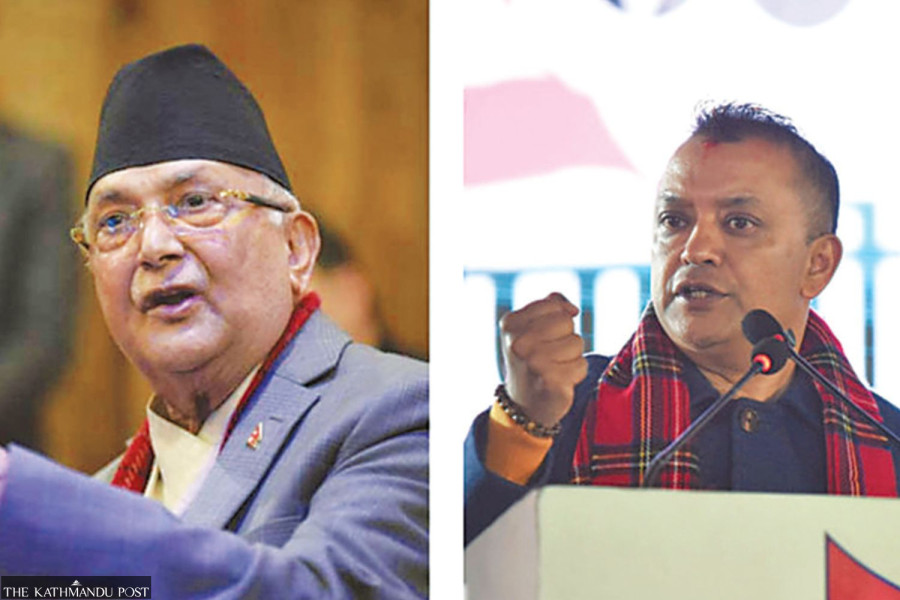
Nepali Congress has called a central committee meeting to review election results, but CPN-UML is still undecided on formal assessment. UML chair KP Sharma Oli (left), and Nepali Congress chief Gagan Thapa. Post File Photos
After Nepali Congress leaders demanded their party leadership step down following the party's debacle in the March 5 snap parliamentary elections, CPN-UML leaders are also facing internal pressure to do the same.
The strengths of the two largest parties from the dissolved parliament have been reduced to around one-third in the snap elections, which followed September’s anti-corruption Gen Z movement that toppled the UML-Congress coalition government led by KP Sharma Oli. As the Election Commission prepares to announce the final results, the pro-Gen Z Rastriya Swatantra Party (RSP) is set to claim 182 seats. This includes 57 under the proportional representation (PR) category and leaves the party just two seats short of a two-thirds majority in the 275-member parliament.
One of the key demands of the Gen Z uprising was generational change within political parties. In January this year, the Congress held a special convention, which elected Gagan Kumar Thapa as party president despite strong dissenting voices within the party.
Although the Gen Z movement forced UML chief Oli from power, he was re-elected chair of the UML at the party’s 11th general convention in November.
As the two parties went into the elections, both Thapa and Oli were projected as their respective prime ministerial candidates. However, both leaders suffered bruising defeats in their constituencies, and their parties performed dismally. This has led to discussions about possible replacements.
Earlier, when Thapa had expressed his intention to resign following the party’s poor performance, party vice-president Bishwa Prakash Sharma advised him not to step down. Sharma argued that the party’s defeat could not be attributed to Thapa alone, so there was no need for him to resign immediately.
The Congress is preparing to call its central working committee meeting in the next few days to review the election results. According to party spokesperson Devaraj Chalise, who is also close to Thapa, the meeting is expected to decide whether Thapa should resign.
“The upcoming central committee meeting will decide Thapa’s fate,” Chalise said.
However, leaders of the Congress faction loyal to former party chief Sher Bahadur Deuba, who vehemently opposed the special convention, argue that Thapa should step down following the party’s disappointing performance.
Krishna Sitaula, a Deuba loyalist and a member of the National Assembly, said on Wednesday that the humiliating loss in the elections would be discussed in the party.
At the same time, a case related to the party’s special convention, filed by the Deuba faction, which claims it was illegal, is sub judice at the Supreme Court.
Like Congress, dissidents within the UML have also begun discussing alternatives to party chair Oli. After the Gen Z movement, efforts to remove Oli from party leadership were not endorsed at the UML general convention, and the party subsequently went into the election under his leadership.
UML Deputy General Secretary Yogesh Bhattarai has suggested that Oli step down, warning the party could face unexpected consequences if he continues.
“Our party can not function the way it has been. It demands a serious review, and that review could even concern the party leadership,” Bhattarai told the Post. “We will have a serious discussion on this matter.”
He cited Madhav Kumar Nepal’s resignation from party chief after the UML’s poor performance in the 2008 Constituent Assembly elections as an example for Oli. Nepal had relinquished power, taking moral responsibility for the defeat.
In the 2008 elections, UML was squeezed into third position, behind the then CPN (Maoist) and the Congress. That performance, however, was stronger than the party’s showing in the March 5 elections. Even as dissident voices are growing against Oli, the party arithmetic is still in his favour.
The party’s 11th general convention held last November is strong evidence that Oli has a firm hold on the party's central committee and secretariat members. Deputy General Secretary Bhattarai argues that fractionalism within the party will emerge in the aftermath of the elections. He also suggested that party leaders who earlier supported Oli during the general convention may turn against him if he does not step down from leadership.
Complementing his claim, Bishnu Paudel, the party's vice-chair and a staunch supporter of Oli, has also hinted at opposing Oli’s continuation.
In his written address after facing a humiliating loss to RSP candidate Sulabh Kharel, Paudel said he would initiate a restructuring of the policies, leadership, organisation, and working style of the UML in accordance with public aspirations.
“I express my commitment to undertake a serious review of the mistakes and shortcomings on our part in the past, to transform ourselves in line with the expectations of the people, and to take the initiative in restructuring the policies, leadership, organisation, and working style of UML,” he stated.
However, not every leader shares Paudel and Bhattarai’s views.
Raghubir Mahasheth, another deputy general secretary, believes that Oli should not step down.
“I don’t think the party chair should step down from his position over the party's defeat in the recent elections,” Mahasheth told the Post.
On Thursday, Oli took to Facebook to thank the public for their support of the party and accepted the election results, though he said the outcome fell below his expectations. He has not indicated any intention of stepping down as party chair.
Left-leaning political analyst Jhalak Subedi believes that it is easier said than done to remove Oli from the party leadership given the current party structure. Subedi also says that though Oli should not be forced out of party leadership on moral grounds, his replacement, however, is necessary to reinvigorate the party.
“Unless Oli steps down, be it voluntarily or forcibly, this agenda will keep floating within UML,” he said.




 20.58°C Kathmandu