As rift grows between Communist Party co-chairs, Dahal holds a meeting with Congress chief Deuba
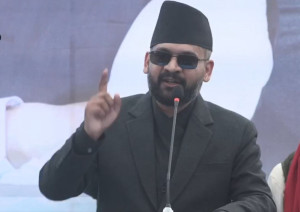
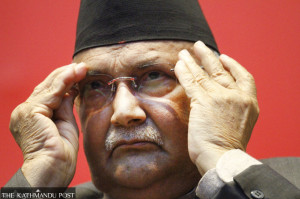
Dahal and Deuba’s closed door meeting comes amid widespread speculation of a growing trust deficit between Dahal and party Co-chair KP Sharma Oli Post File Photo
With mistrust between the two co-chairs of the ruling Nepal Communist Party growing, Pushpa Kamal Dahal held a closed-door meeting with Nepali Congress President Sher Bahadur Deuba on Thursday.
Multiple leaders from the Nepali Congress and the Nepal Communist Party (NCP) confirmed to the Post that the meeting had happened, but stopped short of providing details.
“I can share that latest political developments figured in the meeting,” said Bishwo Prakash Sharma, spokesperson for the Congress party. “But even we have yet to be briefed [by Deuba] about the meeting.”
Though Co-chairs KP Sharma Oli and Dahal had promised to steer the unified communist party—born in May last year after a merger between the CPN-UML and the Maoist party—as “two co-pilots”, a rift recently began to grow between the two leaders, with Dahal making remarks increasingly about an agreement he had reached with Oli.
The agreement signed between the two leaders says that they will head the government in turn—two-and-a-half years each. If the agreement is anything to go by, Oli’s time as prime minister is only more than a year.
With Dahal making statements concerning Oli, former UML leaders too have raised the issue of the party’s political ideology, making a pitch for adopting “people’s multiparty democracy”. Former Maoist leaders, however, have been demanding that the party should first make public the political document that was drafted when the two parties announced their merger.
The former Maoists, who had adopted “21st-century people’s democracy” as their political line, say the unified party should opt for “people’s democracy” as a compromise.
These internal issues are signs of a growing rift between the two party leaders and their respective factions, say party leaders.
Furthering suspicions, Deuba on Friday, a day after his meeting with Dahal, told a programme organised by local-level employees affiliated with the Congress party that the Oli government could potentially “fall”.
“We have been constantly fighting for democracy,” said Deuba at the programme. “We overthrew the Ranas, the Panchayat system and the monarchy. If need be, we could unseat the Oli government as well.”
Party leaders, however, were quick to characterise Deuba’s statement as a bit too far-fetched, even though it might have meaning as it came a day after his meeting with Dahal.
Former Maoist members in the ruling party say that Dahal’s concerns are increasingly growing, as he does not have a defined role in the party.
While Oli has not shown any signs of upholding the agreement he reached with Dahal regarding a rotating turn at the helm of government in turn, he has also not let Dahal chair party meetings.
Former Maoist leaders say that unification between the two parties should’ve meant equal status for Oli and Dahal, with one running the government and the other leading the party.
The arrangement was supposed to be in place until the unity convention, and according to the party’s interim statute, it should take place within May next year.
“It was not that the Maoist Centre dissolved into the UML; it was a unification,” said Hemraj Bhandari, a former Maoist leader, who is a central committee member in the ruling communist party. “It was a unification of two parties that had separate identities. Problems will continue if one of the parties refuses to follow the spirit of unification.”
Anil Giri is a Chief Sub Editor covering diplomacy, international relations and national politics for The Kathmandu Post. Giri has been working as a journalist for more than two decades, contributing to numerous national and international media outlets.




 14.24°C Kathmandu