Notorious killer elephant tracked again after fatal attacks in Chitwan
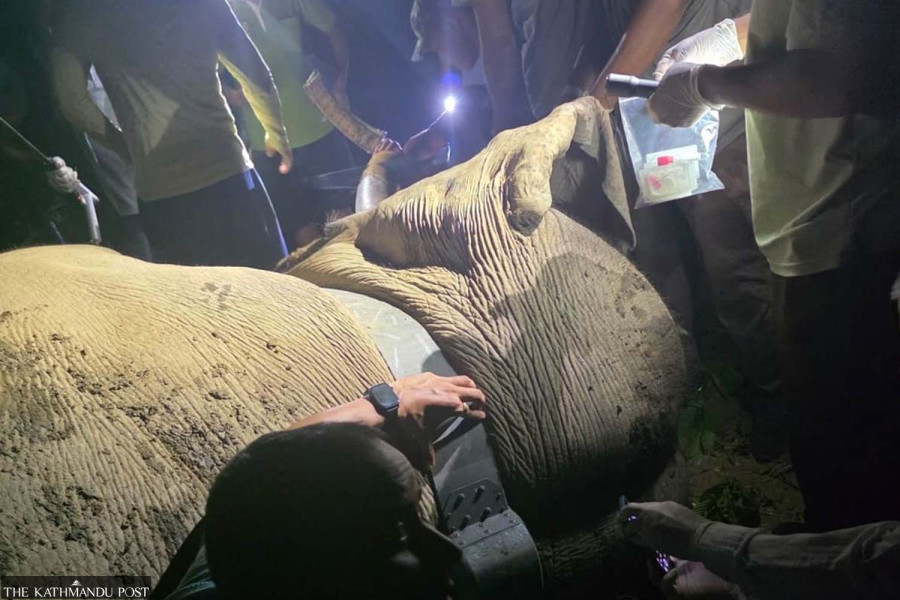
Wildlife officials dart and fit satellite collar on wild bull elephant ‘Dhurbe’ after a 10-day search, hoping to prevent further deadly encounters with people. Ramesh Kumar Paudel/TKP
Wildlife authorities have located and fitted a satellite tracking collar on a notorious wild elephant responsible for at least 25 human deaths, days after it killed a woman and her young son in southern Nepal.
The wild bull elephant, known as ‘Dhurbe’, was found at around 10:30pm on Wednesday near the Sukhivhar post in the western sector of Chitwan National Park after a 10-day search.
Avinash Thapa Magar, the park’s information officer and conservation officer, said the elephant was tranquilised using a dart before officials fitted it with a GPS-enabled satellite collar to monitor its movements. The team also trimmed its tusks as part of the operation.
The collar will allow park officials to track the elephant’s location in near real time through computers and mobile phones. If the animal moves towards human settlements, response teams can be deployed immediately to drive it back into the forest.
The operation followed mounting public pressure after Dhurbe attacked and killed 25-year-old Ashika Bote and her four-year-old son, Bharat Bote, at Belhatta in Jagatpur, Bharatpur Metropolitan City, shortly after midnight on July 4. Both died at the scene.
Although park authorities launched the search immediately after the attack, heavy monsoon rains, dense forest and thick undergrowth hampered efforts to locate the elephant.
“Adverse weather, dense jungle and overgrown vegetation made the operation extremely difficult,” Thapa Magar said. “Park staff, soldiers from the New Gorakh Battalion responsible for park security and technicians from the National Trust for Nature Conservation's Sauraha office were all continuously involved in the search.”
This is the fourth time Dhurbe has been fitted with a tracking collar.
The elephant has long been one of Nepal’s most notorious human-wildlife conflict cases. It has repeatedly ventured out of Chitwan National Park into surrounding communities and has also been reported in the neighbouring districts of Bara and Parsa, where it has attacked people.
Dhurbe’s violent history stretches back to 2010, when it began attacking people around Chitwan National Park before expanding its range into Bara and Parsa districts. According to the park, the elephant has now killed 25 people, including the two latest victims.
Following the deaths of 15 people, the government ordered the elephant to be shot in December 2012 and spent around Rs1.6 million on a military operation to hunt it down. Despite being wounded, the elephant escaped into the dense forest and reappeared in western Chitwan in 2016. It resurfaced during the winter near Sukhivhar in the park’s western sector.
Initially considered less aggressive, the elephant later expanded its range to the park’s eastern region and the northern part of the Barandabhar forest corridor.
In April 2020, officials replaced the original radio collar with a satellite-based tracking device, followed by another satellite collar in November 2023.
The latest collar, fitted on Wednesday, was provided by conservation officer Avinaya Pathak for doctoral research on elephant movement and behaviour.
Unlike previous devices that transmitted the elephant’s location every hour, the new collar can provide updates as frequently as every 15 minutes, giving wildlife authorities a much better chance of responding quickly when the animal approaches villages and reducing the risk of further human casualties.
Chitwan is also home to other wild bull elephants, including Ronaldo and Govinde, which conservationists say play an important role in breeding with captive female elephants. However, human-elephant conflict continues to claim lives in and around the park every year, as local communities press for a lasting solution.




 22.15°C Kathmandu
1.jpg)