Nagdhunga-Sisnekhola tunnelway completed after 79 months, set to open within weeks
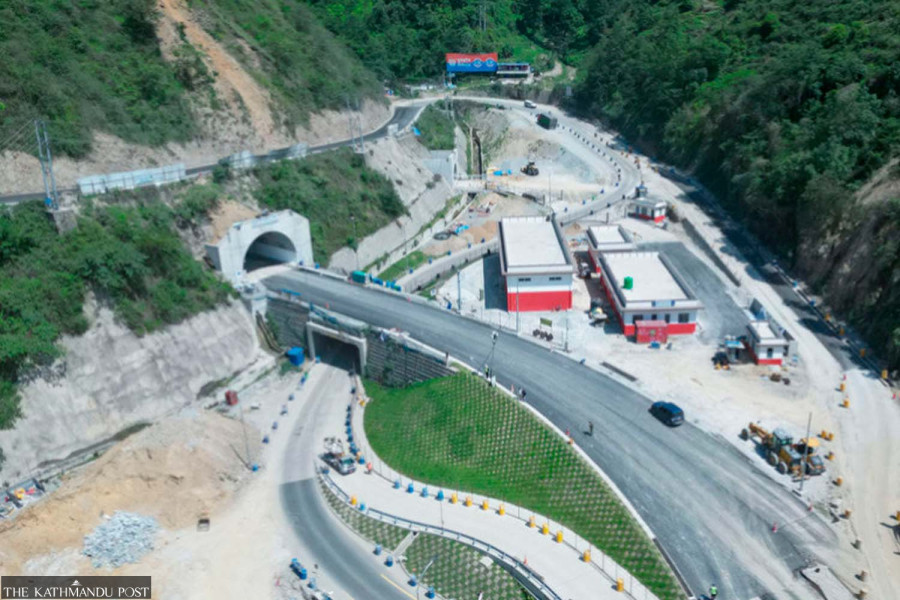
Nepal’s first tunnelway is expected to open by mid-July after years of delays, introducing electronic toll collection and cutting travel time. Post File Photo
Construction of the Nagdhunga-Sisnekhola tunnel, Nepal’s first road tunnel, has been completed 79 months after work began, paving the way for its operation later this month.
Japanese contractor Hazama Ando Corporation has formally handed over the completed tunnel to the Nagdhunga Tunnel Construction Project. The government is preparing to bring the tunnel into operation within the Nepali month of Shrawan, which begins in mid-July.
Construction began on October 21, 2019, under a contract requiring completion within 42 months. The deadline was missed due to the Covid-19 pandemic, local obstructions and other implementation challenges.
Although the contractor completed and handed over the project in May, the government is now carrying out final preparations before opening it to traffic.
Under the contract, Hazama Ando will remain responsible for rectifying any construction defects that emerge during the one-year defect liability period.
Project Director Saujanya Nepal said the construction work had been completed and responsibility for the tunnel had now shifted to the project office.
“The contractor has finished its work and handed over the tunnel to us,” Nepal said. “The company will remain responsible for correcting any defects that appear within one year.”
He said software installation, system testing, and staff training are underway before commercial operations begin.
Toll plazas on both the Kathmandu and Dhading sides have also been completed.
“The toll plaza structures are finished, and software installation is in progress,” Nepal said. “We are also training staff to familiarise them with tunnel operations before opening it.”
He added that slope stabilisation and landslide mitigation work on the Dhading side had also been completed.
The contract to operate and manage the tunnel has been awarded to Yusin-ART JV, a joint venture between China’s Yusin and Nepal’s ART.
Around 150 personnel will be deployed to run the facility. Under the five-year operating contract, the company will be responsible for tunnel maintenance, traffic management, emergency response, toll collection and the upkeep of both the tunnel and the 2.8-kilometre approach roads connecting Kathmandu and Dhading.
The operator will also be required to provide round-the-clock management and ensure uninterrupted operation of the tunnel.
Road Board Nepal Executive Director Ganesh Bahadur KC said the tunnel would introduce a fully digital toll payment system using electronic tags and radio-frequency identification (RFID) technology.
Motorists will be able to use an N-Tag linked to their bank account. Once the tag is installed, toll charges will be deducted automatically each time a vehicle passes through the electronic gate.
“If motorists have an N-Tag linked to their bank account, the toll amount will be deducted automatically when they pass through the gate,” KC said.
Vehicle owners will be required to maintain a deposit of up to Rs2,000 in their account. The Road Board has already held discussions with 13 Class ‘A’ commercial banks to integrate the payment system, and additional banks may join later.
KC said N-Tags will be mandatory for regular tunnel users. Vehicles will also carry RFID stickers on their windscreens, allowing tolls to be collected automatically through RFID gates installed at both ends of the tunnel.
For occasional users who do not have an N-Tag or RFID sticker, payments will also be accepted through QR codes and Fonepay.
The operating company will collect toll revenue and deposit it daily into the Road Board Nepal’s account.
The government has already approved toll rates for different categories of vehicles.
Cars and vans entering Kathmandu through the tunnel will pay Rs65, while those travelling towards Dhading will pay Rs60. The project estimates that about 859 cars and vans will enter Kathmandu each day through the tunnel, while around 646 will travel in the opposite direction.
Minibuses, light trucks and tipper trucks will pay Rs115 when entering Kathmandu and Rs80 when leaving the Valley. Daily traffic is estimated at around 540 inbound and 406 outbound vehicles.
Buses and standard trucks will be charged Rs260 to enter Kathmandu and Rs200 to travel towards Dhading. The project expects approximately 794 such vehicles to enter the Valley each day and 597 to leave through the tunnel.
Heavy trucks and lorries will pay the highest toll, with charges set at Rs600 for entry into Kathmandu and Rs250 for outbound journeys. Daily traffic is projected at around 596 inbound and 448 outbound heavy vehicles.
According to the Nagdhunga-Sisnekhola Tunnel Traffic Operation Directive 2024, pedestrians, motorcycles, three-wheelers and other non-motorised vehicles will not be permitted to use the tunnel after it opens.
Vehicles carrying highly flammable or explosive materials, including petrol, diesel and liquefied petroleum gas, will also be prohibited from entering the tunnel. Such vehicles will instead continue using the existing Nagdhunga-Sisnekhola road.
The main tunnel stretches 2,688 metres, while the parallel emergency escape tunnel measures 2,557 metres.
The project was financed through approximately Rs21.5 billion in concessional loans from Japan, with the government contributing around Rs6 billion.




 14.58°C Kathmandu