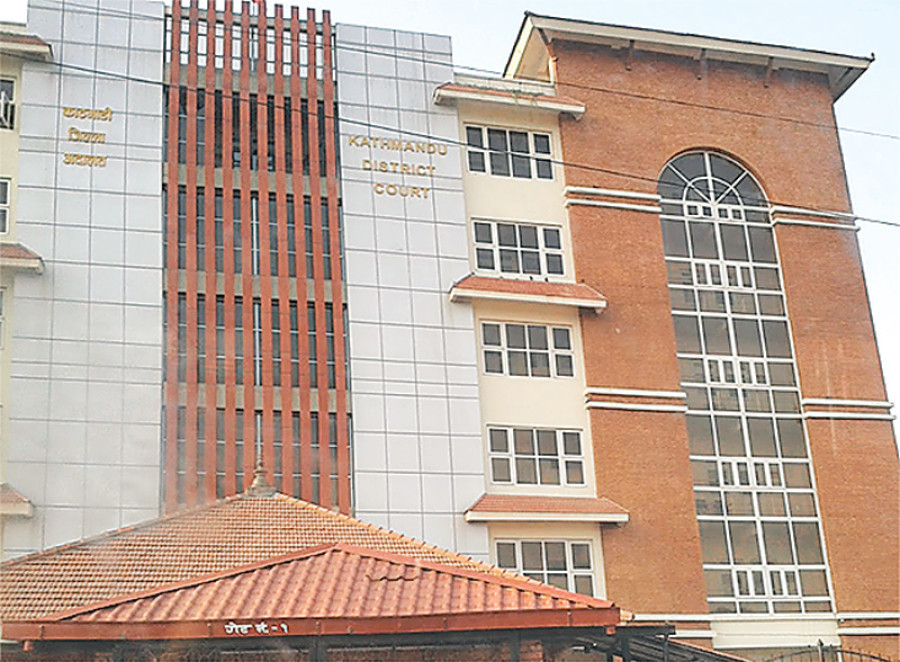
Kathmandu District Court has sentenced Saroj Mishra, former editor of the Rajdhani Daily, to four months in prison and imposed a fine in a criminal defamation case, raising strong criticism from media organisations and press freedom advocates, who describe the verdict as a serious setback for freedom of expression.
The verdict was delivered on April 8 by a bench led by Judge Atmadev Joshi and authenticated on June 9. According to the full text of the judgment, Mishra was sentenced to four months' imprisonment and fined Rs1,000.
The court also ordered compensation totalling Rs500,000 to the plaintiff, with Rs250,000 to be paid by Mishra and the other Rs250,000 by the Rajdhani daily.
The judgment found Mishra guilty under Section 306(1) of the National Penal Code, 2017, concluding that the published report had damaged the plaintiff's character, conduct, morality and reputation without sufficient factual basis.
The court imposed a three-month prison sentence under Section 307(1) of the Penal Code and added a further one month under the section’s restrictive provision, along with the Rs1,000 fine.
“The defendant has been found guilty of damaging the plaintiff's character, conduct, morality and reputation based on speculation without sufficient basis,” the judgment states.
The case arose from a report published in the print and online editions of Rajdhani Daily on July 22, 2023, under the headline “The Arbitrary Actions of Three Colonels in the Army’s Legal Department”.
Advocate Shobha Karki filed a criminal defamation case at Kathmandu District Court on July 31, 2023, alleging that the report contained false and damaging claims about her.
According to the complaint, the article accused her of frequently visiting judges’ residences, influencing court proceedings through unofficial “settings”, and accumulating illicit wealth.
Karki sought Rs10 million in damages, arguing that the publication had seriously harmed both her professional standing and personal reputation.
A day after the report was published, a complaint was lodged with the Press Council Nepal. Following the council’s directive, Rajdhani Daily published a clarification on August 4, 2023.
During the proceedings, the defendants argued that the article had not explicitly named Karki, that it had been published in the public interest and that a clarification had already been issued in accordance with the Press Council’s recommendation.
The court rejected those arguments.
Although the report did not mention Karki by name, the judgment said it described her as “a lawyer with the Karki surname, married to Mahendra Jung Shah”, making her identity readily identifiable to readers.
The court further held that the newspaper had failed to produce credible evidence, official documents or reliable sources to substantiate the allegations contained in the report.
Because the allegations were published without adequate factual support and were found to have harmed the plaintiff's reputation, the court concluded that the offence of criminal defamation under Section 306 of the National Penal Code had been established.
The case proceeded through multiple hearings over nearly three years.
During the trial, the court examined witness testimony, copies of the published article, records from the Press Council Nepal and relevant military court decisions relating to an army officer, Prem Shahi.
On March 10, the court directed both parties to submit their final written arguments before issuing its verdict on April 8.
Following the authentication of the judgment on June 9, the defendants became eligible to appeal the ruling at the Patan High Court within 35 days.
Media organisations criticise verdict
The prison sentence has drawn widespread criticism from journalists, media organisations and freedom of expression advocates, who argue that defamation disputes should be resolved through civil remedies rather than criminal prosecution.
Mishra described the ruling as unprecedented.
“I am unaware of any case in Nepal’s judicial history where a journalist has been sentenced to four months in prison and ordered to pay such a large amount of compensation simply for publishing a news report,” he said.
“We cooperated with the Press Council and published a clarification. Even then, the punishment imposed is unexpectedly severe.”
Mishra said the judgment could have a chilling effect on investigative journalism and discourage journalists from reporting on matters of public interest.
Taranath Dahal, executive chief of Freedom Forum, said the ruling reflected a troubling approach to press freedom.
“Defamation should be addressed through civil law by determining appropriate compensation where necessary,” Dahal said. “Imprisoning a journalist over defamation is highly objectionable and reflects growing prejudice against the media within the judicial system.”
He warned that criminal penalties for journalistic work could undermine constitutional guarantees of freedom of expression and weaken investigative reporting.
The Federation of Nepali Journalists also condemned the verdict.
FNJ president Nirmala Sharma described the custodial sentence as “a direct blow to modern journalism and the constitutional guarantee of freedom of expression”.
“A free press is indispensable for a functioning democracy,” Sharma said. “Attempts to weaken independent journalism are deeply concerning.”
She said journalists had long relied on the judiciary to protect constitutional freedoms when facing pressure from the executive or other state institutions.
“Now it appears that the courts themselves are adopting an increasingly restrictive approach,” she said.
Sharma added that using criminal law to punish journalists risked creating fear within newsrooms and discouraging critical reporting on issues of public interest.
Press freedom advocates have repeatedly called for defamation to be removed from Nepal's criminal justice framework, arguing that civil remedies provide sufficient protection for individuals whose reputations have been harmed while avoiding unnecessary restrictions on media freedom.




 23.73°C Kathmandu