Nepal’s first transgender lawmaker is just getting started
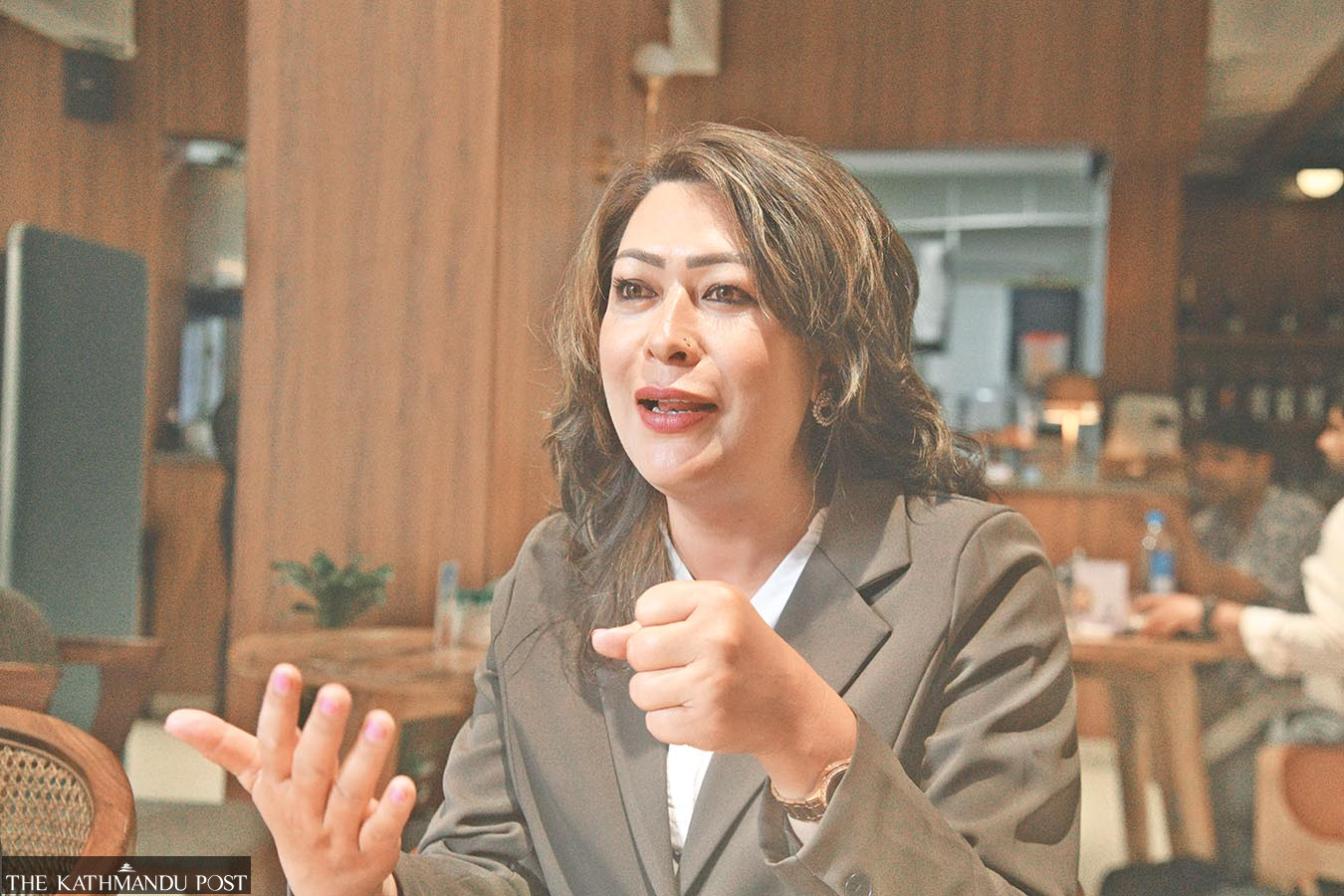
Bhumika Shrestha was bullied out of school and once struggled to find words for her identity. Now she sits in Nepal’s federal Parliament, carrying decades of activism into the country's highest legislative body.Bhumika Shrestha pictured in Kathmandu earlier this month. Deepak KC/TKP
Bhumika Shrestha’s last three months have, by any measure, been historic. Shrestha has fought for the rights of sexual and gender minorities for the past two decades. Now she is carrying that fight into the legislature as Nepal’s first transgender Member of Parliament. Shrestha has made an impact almost immediately. As a member of the parliamentary Law, Justice and Human Rights Committee, she helped push through one of the most crucial symbolic changes—the renaming of the Ministry of Women, Children and Senior Citizens as the Ministry of Women, Children, Gender and Sexual Minorities and Social Security.
“I didn’t know the name itself would change,” she says. “I was also surprised.”
That gap between what she pushed for and what arrived runs through much of her account of these past three months of her tenure. And her journey, through her time as an MP and everything before that brought her there, reflects a broader tension in Nepal’s democratic experiment—between progressive court rulings and slow-moving institutions and between symbolic recognition and substantive rights.
Long before any of that, the classroom was the first place where the gap between who she was and what the world was prepared to recognise became impossible to ignore. When teachers taught the concept of napunsak linga (neuter gender), the entire class would turn and laugh at her, Shrestha recalls. By seventh grade, male students had begun harassing her in school bathrooms, saying ‘‘let’s see what’s in there’’ as they tried to check her body.
At home, what had felt like acceptance rested on an assumption she eventually understood: her family had been waiting for her to become a man. When that transformation never arrived, the tolerance did not survive it. By grade eight, she had stopped using the school bathrooms entirely as male students would harass and humiliate her. She stopped drinking water during the school day. That is the reason, she says, she carries kidney stones today.
‘‘I felt like I was the only person in the world whose biological body and mental identity were different,’’ she says.
There was no one to explain any of it to her, no name for what she was until someone first saw her while waiting for a bus at Ratna Park.
Pinky Gurung was working as the outreach shift coordinator for the Blue Diamond Society, Nepal’s pioneering LGBTIQA+ rights organisation, when she noticed a teenager near the park’s gate: black cotton pants, white shirt, a red woollen half-sweater, hair longer than most boys wore it and dyed a shade of burgundy, a red tika on her forehead. ‘‘As soon as I saw her, I recognised her, I recognised her as trans,’’ Gurung recalls. “She seemed a bit scared and uncomfortable; she didn’t know the details about the community yet. She was a child, unaware of the LGBTIQA+ community and hadn’t met any peers.’’ Gurung talked to her and brought her to the office. She was fifteen. It was around 2003.
What followed was two decades inside one organisation, moving from volunteer to trainer to one of its central figures. She identified individuals within the trans community for leadership training, monitored and documented violence against sexual and gender minorities, and ran legal awareness and counselling sessions for people navigating a system with no real category for them.
She organised several press briefings so journalists would hear directly from the community about the difficulties it faced, and lobbied political parties and government offices—the District Administration Office, then the District Development Committee, municipalities—pushing them to issue citizenship documents that reflected third-gender identity. The turning point came in 2007, when the Supreme Court ruled that gender identity must be determined by self-identification rather than medical examination, and ordered the state to recognise a third gender category—the first time Nepali law had said anything of the kind.
After that, much of that lobbying sharpened into a single, concrete demand: that the verdict be implemented, not just acknowledged. It was the slow accumulation of that work, meeting by meeting, office by office, that built the public visibility that made her a recognisable figure long before any election brought her to Singha Durbar.
Pinky Gurung, who by then had watched her for two decades, reflects on what made the arc possible. ‘‘She was one of the few trans people who was visible from a very young age—she never hid who she was, and that visibility became the foundation of her advocacy,’’ Gurung says. ‘‘Once she joined the Blue Diamond Society, the platform and opportunities allowed her to grow and enhance her capacity.’’
The route into the legislative body carried its own complications. Shrestha entered Parliament through the Janajati women’s quota because Nepal’s proportional representation system still has no category for gender and sexual minorities—a contradiction that underscores both how far the country has come and how much remains unresolved.
Her working day is longer than most people imagine. The House, some days, runs from 11 am to 7 pm in the evening—not the two or three hours that public perception sometimes assumes, and shorter only on days when protests interrupt proceedings. On other days, she moves between committee meetings, subcommittee programmes, and ministry visits.
There is little time left for anything outside Parliament. ‘‘Lately, my family and friends jokingly tell me that I don’t even remember their birthdays or care about them,’’ she says. ‘‘The care is there. But since this is just the beginning, I’m still learning to manage things.’’
Inside that schedule, the most concrete result so far came from a meeting convened for proportional representation lawmakers, where she raised a longstanding bureaucratic gap directly with Prime Minister Balendra Shah. Under the Government of Nepal Work Division Regulation, no ministry had formal responsibility for issues affecting gender and sexual minorities. For years, activists had found themselves moving between ministries, each able to argue that the issue belonged somewhere else.
Shrestha had asked only for an expansion of the ministry’s terms of reference. Instead, the government renamed the Ministry of Women as the Ministry of Women, Children, Gender and Sexual Minorities and Social Security. It is the kind of small, structural win that street advocacy rarely produces and lawmaking occasionally can, and on its own, it is also evidence of how far the rest of the agenda still has to travel.
Since her parliamentary journey in April, she has addressed the House multiple times. The range of issues reflects an adjustment she is still making. For more than two decades, Shrestha’s work centred on a single community. But Parliament demands something broader. ‘‘I cannot just raise my voice for my community alone,” she says. “I have to look after children’s issues and others too.”
This is partly why she sought a place on the Law, Justice and Human Rights Committee, where she now serves on a subcommittee focused on children in care homes. In the committee, she has also pushed to include intersex children in the Child Rights Act amendment. Intersex, she explains, refers to people born with reproductive or sexual autonomy, chromosomes, or hormones that do not fit neatly into the standard definitions of male or female—a biological variation present at birth, not a matter of identity or choice. The concern she is pressing is a specific medical practice: when intersex infants are born, doctors and families sometimes perform irreversible sex assignment surgeries on them before the child is old enough to understand or consent, surgeries aimed at making their bodies conform to male or female norms.
Unlike gender-affirming surgeries sought voluntarily by those who understand their own identity, these remove that choice permanently; a harm that law has not yet named as such. She has also proposed replacing the gendered adoption-law terms ‘‘Dharmaputra/Dharmaputri’’ with the gender neutral ‘‘Dharmasantan’’. ‘‘If a child is protected, they won’t face problems when they grow up,’’ she says.
Bhumika Shrestha spent two decades advocating for the rights of gender minorities. Deepak KC/TKP
These are the ambitions still in motion, not yet achievements. No legislation has passed yet. The work of lawmaking, she is discovering, happens mostly out of public view: in committee meetings, ministry offices and consultations that rarely attract headlines.
“When different LGBTIQA+ organisations bring conflicting suggestions to the ministry, the process stalls,” she says. “Getting everyone to present one unified document is where much of the energy goes now.” It is the unglamorous interior of legislative work, the part that happens before anything can be voted on.
Some issues remain not merely slow-moving but effectively stalled. The Ministry of Home Affairs has paused all processing of legal gender recognition applications, halting a process she completed in 2021. ‘‘Everyone keeps objecting inside the House,’’ she acknowledges. “I’m planning to speak on this next time my turn comes.’’
The obstacles are not only bureaucratic. She is navigating disagreements within the movement itself. Her entry through Janajati women’s quota drew immediate criticism from within the LGBTIQA+ community for occupying a ‘‘woman’s seat.’’
‘‘The current election system lacks a specific cluster for gender minorities,” she says in response. “My inclusion within the women’s category is a practical necessity of the current legal architecture, even as I fight to expand those categories. No matter how I reached the House, I am there to speak for my community. But when some friends from my own community oppose me, it makes me sad.’’
A second dispute runs deeper still, over what gender marker transgender people should be allowed on their citizenship documents. Sunil Babu Pant’s 2007 Supreme Court case first established that gender identity must be recognised by the state based on self-identification rather than medical examination. Pant has since, she says, lobbied the Ministry of Home Affairs to restrict transgender people to ‘Other’ citizenship marker, arguing that a distinct category demonstrates strength in numbers. Shrestha and several other organisations oppose this position.
The ‘Other’ marker currently limits access to Civil Service positions, meaning the choice of gender marker shapes not just identity but employment. She argues thata person’s right to identify as per their choice is guaranteed by Article 12 of Nepal’s 2015 Constitution, which preserves the right to citizenship that reflects one’s self-identified gender. The same 2007 ruling that Pant won established the principle of “self-feeling”: that gender identity is determined by the individual, not by a bureaucrat or an activist. Pant himself, she notes, travels on a passport where he identifies as male.
Pant, however, said he sees no contradiction. ‘‘Human rights advocacy is not limited to one’s own category,” he said. “A person does not need to be a woman to advocate for women’s rights.’’ Pant added that his support for the ‘Other’ category was never about placing everyone into it, but about ensuring legal recognition for those whose identities fall outside the male-female binary and that Nepal’s own indigenous traditions of recognising multiple gender expressions deserve consideration alongside international human rights frameworks.
Even where the law has already moved, it has not moved far enough to matter in practice. Shrestha emphasises that while obtaining citizenship and gender markers is important, the movement’s work is not finished. ‘‘Marriage equality is next on the agenda and remains a core issue for the community,’’ she says. She is also direct about her own stake in it: despite her progress as a parliamentarian, she still does not currently have the legal right to marry.
Since a 2023 Supreme Court interim order, same-sex couples can register their marriages, but only in a separate civil register, not the main one. Those certificates are explicitly temporary. Only 35 same-sex couples have registered partnerships in Nepal since provisional recognition in 2024, but those couples cannot inherit property, make medical decisions for each other, or adopt.
Shrestha says he feels like she is just getting started. She has a vision that now seeks to turn representation into influence, visibility into lasting change. Her five-year plan, she says, extends to gender-neutral language in inheritance law—‘‘santan’’ instead of ‘‘son’’ or ‘‘daughter’’, updated teacher training guidelines so that LGBTIQA+ identities are discussed accurately in classrooms, and existing toilets relabelled as gender-neutral rather than building new ones. ‘‘We need to move beyond symbolic budgets and training to actual action-oriented programmes,’’ she says. ‘‘There is more to vision, and there is more to me.’’
Aarya Chand is a reporter at The Kathmandu Post covering social issues. Before moving to the social beat, Chand was an intern covering culture and lifestyle for the Post.




 23.78°C Kathmandu