Proposed ‘lateral entry’ into specialised civil service positions sparks concern among bureaucrats
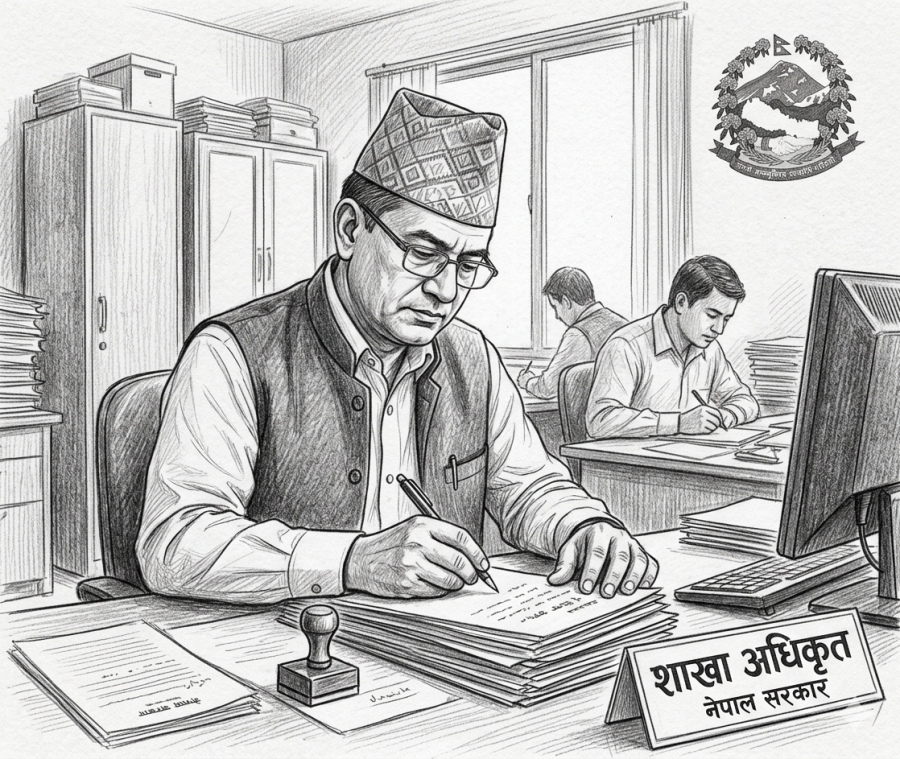
The draft Federal Civil Service Bill proposes reducing internal promotion quotas to expand open competition, while introducing compulsory retirement for employees aged 55 or those who have completed 30 years of service. AI-generated image
A special provision allowing “lateral entry” into highly specialised positions in the bureaucracy has been incorporated into the latest draft of the proposed Federal Civil Service Bill.
The provision appears under Section 10(14) of the bill prepared by the Ministry of Land Management, Cooperatives, Federal Affairs and General Administration. Section 10 governs vacancy fulfilment in the Federal Civil Service. Sub-section 14 states: “Notwithstanding anything contained elsewhere in this Section, the Government of Nepal, for a specified period, may make special arrangements for lateral entry into any executive or expert position of a specialised nature within the civil service, in consultation with the Public Service Commission regarding the suitability of the candidate.”
Sub-section 15 further provides that the qualifications, selection process, performance contracts, terms of service and remuneration of such recruits will be determined by criteria set by the government in consultation with the Public Service Commission.
A Joint Secretary at the ministry said the provision had been introduced to address situations where highly specialised expertise, beyond the experience and skills available within the existing bureaucratic structure, is urgently required.
He said that if the government needed specialists such as economists or technical experts for a particular project, they could be recruited for a fixed term.
“The government cannot do this unilaterally. Such appointments will be made with the direct involvement of the Public Service Commission,” he said. “These recruits will not enjoy the same perks and privileges as permanent civil servants. Their terms of service and benefits will be governed separately.”
However, the draft uses the term “executive position” alongside “expert position”, raising concerns among bureaucrats. Since an executive position generally refers to the head of an office with final decision-making authority, officials say the provision leaves room for broader interpretations.
The draft does not define the term.
“An executive position could mean anything from a district office chief to a ministry secretary,” an official at the Ministry of Law, Justice and Parliamentary Affairs said. “The ministry where the draft originated needs to clarify the reason behind introducing this provision.”
The law ministry official argued that allowing lateral entry into regular civil service positions would bypass established recruitment procedures.
“You cannot simply appoint a secretary or a joint secretary from outside the civil service through lateral entry,” the official said. “If the intention is to appoint executive heads for specific development projects, there is no need to include such a provision in the Civil Service Act.”
The official added that the clause requires broader consultations with line ministries before it is finalised.
According to the official, if lateral entry is intended for positions within the regular civil service hierarchy, it is likely to face strong opposition from career bureaucrats. The official also argued that several provisions in the draft raise constitutional and legal concerns.
As the bill remains under consultation, officials at both the Ministry of Land Management, Cooperatives, Federal Affairs and General Administration, which drafted the bill, and the Ministry of Law, Justice and Parliamentary Affairs, which is vetting it, declined to comment on the record.
Civil servants were already concerned by another proposal requiring compulsory retirement for employees who have reached 55 years of age or completed 30 years of service. The inclusion of lateral entry into executive positions has further heightened those concerns.
Defending the proposal, another official at the Ministry of Land Management, Cooperatives, Federal Affairs and General Administration said existing laws already allow the government to hire experts on a contractual basis. According to the official, the phrase “positions of a specialised nature and expert positions” should not be interpreted as permitting lateral entry into regular positions within the civil service hierarchy.
Lower retirement age and shorter tenures
Section 57 of the draft outlines proposed changes to compulsory retirement.
Sub-section (1) retains the compulsory retirement age of 60 years for civil servants. However, a transitional provision states that when the new Act comes into force, employees who have either reached the age of 55 or completed 30 years of service will be compulsorily retired.
If enacted without amendment, the provision would require a large number of bureaucrats meeting either criterion to retire on the date the Act takes effect.
The draft also proposes that civil servants who turn 58 during the fiscal year in which the Act comes into force will also retire. Under Section 33 of the existing Civil Service Act, 1993, the compulsory retirement age is 58.
The draft further proposes shortening the tenure of the bureaucracy's highest-ranking officials.
The tenure of the chief secretary (officer 14th level, special class) has been reduced from three years to two years, while the tenure of a secretary (officer 13th level, special class) has been cut from five years to three years under Section 24, which governs Gazetted Special Class officers.
The bill retains the existing minimum recruitment age of 18 years for non-gazetted, assistant-level positions and 21 years for officer-level posts.
The upper age limit also remains unchanged at 35 years for male applicants and 40 years for female applicants.
Likewise, the existing provision under Section 10(c)(1) of the Civil Service Act, 1993, allowing former army and police personnel up to the age of 40 to compete for specified Federal Civil Service posts has been retained.
A Joint Secretary involved in drafting the bill said certain civil service positions require specialised security training, making former security personnel particularly suitable.
He cited security personnel assigned to sensitive institutions such as the Department of Printing, saying that such age exemptions have long existed for these specialised positions.
Major restructuring of recruitment and quotas
The draft also proposes a major overhaul of recruitment ratios by reducing the share of internal promotions and expanding opportunities through open competition.
It would also allow civil servants adjusted to the Provincial Civil Service and Local Service under the federal adjustment programme to compete for senior positions in the Federal Civil Service.
Under the proposal, the share of vacancies filled through open competition at the under secretary level would increase from the current 10 percent to 40 percent.
Vacant under secretary posts would be filled through 40 percent open competition, 10 percent inter-level competition and 50 percent internal promotion.
For the post of joint secretary (11th level), the draft proposes allocating 10 percent of vacancies for open competition, 20 percent for inter-level competition and 70 percent for promotion.
The proposed inter-level competition category would allow civil servants serving in the Provincial Civil Service and Local Service under the federal adjustment programme to compete for these positions.
At the lower levels, the draft proposes increasing the share of vacancies filled through open competition for the post of Non-Gazetted Second Class (Assistant Fourth Level) to 80 percent from the current 70 percent. The remaining 20 percent of vacancies would be divided equally, with 10 percent filled through inter-level competition and 10 percent through internal promotion.
For Non-Gazetted First Class (Assistant Fifth Level) posts, the proposed recruitment ratio is 40 percent through open competition, 20 percent through inter-level competition and 40 percent through internal promotion.
Vacancies for section officer (Gazetted Third Class/Seventh Level) would be filled through 70 percent open competition, 10 percent inter-level competition and 20 percent internal promotion.
The draft also proposes ending permanent recruitment for several information technology-related posts. Permanent appointments for Computer Operator and Computer Technician (Non-Gazetted First Class), as well as Assistant Computer Operator (Non-Gazetted Second Class), would cease once those positions become vacant.
The bill further states that permanent recruitment will no longer be conducted for vacant Non-Gazetted Fifth Class positions, except for posts designated by the Government of Nepal through notification in the Nepal Gazette as core functional positions.
Instead, the draft proposes creating a new Nepal Information Technology Service within the Federal Civil Service. Existing IT personnel currently serving under the Miscellaneous Service would be transferred to the new service. The bill also provides that Assistant Computer Operators and Computer Operators already in service will receive promotion and career development opportunities within the new IT service based on their academic qualifications and work experience.
The draft further states that decisions on staffing levels and vacancy fulfilment should take into account the country's macroeconomic conditions and administrative liabilities, with the objective of achieving maximum efficiency with the minimum required workforce. To maintain a lean bureaucracy, it proposes making organisational structure and staffing management (O&M) reviews mandatory every five years.
New intersectional approach to inclusion quotas
Section 11 of the draft introduces significant changes to the civil service's inclusion system.
Under the existing framework, 45 percent of posts filled through open competition are reserved for inclusive groups. Within that reservation pool, 33 percent is allocated to women, 27 percent to Indigenous Nationalities (Adivasi Janajati), 22 percent to Madhesis, 9 percent to Dalits, 5 percent to persons with disabilities, and 4 percent to candidates from backward regions.
The proposed bill increases the overall reservation pool from 45 percent to 49 percent of all posts filled through open competition.
Half of this 49 percent reservation pool would be reserved exclusively for women, while the remaining half would be allocated among broader inclusive groups.
Within the women’s reservation pool, 27.7 percent would be allocated to Khas Arya women, 25 percent to indigenous nationalities (Adivasi Janajati), 15 percent to Madhesis, 12.7 percent to Dalits, 6.6 percent to Tharus, and 4 percent each to Muslims, backward regions and persons with disabilities.
The remaining half of the inclusive reservation pool, open to applicants of all genders within the designated categories, would be distributed as follows: 32.5 percent for indigenous nationalities (Adivasi Janajati), 19 percent for Madhesis, 15 percent for Dalits, 10 percent for indigent Khas-Aryas, 9 percent for Tharus, 5 percent each for Muslims and applicants from backward regions, and 4 percent for people with disabilities.




 18.41°C Kathmandu