Forest litter replaces chemical fertiliser in Arghakhanchi village
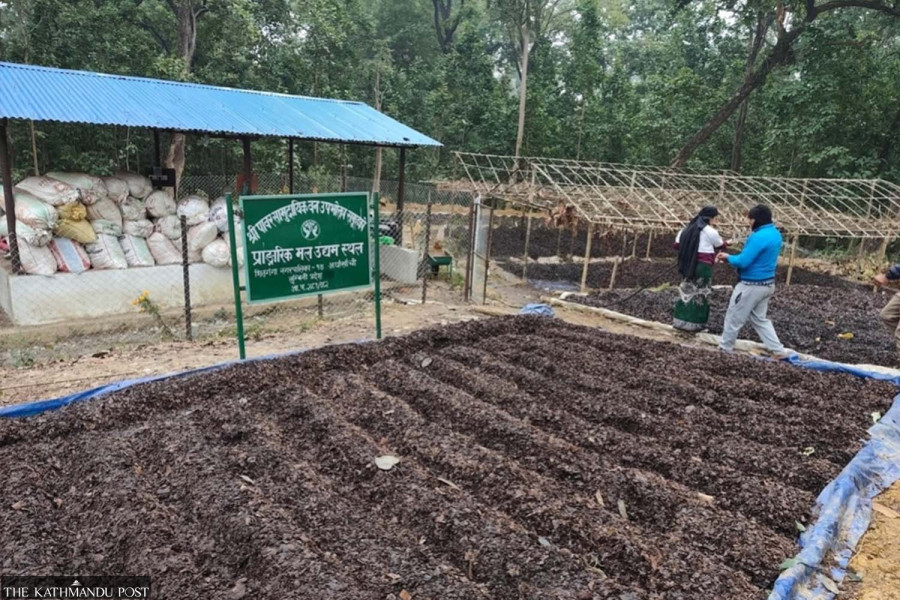
Community forest users are turning fallen leaves into compost, helping farmers cut costs, create jobs and reduce the risk of wildfires. Birendra KC/TKP
For years, farmer Hari Bahadur Tandan of Pawar village in ward 14 of Sitganga Municipality relied on chemical fertilisers to grow rice seedlings. Securing fertiliser was often a struggle, requiring trips to markets in Kapilvastu and Butwal.
This year, he did not buy a single bag.
Instead, he used organic compost and farmyard manure produced from fallen leaves collected in the nearby Pawar Community Forest.
Tandan cultivates paddy on about 0.5 hectares of land and says he has no intention of returning to chemical fertilisers.
“I will use compost made from forest litter throughout my fields, including the seedbeds,” he said. “Chemical fertilisers produced around 1,5000 of paddy, but I expect even better yields from organic manure.”
His confidence stems from previous experience using the compost on vegetables and other crops, where he saw improved growth and higher production.
“This fertiliser improves soil fertility and crop quality,” he said. “I have used chemical fertilisers for years, but now I plan to replace them entirely with compost made from forest leaves.”
Tandan is also a member of the community forest user group. He has spent years helping protect the forest, building fire lines during the dry season, pruning trees and carrying out conservation work.
“I care about the community forest as much as my own land,” he said.
Another farmer, Chura Karki, also plans to abandon chemical fertilisers. He intends to rely on farmyard manure and compost made from forest litter to grow organic grains and vegetables.
Karki cultivates roughly 0.85 hectares of farmland and produces around five tonnes of paddy annually. He believes organic fertiliser will further increase productivity.
“Organic manure improves soil health, which leads to better harvests,” he said. “The land here is already fertile. Crops grown organically can also fetch higher prices in the market.”
According to Karki, villagers have agreed to phase out chemical fertilisers as organic alternatives become available.
“The forest is becoming a strong source of livelihoods,” he said. “By turning what was once waste into compost and promoting organic farming, we want to build prosperity through agriculture and forest-based enterprises.”
Karki, who also heads the advisory committee of the Pawar Community Forest User Group, said nearly every household now participates in activities such as tree planting, clearing undergrowth, pruning vegetation and collecting leaves, generating income in the process.
“Our goal is to produce organic crops that can reach major urban markets,” he said. “We want to develop both agricultural and forest enterprises and create local jobs so people no longer have to leave for foreign employment.”
Although Pawar village is remote from the district headquarters, it lies close to the Pipara area of neighbouring Kapilvastu district. Agricultural products can be transported easily to Kapilvastu and Butwal. The village is also engaged in dairy farming and livestock raising, including goats and pigs.
Farmer Bir Bahadur Khamchaki, who cultivates about 0.36 hectares of paddy fields, was among those involved in the pilot project. Last winter, the community forest user group paid residents daily wages to collect fallen leaves from the forest floor.
The leaves were gathered at designated sites inside the forest. The Division Forest Office provided machinery to shred them. The material was then decomposed and processed into organic fertiliser.
Residents from five community forests — Pawar, Buddha, Charpokhari, Deurali and Banganga — collected 33 tonnes of forest litter during the winter season. The material was converted into organic compost, which was distributed among farmers.
Of the 111 households in the user groups, 50 used the compost on crops, vegetables and tree plantations. The fertiliser was sold at Rs25 per kilogram.
This winter, villagers again collected forest litter that would otherwise have been left to decay or washed away by monsoon runoff. Participants received a daily wage of Rs700 for the work.
Demand for the compost has risen after farmers reported favourable results.
Khamchaki, who also chairs the Pawer Community Forest User Group, said the village aims to eliminate chemical fertiliser use.
“Every year, rainwater washed away huge amounts of fallen leaves,” he said. “We have now turned that waste into a resource. If this compost continues to increase production, there will be no need for chemical fertilisers.”
Removing the leaf litter has also helped reduce wildfire risks.
“The leaves used to accumulate and go to waste,” Khamchaki said. “Now they are producing organic vegetables and food crops. We want Pawar village to be known for organic agriculture.”
Farmer Loknath Khanal said many residents had relied on chemical fertilisers largely because of labour shortages caused by youth migration.
“We no longer need to buy chemical fertilisers as we can produce compost from forest litter,” he said.
Khanal believes organic vegetables and grains will command premium prices and could encourage educated young people to return to agriculture.
“With growing demand for organic food, agriculture can create jobs and support livelihoods here,” he said.
So far, the project has produced five tonnes of compost, and preparations are underway to increase output to six tonnes. A dedicated processing plant has been established inside the forest. The Division Forest Office has already provided two shredding machines and plans to supply another this year.
The initiative is part of a scientific forest management programme that combines conservation with income generation. Community forest users earn revenue from timber sales while maintaining and protecting forest resources.
Collected leaves are swept from the forest floor, transported in baskets and sacks to the processing facility, shredded and decomposed before being turned into compost.
“The project has created jobs for local people,” said Keshar Khadka, information officer at the Division Forest Office. “At the same time, cleaner forests reduce wildfire risks and help protect wildlife, birds, insects, medicinal plants and other biodiversity.”
The composting process involves collecting leaves, shredding them into fine material and allowing them to decompose in pits for around two weeks. The material is then screened and packaged for use or sale.
Khadka said the fertiliser has the potential to significantly increase crop yields while generating income for farming households.
By clearing forest floors of combustible litter, the project has also reduced the likelihood of dry-season forest fires.
“The programme delivers environmental benefits while creating economic opportunities,” Khadka said. “It is opening new pathways for self-employment through organic farming.”
Arghakhanchi district has 63,207 hectares of forest, including 34,342 hectares managed as community forests. The district is home to 466 community forest user groups.
Among its six local governments, Shitganga Municipality contains the largest forest area, covering 47,364 hectares. It is also the largest municipality in Nepal by area. Malarani Rural Municipality has the smallest forest area, with 2,870 hectares.




 17.84°C Kathmandu