Government invites feedback on disability law online, but target group is locked out
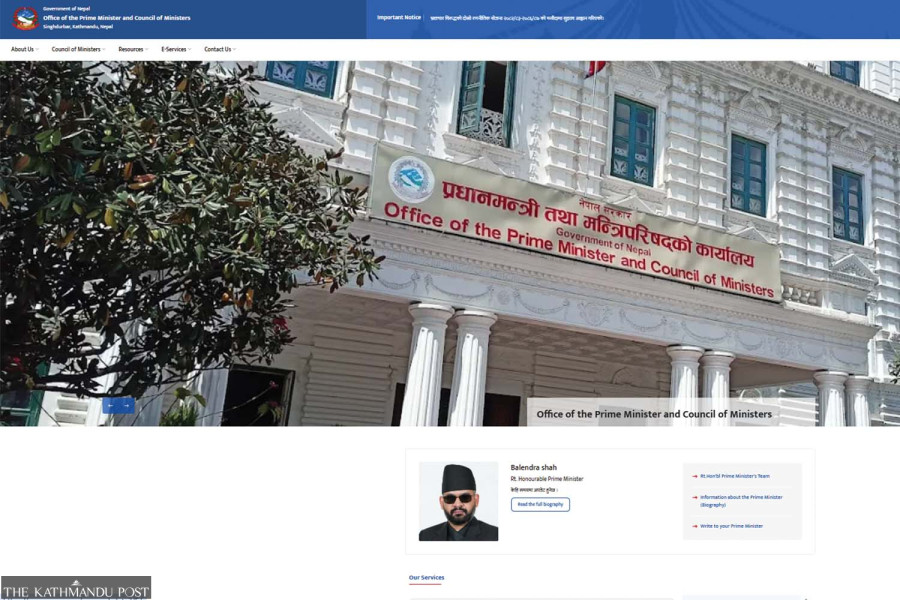
Government documents remain unreadable for visually impaired users due to inaccessible file formats and poor design. A screengrab of the Office of the Prime Minister and Council of Ministers’ website. Post photo
The Ministry of Women, Children and Senior Citizens published a public notice on April 10, inviting feedback on a draft amendment to the Act Relating to Rights of Persons with Disabilities, 2017. The notice and the draft remain available on the ministry’s website. However, the very people the law is meant to serve remain shut out of the information itself. Although the document explicitly calls for making information accessible, the published notice is, in reality, not accessible.
The documents were uploaded in image-based files and in Preeti font formats that screen reader software used by visually impaired people cannot interpret. Key elements such as headings, paragraphs and lists were not properly tagged, making navigation nearly impossible. Even basic functions like enlarging text, translating content or integrating it into assistive tools are either difficult or entirely unusable.
“It is ironic that a draft law meant for us is published in a way we cannot read,” said Saugat Wagle, coordinator of Sarwodaya Abhiyan who also works with Nepal Airlines Corporation and supports visually impaired students during examinations. “We only understood what changes were proposed after one of our friends converted the document into an accessible format and shared it on social media.”
According to Wagle, even the government’s integrated service platform, the Nagarik App, has recently become inaccessible for visually impaired iPhone users. “If content is simply made available in Unicode, it would already make a huge difference for us,” he said.
The problem goes beyond a single notice. From students to government employees, people with disabilities face persistent barriers in accessing official documents, laws and services online. Despite repeated commitments to digital inclusion, many government websites continue to prioritise visual design over usability.
Prof Kamal Lamichhane, a senior researcher at the University of Tokyo, said developers often focus on aesthetics rather than accessibility. “Designers tend to think about how a website looks, not how it works for everyone. Even simple features like colour contrast options or keyboard navigation can significantly improve accessibility to people with disabilities.”
Lamichhane argued that technological advancement should benefit persons with disabilities the most, yet the opposite is often true. “Accessibility is not expensive if it is designed from the start. The real problem mindset. Retrofitting systems later is what drives up the cost,” he said.
The issue has gained renewed attention as the government promises reforms. The Rastriya Swatantra Party-led government has included making government websites disability-friendly in its 100-day governance reform agenda. The Ministry of Communication and Information Technology has set a target to make over 250 government websites accessible within 30 days.
Subas Dhakal, director at the Department of Information Technology, said efforts are underway to improve systems. “We have already made around 55 adjustments to enhance accessibility. While making every website fully compliant requires significant resources, we are focusing on basic improvements for now. The changes are aligned with international standards,” he said.
The department has also begun training programmes aimed at making government websites more inclusive. Director General Shree Chandra Shah described the initiative as a historic step, acknowledging resource constraints but emphasising that accessibility is a government responsibility.
Globally recognised standards such as the Web Content Accessibility Guidelines (WCAG) 2.2 outline how digital content can be made usable for all. The guidelines stress four key principles—content must be perceivable, operable, understandable and robust. This includes adding alt text (alternative text) to images, captions to videos, ensuring keyboard navigation and maintaining clear colour contrast.
The government issued Directive on the Development and Management of Government Office Websites, 2021, which also mandates accessibility to persons with disabilities. It requires websites to use Unicode text, offer adjustable font sizes, maintain responsive design across devices and provide content in both Nepali and, where possible, English. However, implementation remains inconsistent.
Devi Datta Acharya, president of the National Federation of the Disabled-Nepal, said advocacy for accessible digital systems has been ongoing for years. “Efforts began during the tenure of former communications minister Jagdish Kharel, when a task force was formed to push this agenda forward,” he said. “It is encouraging that accessibility has now been included in the 100-day reform plan.”
Acharya said that awareness among officials has improved over time. “Earlier, many officials did not even realise this was an issue. That lack of understanding delayed implementation. Now there is more commitment, but it must translate into action,” he said.
According to Acharya, accessibility audits have been conducted for the websites of around eight ministries, and improvements are being made based on the findings. The federation, he says, has been providing technical support, training auditors and offering policy recommendations.
“Access to information is a fundamental right. When digital systems are not accessible, persons with disabilities are excluded from job opportunities, public services and essential information,” said Acharya, adding, “Accessible systems would allow people to access services from home, which is especially important.”
Although the government’s recent efforts are encouraging, Prof Lamichhane argues that digital inclusion must be made sustainable and institutionalised. “There should be a legal provision to deny approval to any government website that does not meet WCAG standards. This would not add extra costs but would ensure that technology is accessible to all from the outset,” he said. “IT students should be taught these standards at university so that every system they develop in the future is inclusive by default. True inclusion is not about creating separate solutions for persons with disabilities, but about embedding our needs within systems designed for everyone.”
Recent government data also highlight the broader challenge. The Finance Ministry’s latest macroeconomic report points out that while digital technology is expanding rapidly in Nepal, the digital divide remains a major concern. This divide is not limited to internet access but extends to whether people can actually use digital services.
Stakeholders warn that unless accessibility is prioritised, the gap between those who can benefit from technology and those who cannot will continue to widen. For persons with disabilities, this means further marginalisation in an increasingly digital society.




 15.61°C Kathmandu