Scientist vacancies hamper agriculture research in Nepal
Absence of scientists and technicians cripples research, weakens services and deepens the crisis for farmers across Nepal. An overview of the Pakhribas campus of Nepal Agricultural Research Council in Dhankuta. Binod Ghimire/TKP
Agricultural research centres across Nepal are struggling to function effectively due to a severe shortage of human resources, undermining research, technology development and support services for farmers.
The Pakhribas Agricultural Research Centre in Dhankuta, established in 1971 with the support of the British government to provide agricultural training to retired Gurkha soldiers, is among the worst affected.
Once regarded as a leading hub for developing agricultural technologies and improving the livelihoods of farmers in the eastern hills, the centre is now facing a critical shortage of scientists and technicians.
Prenil KC, chief of the centre, said the absence of staff against sanctioned posts has severely hampered its effectiveness. “We have the infrastructure and immense potential, but due to the manpower shortage, we have not been able to meet our objectives,” he said.
The centre has a sanctioned strength of 85 staff, including one principal scientist (S-5), 18 scientists across S-1 to S-4 levels, along with technical and administrative personnel. At present, only 12 staff members are in place. The situation is particularly difficult in scientific positions. The post of principal scientist has remained vacant for years, while of the 18 sanctioned scientist posts, only one senior scientist is currently working.
A single scientist, five technical officers and four technical assistants are now sustaining the centre’s operations. As a result, core research and technology development work has been directly affected. Laboratories for soil testing, crop disease identification, pest control, horticulture and breeding have remained closed for years.
“There is no manpower to run the laboratories; equipment has remained unused,” KC said, adding that the inability to operate laboratories has weakened the centre’s research capacity.
The centre, spread over around 1,840 ropanis, has sufficient land for research and technology development, but much of it remains underutilised due to the shortage of staff. Maintenance of infrastructure has also become a major challenge. With over 90 buildings, residences, sheds and laboratories, the lack of technical and support staff has increased the risk of long-term damage to physical assets.
The decline in research activities has also affected the centre’s budget, which has been shrinking in recent years. At its peak, the centre employed up to 250 labourers daily, but that number has now dropped to around 55 to 60. This has had a wider impact on rural employment and local economies.
“The labourers working here did not just provide labour; they also took skills back to their villages,” KC said. “That system is now declining, which has also affected the rural economy.”
The lack of scientists has also weakened the connection between research and farmers. Coordination with Agriculture Knowledge Centres and local-level agriculture branches has declined, limiting the dissemination of new technologies.
The centre’s contribution to maize seed production has been significant, particularly in developing varieties suitable for mid-hill regions such as Manakamana-1 and Manakamana-2. However, it is now unable to meet increasing demand. “Demand for maize seeds has risen sharply, but we do not have the capacity to produce them,” KC said.
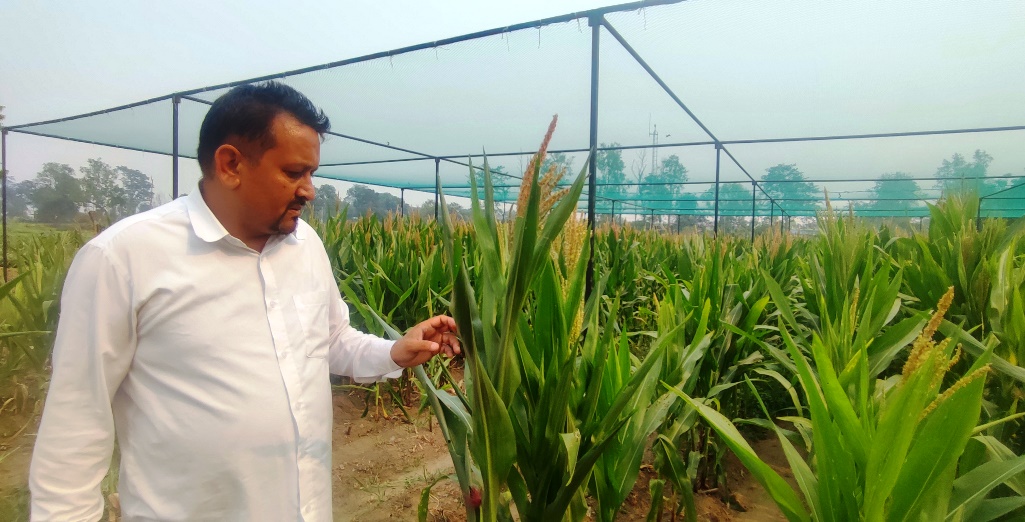
Crops specialist Dhruba Regmi inspects a maize cultivar at Rampur, Chitwan recently. Ramesh Kumar Paudel/TKP
Despite the constraints, some research activities continue. Work is ongoing on 12 varieties of Akbare chillies, while 12 varieties of Dhankute cucumber have been collected for study. Research on chayote is also underway. The centre’s work on Giriraja chickens, which began in 1991, remains a notable success, helping farmers increase productivity and income.
However, beyond such limited achievements, overall efficiency has declined. In the absence of adequate scientists and technical staff, long-term research, development of new crop varieties and disease control technologies have nearly come to a standstill. Officials say recruitment processes have recently moved forward, raising some hope for improvement after June.
Circumstances at the National Maize Research Programme in Rampur, Chitwan, are no better. The programme operates with 35 staff against a sanctioned strength of 69, with key scientific positions remaining vacant.
According to Shuk Bahadur Gurung, information officer at the programme, one principal scientist post is vacant, while positions at various senior scientist levels remain unfilled. There is no staff at the S-3 level, and other posts are also below sanctioned strength.
“We have developed four maize varieties over four years, but they are yet to be released,” Gurung said. “Due to the lack of manpower, work has not progressed at the required pace.”
Among the varieties awaiting approval is ‘Murali’ maize, a type suitable for Nepali conditions but still pending formal release. The variety is widely used for popcorn, much of which is currently imported. Gurung said domestic production of such varieties could help reduce imports.
The programme has developed 31 open-pollinated and 10 hybrid maize varieties. However, research efforts have been constrained by limited manpower. Gurung said research on soil requirements and agricultural mechanisation has also been affected.
Maize is cultivated on around 916,000 hectares in Nepal and contributes 7.6 percent to total agricultural production. Annual demand for maize seed is estimated at 24,639 tonnes, while domestic supply stands at just 3,407 tonnes. “Due to manpower shortages, we have not been able to meet our targets,” Gurung said.
The Ginger Crop Research Programme in Kapurkot Rural Municipality-3, Salyan, is experiencing similar constraints. The programme, which works on ginger and turmeric across the seven provinces, has only eight staff against a sanctioned strength of 19.
Programme chief Ghanshyam Bhandari said the absence of specialists has affected work in areas such as variety development, pest management and soil testing. “I have to look after multiple areas due to the shortage of specialists,” he said.
Despite the limitations, the programme has preserved 105 turmeric, 63 ginger and 12 black turmeric genotypes. It has also developed varieties such as Kapurkot-1 and Kapurkot-2 for both ginger and turmeric.
Bhandari said controlling rhizome rot disease in ginger has been a significant achievement, but progress remains slow. “It takes two years to develop a new variety. By now, we should have developed many more, but due to the shortage of technicians, we have not been able to meet expectations,” he said.
The National Citrus Research Programme in Paripatle, Dhankuta, is also facing a severe crisis. Established in 1961 to improve production and quality of citric fruits such as oranges, junar (sweet orange) and lime, the centre now operates with only eight staff against 37 sanctioned posts.
The absence of specialists in key areas such as pomology, plant pathology, soil science and pest management has severely affected research. Programme coordinator Basanta Chalise said recruitment has been stalled due to delays in amending regulations under the Nepal Agricultural Research Council.
“Most scientists and technicians do not want to stay in remote areas,” Chalise said. “Some have gone for further studies, while others have been transferred elsewhere.”
The lack of expertise has affected research on citrus diseases, including citrus greening, which has spread widely in recent years. Farmers say they are struggling without technical support.
“There are no technicians available to advise farmers on disease and pest problems,” said Harka Bahadur Rai, a citrus farmer in Dhankuta.
Farmers say problems such as fruit flies, mites, canker disease and root rot are destroying orchards, but research and control measures have not kept pace. The absence of a proper nursery certification system has also allowed diseased plants to enter the market, worsening the crisis.
In Palpa, the Citrus Fruit Development Centre in Tansen operates with six staff against a sanctioned strength of 12. Key technical positions remain vacant, making it difficult to carry out research and extension work.
“It is very difficult to work when posts are vacant,” said centre head Joginder Kandu. He said the increasing incidence of citrus decline cannot be addressed under the current structure and manpower.
The Coffee Research Programme in Bhandaridada, Ruru Kshetra-4, Gulmi, is also operating with just four staff against 17 sanctioned posts. Positions for senior scientists in horticulture, soil science and plant pathology remain vacant.
Janardhan Gautam, head of the programme, said that although 44 coffee genotypes have been preserved, research has not progressed as planned. “Without specialists and technicians, research has not happened as expected,” he said.
Coffee farming, which originated in Gulmi, has expanded to around 43 districts. However, production has recently declined in some areas due to pest infestations, including borer insects.
Across these centres, officials say the shortage of skilled manpower has weakened the link between research, extension and agricultural production. Coordination with Agriculture Knowledge Centres and local governments has declined, limiting the transfer of technology to farmers.
Recruitment has remained stalled for years, while staff continue to retire or transfer, leaving positions vacant. Researchers warn that unless immediate steps are taken to address the staffing crisis, Nepal’s agricultural research system will continue to weaken, affecting productivity, food security and farmers’ livelihoods.




 22.94°C Kathmandu
1.jpg)