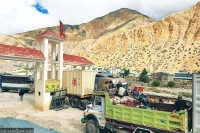
Users complain of weak connectivity, call drops, and one-way audio.Nepal Telecom tower located at Dungrakot Hill in Masta Rural Municipality, Bajhang. Basanta Pratap Singh/TKP
Nepal Telecom’s mobile network problems in Bajhang district have persisted for over two months, leaving thousands of users struggling to make calls and access basic communication services.
Customers complained that the network began deteriorating in mid-February and the issue is yet to be fixed. Users report frequent call drops, calls connecting without ringing, one-way audio and even instances where dialled numbers connect to the wrong recipients. In many cases, phones display signal bars but the service does not function.
“We already had weak signals in the villages, but now even in the district headquarters calls don’t go through when needed,” said Asha Jethara, a resident of Talkot Rural Municipality who currently lives in the district headquarters Chainpur. “It has been two months, and we still cannot rely on the network. Sometimes we have to walk to deliver messages.”
Previously, cellphone network disruptions in Bajhang, a remote mountain district in Sudurpaschim province, would occur briefly during heavy rainfall, snowfall or windstorm. “Now the phone does not work at all,” said another user Keshav Raj Joshi. “Even when a call finally connects, sometimes we cannot hear the person on the other end, and at other times they cannot hear us.” Joshi, who runs a business in Chainpur, claimed the unreliable network has begun to affect his daily trade and transactions.
The local people have also criticised Nepal Telecom for failing to resolve the issue despite repeated complaints. “It has been more than two months. We have visited the Telecom office to complain. They say it is a technical problem affecting many districts in Sudurpaschim. But why has it not been fixed yet?” said another user.
The disruption has hit remote settlements hardest, where mobile phones are often the only means of communication. Bhim Bohara from Surma said the situation can be dangerous. “If someone falls ill or there is an emergency, we have to send a person on foot to inform others. If we need to call a vehicle to take a patient to hospital, it can take hours. Who will take responsibility if any untoward incidents happen due to this?” said Bohara.
Bam Bahadur Singh, chief of Nepal Telecom’s Bajhang office, said the problem has been reported to regional and central offices. “We have tried to fix it with available manpower and technology, but it has not been possible. We have repeatedly informed higher authorities. We are told the issue exists across the country and efforts are ongoing,” said Singh.
Singh surmised that increased user demand and limited infrastructure could be contributing factors. Although Nepal Telecom installed seven new towers in the current fiscal year of 2025-26, not all have reliable electricity supply.
Nepal Telecom has so far installed 26 towers across Bajhang district. However, officials say network performance has remained inconsistent, largely due to irregular electricity supply at several tower sites.
According to telecom staff, towers in Saipal, Khaptadchhanna, Talkot, Thalara, Surma, Bitthadchir, Durgathali, Kedarsyun, Chhabispathibhera and Masta rural municipalities, as well as in Bungal and Jayaprithvi municipalities, frequently fail to operate properly because of unreliable power supply.




 26.12°C Kathmandu