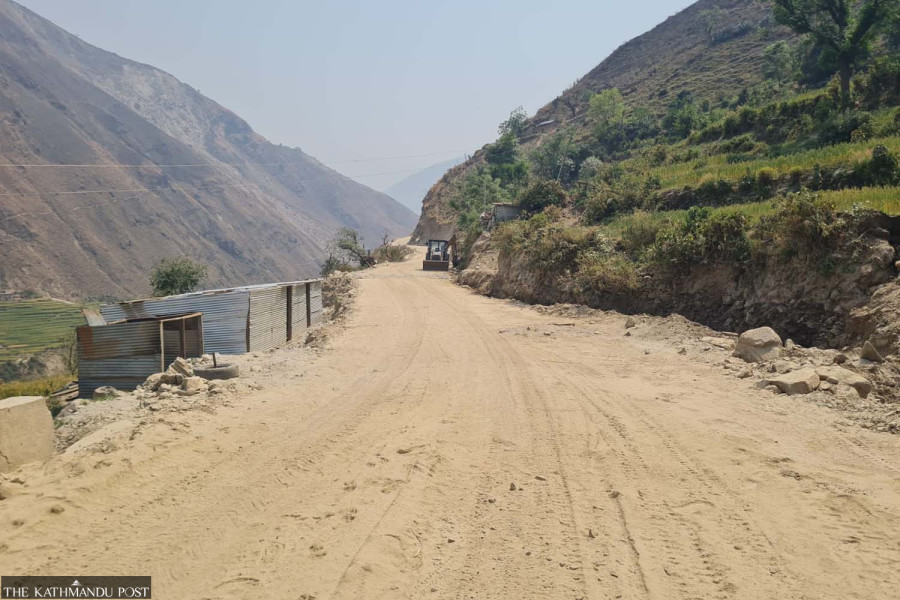
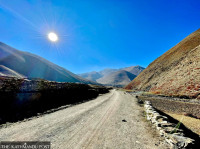
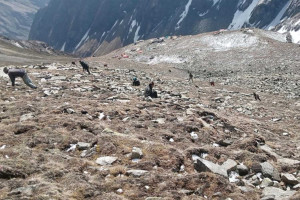
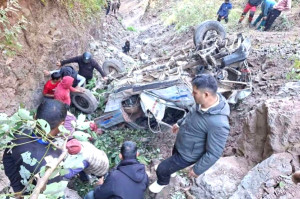
Because of the long, uncomfortable and often dangerous road journey, many residents continue to rely on air travel despite higher ticket prices. Dust in the dry season and mud during the monsoon make travel along Humla-Surkhet road difficult. Post photo
Residents of Humla, arguably the country’s most remote district, complain that a newly opened road link has brought little relief as high fares, unsafe conditions and regulatory gaps continue to make travel both costly and arduous.
Distance from Simkot, the district headquarters of Humla, to Surkhet is 334 kilometres. Yet passengers say they are paying far more than the standard rate for rural roads elsewhere in Karnali Province. The government caps fares on dirt roads in other districts at Rs10 per kilometre, but in Humla it costs nearly Rs17.5 per kilometre on big passenger buses. Those relying on smaller vehicles face even higher costs, with jeep operators charging up to Rs7,500 under the pretext of “reserve” trips.
The financial burden does not end with the fare. The journey typically takes two days, with vehicles halting overnight at Pilichaur on the Bajura border before completing the remaining stretch to Surkhet the following day. Travellers heading further to Nepalgunj must add another four hours.
“Transport is already expensive, and then there are hotel stays and food costs,” said Netra Shahi, a teacher at a basic school in Kharpu. “We stop for meals at least three times and snacks several times. Even if accommodation costs around Rs1,000, the total extra expense easily reaches Rs3,000.” He estimates a one-way trip to Surkhet costs him nearly Rs10,000.
Because of the long, uncomfortable and often dangerous road journey, many residents continue to rely on air travel despite higher ticket prices. Mohan Rokaya of Simkot Rural Municipality-7 said flights from Nepalgunj to Simkot cost around Rs11,814. “Flying feels safer,” said Rokaya. “The road is newly opened, risky, and in many places there are no bridges. Passengers often have to get down and push vehicles.”
Dust in the dry season and mud during the monsoon make travel even more difficult. Vehicles frequently get stuck, delaying already long journeys.
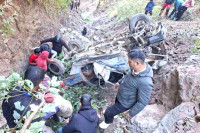
Authorities acknowledge the risks of travelling along the road section. Senior Superintendent of Police Ram Prakash Shah, spokesperson for the provincial police office, said narrow stretches and sharp bends increase the likelihood of accidents. Police data show that in the seven years since the road opened, Humla has recorded 73 road accidents, leaving 36 people dead and 146 injured.
“The road runs along steep cliffs above the Karnali river. If a vehicle falls, recovery is nearly impossible,” said Bijaya Lama, a civil society leader in Humla. “People travel at their own risk. We have been lucky there has not been a major disaster so far.” He identified the Sallisasla-Daman section as particularly dangerous.
Despite the risks, transport services have expanded. Mid-Western Transport Entrepreneurs Committee, Hilsa Transport and Battalion Transport Pvt Ltd operate services from Humla to Surkhet and Nepalgunj, with some extending to Kathmandu. Hilsa requires passengers to change vehicles in Surkhet, while Battalion offers a direct journey to the national capital.
Operators argue that fares reflect operational challenges. “Driving at night is not allowed on the Karnali Highway, so vehicles must halt at Pilichaur,” said Ramu Shrestha, chairman of Battalion Transport. “The road is risky, fuel prices have risen, and passenger numbers are inconsistent… We are running vehicles above the 2022 model standard, but maintenance is required almost daily.” He said a single Kathmandu-Humla trip consumes fuel worth around Rs130,000, with fares to the capital set at Rs8,100.
Regular bus services linking Humla with Surkhet, Nepalgunj and Kathmandu began on December 17 last year. Hilsa Transport operator Bishal Rokaya maintained that fares are reasonable given the road conditions. “We are taking risks to operate in very difficult terrain,” he claimed.
Officials, however, point to regulatory issues. Assistant Chief District Officer of Humla Rajendra Kumar Chand said fares remain high partly because the road lacks a permanent route permit. “The Nepali Army has yet to formally hand over the road to the Department of Roads,” Chand said. “We are operating under temporary permits, which makes fare regulation difficult.”
According to Rajendra Karki, chief of the Transport Management Office in Jumla, even temporary permits have not been renewed recently. “The district administration must recommend permits after consulting operators, usually every three months, but that process has stalled,” he said.
The situation contrasts sharply with other sections of the Karnali Highway. On the 232-kilometre Surkhet-Jumla stretch, passengers pay around Rs2,000, or roughly Rs8.6 per kilometre. From Khulalu in Kalikot to Simkot, a 196-kilometre segment, the fare is Rs1,190. But beyond this, costs rise steeply.
“On the Humla section alone, we end up paying about Rs23.5 per kilometre,” said Parimal Budha of Sarkegad Rural Municipality-4. “High transport costs have kept prices of daily essentials from falling and made it hard to move local products.” According to him, a 30-kilogram sack of rice costing Rs2,100-2,500 in Surkhet or Nepalgunj sells for Rs3,000-3,200 in Humla. So is the situation of other essential goods, he said. “Freight by air, once as high as Rs125 per kilogram, has offered some relief after reductions,” Budha said. “But road transport should not cost more than Rs20 per kilogram.”
Passengers also complain about poor service standards. Gangaram BK of Simkot-3 said jeep operators often overcrowd vehicles without issuing tickets. “They charge almost the same as a full reserve fare,” he said. “The poor are hit the hardest.”
Humla was connected to the national road network only in July last year after a Bailey bridge was installed over the Karnali river at Chuwakhola in Kharpunath Rural Municipality. Although the road track had reached Simkot earlier, the lack of a bridge delayed full connectivity by nearly four months of the rainy season. The Simkot-Hilsa road, which links Nepal to the Chinese border, remains closed during winter due to snow, said District Coordination Committee chief Shivaraj Sharma.
The road project has a long history. Plans to connect Humla to China by road date back to 1997, when a viral outbreak and food shortages exposed the district’s vulnerability. Construction began in 2000 using local resources, but progress was slow. The government established a dedicated project in 2013, and the Nepali Army took over construction in 2015, completing the track only in 2025 at a cost of nearly Rs7 billion.
Upgrade work is now underway along the Karnali Corridor, covering 123 kilometres in the southern section and 146 kilometres in the northern section. Project chief Tularam Sharma said efforts include widening roads, building retaining walls, and adding gravel and blacktop surfaces at the cost of around Rs3 billion. According to him, 10 Bailey bridges have already been installed, but eight more are still needed.




 19.47°C Kathmandu