Humla residents relieved with direct bus service to Kathmandu
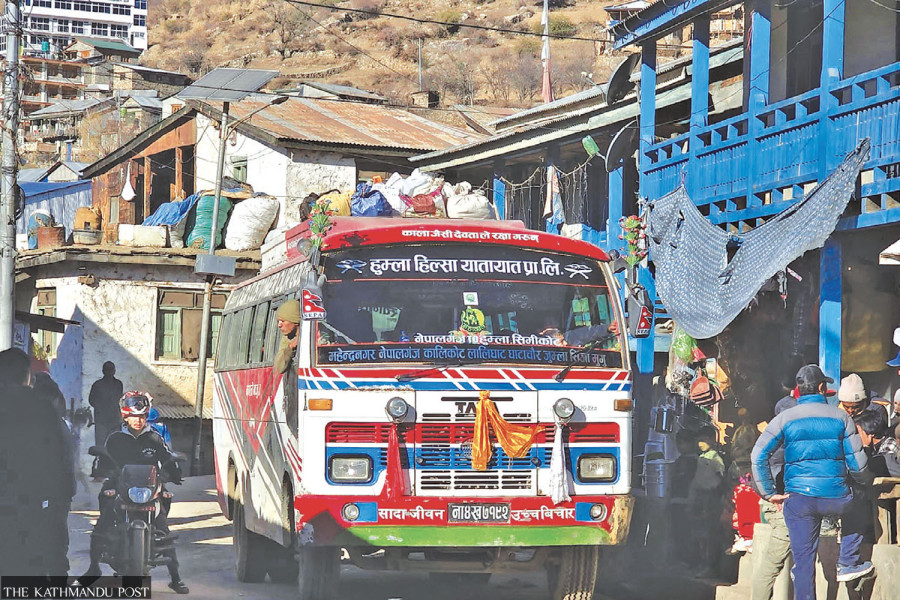
The initiative marks a significant shift for Humla, a district long dependent on air travel and porters for connectivity, but maintaining a regular schedule remains a challenge. Hilsa Yatayat started the first direct bus service from Humla to Kathmandu recently. Post file photo
Sabita Pariyar from Humla, a mountain district of Karnali Province, reached Birendranagar in Surkhet on Friday with a sense of relief she had never experienced before while travelling out of her district. She was headed to Kathmandu, but for the first time, she boarded a bus to the national capital directly from near her home in Simkot.
With the launch of a direct Humla-Kathmandu bus service a few days ago, residents of the north-westernmost district are now travelling to Kathmandu without the exhausting and expensive transfers that once defined long-distance journeys.
“I finally felt relaxed travelling in a single bus. Earlier, we had to change vehicles several times and pay very high fares. Now that hassle has been a thing of the past,” said Pariyar with a sigh of relief.
The direct bus service has been launched by Humla Hilsa Transportation Pvt Ltd. According to Pariyar, the introduction of the service has also pushed down fares due to growing competition. “I used to pay almost double. This time, I bought my ticket to Kathmandu for Rs 6,500,” she said, adding that after one operator took the initiative, other transport companies also started running buses on the route.
For decades, Humla remained one of the country’s most isolated districts, disconnected from the national road networks. Large buses could not operate because the Karnali Corridor—envisioned as a strategic north-south road linking the Chinese border at Hilsa to the southern plains—remained incomplete.
Simkot, the district headquarters of Humla, was finally connected to the national road network in July, 2025. The long-held dream came true with the construction of a Bailey bridge over the Chuwakhola river in ward 5 of Kharpunath Rural Municipality, effectively linking Simkot via the Karnali Corridor.
According to the District Traffic Police Office in Humla, the direct bus service was formally launched on December 17, 2025. The office has fixed the official fare to Kathmandu at Rs7,500.
However, traffic police chief Rajesh Chaudhary said maintaining a regular schedule remains challenging due to difficult road conditions. “Because of the terrain and road conditions, buses cannot always operate on a fixed timetable,” Chaudhary said. “Earlier, buses would turn back from Sarkeghad. Now they reach the district headquarters and even depart directly for Kathmandu.”
For locals, the impact has been immediate. Anga Raj Pariyar of Chankheli Rural Municipality-3 said travel has become significantly easier and cheaper. “Earlier, Mahindra Boleros charged whatever they wanted. Now, we can reach Surkhet from Simkot for around Rs5,000, and from Sarkeghad for Rs2,500,” he said.
Recalling his first journey out of Humla, Anga Raj said he once walked for three days to reach Thirpu in Kalikot district before finding a vehicle to Surkhet. “Just reaching Surkhet used to cost more than Rs7,000 in fares alone,” he said.
Over the past year, as road access gradually improved, the fare to Surkhet dropped to between Rs3,000 and Rs4,000, depending on availability. “As the number of vehicles increased, competition brought prices down,” Anga Raj said, noting that the operation of buses has reduced the dominance of smaller vehicles. According to Anga Raj, passenger flow is heavier on downhill routes. “More people travel out of Humla than return. They go to escape the cold, seek medical treatment or travel onward to India for work. That’s why buses are usually full of passengers,” he added.
Bishal Rokaya, an operator with Humla Hilsa Transportation, said his company began the Kathmandu service some three weeks ago. “We were the first to start the direct service from Humla to Kathmandu. After that, another bus service also began operating from Simkot,” said Rokaya. According to him, buses currently charge around Rs5,000 from Simkot to Surkhet, Rs5,500 to Nepalgunj, and Rs7,500 to Kathmandu.
Despite the completion of key sections of the Karnali Corridor, travel remains arduous due to landslides, narrow tracks and lack of blacktopping in many stretches. Still, the launch of direct bus services marks a significant shift for Humla, a district long dependent on air travel and porters for connectivity.
The long-awaited dream of Humla residents to board a direct bus to Kathmandu has been fulfilled after almost three decades. The road, which begins from Khulalu in Kalikot district, runs through Bajura and links to Humla, forming a key part of the Karnali Corridor.
Efforts to build a road into Humla began in 1997 after a viral outbreak linked to famine killed nearly 50 residents. To address the chronic food shortage, the then District Development Committee proposed a road link to China. Construction of the Simkot-Hilsa road started in 2000 using internal resources.




 19.53°C Kathmandu