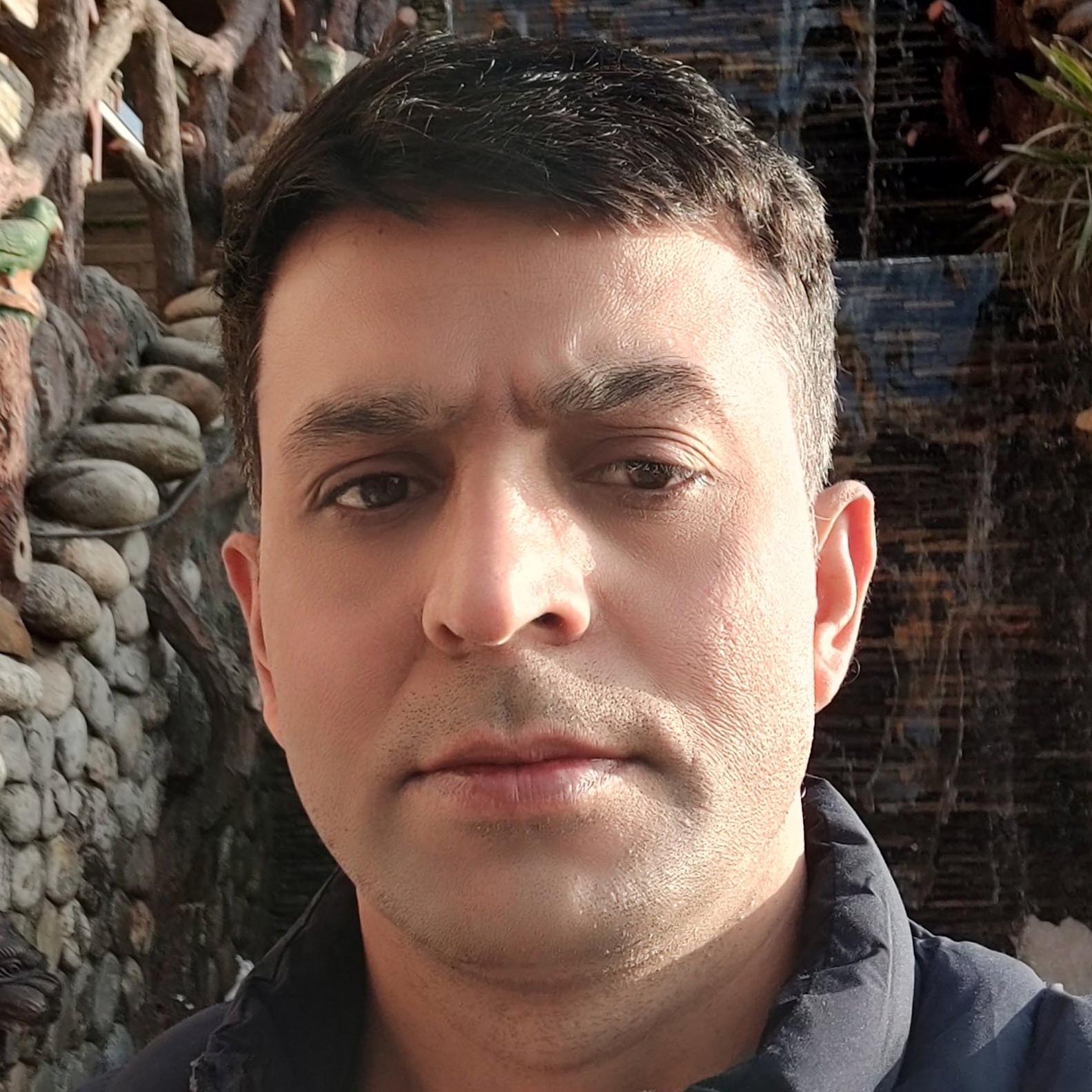
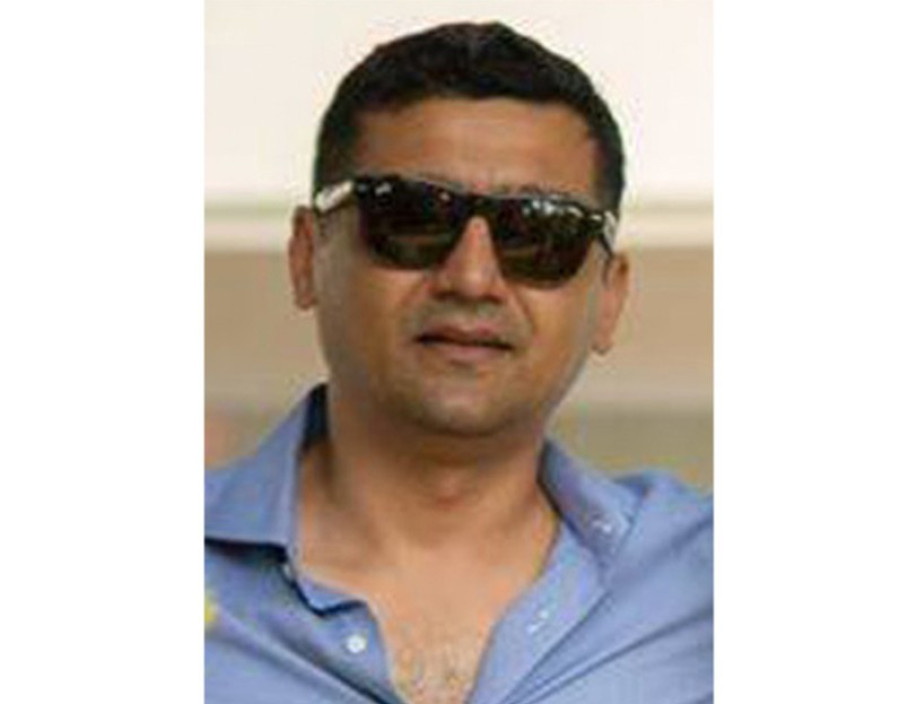
Controversial businessman Deepak Bhatta, who has been arrested in a money laundering case, is alleged to have been involved in multiple irregularities over the past decade and a half, operating under the patronage of political leaders, bureaucrats and senior security officials in power.
Bhatta has been accused of manipulating licences and share acquisitions in hydropower, insurance, microfinance, travel agencies and educational institutions, with his alleged lobbying at the political level to appoint favourable individuals to leadership positions in regulatory bodies and influencing decisions for personal gains.
Past records suggest Bhatt used to influence the formulation of specifications for security agencies’ procurement of lethal and non-lethal equipment and public contracts, secure tenders accordingly, or obstruct the process if unsuccessful. Officials say he also exerted influence during the budget formulation process, particularly by manipulating tax rates to benefit certain business houses. Preliminary investigations show that he acted as a middleman to acquire money, shares and property through unauthorised means.
Acting on a letter from the Department of Money Laundering Investigation, the Central Investigation Bureau (CIB) of Nepal Police arrested Bhatt from Naxal, Kathmandu, on Thursday afternoon. The Kathmandu District Court, on the same day, granted permission to keep him in custody for 10 days for investigation.
Previous attempts by government agencies to investigate Bhatta were reportedly halted due to political pressure. However, following the formation of a new government, the case has been revived.
CIB Chief Additional Inspector General Manoj KC said that a detailed investigation against Bhatt is being conducted by the Department with support from the CIB. “A detailed investigation is underway against Bhatt on money laundering charges. He has been arrested in the course of that investigation. We have also obtained court approval to keep him in custody,” he said.
The department sought a remand from the court, stating that Bhatt had laundered assets acquired through offences under Section 140 of the Insurance Act, 2079, and concealed, evaded and transformed their source by investing in the capital market and other sectors. Based on this, a bench of Judge Madhav Prasad Subedi at the Kathmandu District Court granted the remand.
The remand order states that further investigation is required to record additional statements, obtain financial information and evidence, and carry out analysis under offences prohibited by Section 3(1) of the Money Laundering Prevention Act, 2064. Director General of the Department Gajendra Thakur said no further details could be disclosed as the investigation is ongoing. “The investigation is ongoing. There is nothing more to say beyond this,” he said.
The CIB said that recording Bhatt’s statement has already begun. Although he operates through multiple companies at different levels, Bhatt is formally the chief of Infinity Holdings, a network of business leaders and companies.
Using firms registered in the names of employees working under Infinity Holdings, Bhatt was also active as a local agent in procurement contracts for security agencies involving lethal and non-lethal equipment and logistics. In 2014, a deal worth approximately Rs 1.5 billion for arms procurement was also set to be awarded to Bhatt, but the government hesitated to proceed after the controversy surfaced.
In 2022, Bhatt again secured an Rs 1.5 billion arms procurement contract for Nepal Police and the Armed Police Force after budget transfer from the Ministry of Finance. However, controversy arose not only over alleged overpricing but also over a mismatch between the requirement and the procurement, leading both agencies to hesitate in proceeding with the deal. The issue remains unresolved.
During the tenure of Prime Minister Sher Bahadur Deuba and Finance Minister Janardan Sharma, tax exemptions were granted through a supplementary budget in a way that benefited specific companies. Following suspicions around these tax exemptions, unusual financial transactions and dealings were observed between Infinity Holdings, led by Bhatt, and companies under the Shankar Group.
Tax rates were altered at midnight at Singha Durbar during the preparation of the fiscal year 2022-2023 budget, and Bhatt’s role in the case was also considered suspicious. After the controversy came to light, then Finance Minister Sharma resigned.
A parliamentary probe committee was formed to investigate the tax rate manipulation case. However, the committee submitted its report without thoroughly examining the role of Sharma and other suspects. Sharma later returned to his ministerial position. After the controversy surfaced, the Financial Information Unit (FIU) of Nepal Rastra Bank (NRB) wrote to the Department to probe “suspicious transactions” conducted through bank accounts linked to Bhatt and the Shankar Group.
According to the letter, Rs 450 million was transferred in June 2021 from an account of Jagadamba Steel Pvt. Ltd. at Nepal Investment Bank to Bhatt’s account at Siddhartha Bank. However, the audited financial report of Jagadamba Steel for the fiscal year 2020/21 did not show any such transaction with Bhatt or his company.
It was also found that Rs 301.587 million was transferred to Bhatt’s overdraft (OD) account in June and July 2021, from which Rs 450.445 million was withdrawn around the same period. Although OD accounts are meant to be used within approved credit limits or reimbursement, Bhatt’s account, which had a limit of Rs 5 million, recorded transactions up to Rs 450 million. Similarly, in the OD account of Infinity Holdings, deposits of Rs 184.095 million and withdrawals of Rs 634.093 million were recorded in July 2021 despite an OD limit of Rs 440 million.
During a preliminary investigation into the same case in January 2023, the Department had recorded Bhatt’s statement. At the time, NRB had written to the Department, citing a lack of transparency and undisclosed sources in the suspicious transactions. In April 2025, the Department closed the investigation and returned the case to the central bank for further inquiry. Officials at the CIB and the Department said the same file, previously halted under pressure, has now been revived to resume investigation.
Bhatt has also been linked to acquiring licences for Himalayan Reinsurance and microfinance institutions and was involved in suspicious financial transactions through this. More recently, he and other businessmen have been accused of influencing appointments in the Securities Board of Nepal and the Nepal Insurance Authority to facilitate their activities. The appointment of Sharad Ojha, who did not meet the qualifications, to the Insurance Authority was challenged in court and later annulled.
Similarly, Bhatt has been accused of playing a central role in the appointment of Santosh Narayan Shrestha as chair of the SEBON. “All these matters are under investigation against Bhatt on money laundering charges, and anyone connected to this network is under scrutiny,” said an official at the Department.
Regardless of which party was in power, Bhatt had been securing multi-billion-rupee contracts through political patronage. However, state mechanisms had been reluctant to investigate his alleged illegal activities. Following the Gen Z protests on September 8 and 9, the Department initiated investigations into top political leaders and their relatives on money laundering charges, during which Bhatt was also placed under suspicion.
Bhatt has also been accused of parking illicitly earned money in countries such as Singapore, Hong Kong and Dubai. He travelled to Thailand on March 4 and returned on March 12. Earlier, he had visited Singapore on March 2 and returned the next day. Records also show that he travelled to Hong Kong on August 7, 2025, and returned after four days.
Amid concerns that he might flee abroad after the investigation began, the Department had placed Bhatt on a blacklist through the Department of Immigration on Monday, preventing him from leaving the country. Police also increased security presence at land border points with India. Three days after being blacklisted, Bhatt was arrested by the CIB based on the Department’s letter. Following a preliminary investigation, the Department sought CIB’s support through the Nepal Police headquarters for a detailed probe.
Born on February 4, 1981, in then Bhadrapur VDC-2 of Dadeldhura (now Ajayameru Rural Municipality), Bhatt has remained a key figure favoured by power centres for over one and a half decades. He has previously been accused of influencing ruling and opposition parties, as well as parliamentary committees such as the State Affairs Committee and the Public Account Committee, to shape laws and policies in his favour.
During the peak of internal conflict within the Nepal Communist Party following the merger of the UML and then CPN (Maoist Centre), Bhatt had admitted in August 2020 that he played a mediating role. Later, during the Covid-19 period, the KP Sharma Oli-led government granted a reinsurance licence to a company involving investment from Bhatt and other businessmen.




 17.79°C Kathmandu