RSP working on MP recall rules, but it’s not easy for FPTP seats
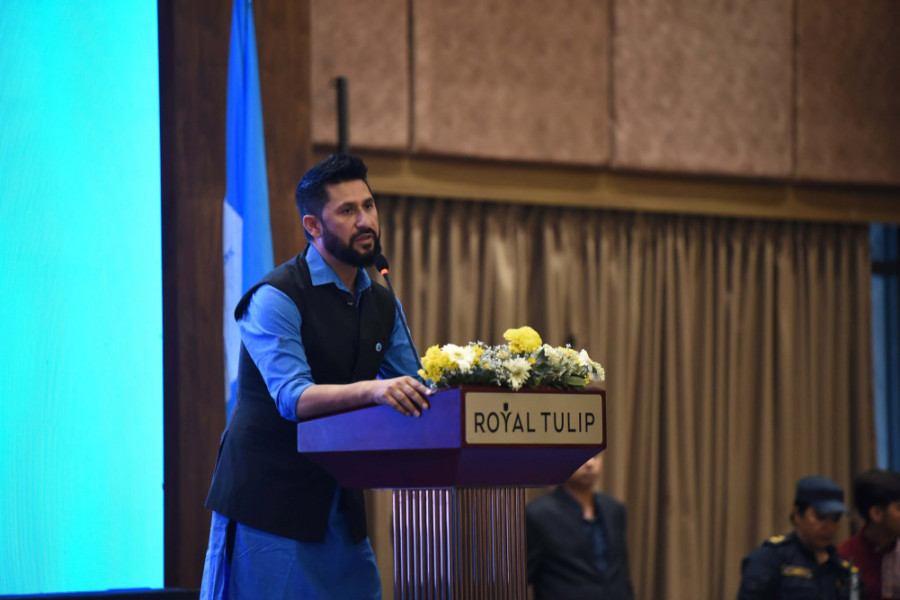
Party may replace MPs who fail to perform or go against party interests. Rastriya Swatantra Party chair Rabi Lamichhane briefs newly elected lawmakers on the party’s provision for the right to recall during an orientation programme organised for them. File Photo
Ever since its establishment four years ago, the Rastriya Swatantra Party has incorporated a provision in its statute that allows the recall of members of parliament if they fail to deliver. Now that it has emerged as the largest party in the House of Representatives with almost a two-thirds majority, it is moving ahead with plans to implement this provision.
While addressing the closing ceremony of a training for the party’s newly elected lawmakers last week, party president Rabi Lamichhane said the party was prepared to exercise the right to recall.
The statute allows for the recall of lawmakers elected both through first-past-the-post (FPTP) and proportional representation (PR) systems. For directly elected representatives, the authority to initiate a recall lies with the party’s ordinary members in the respective constituency, whereas for PR lawmakers, the power rests with the party’s central committee.
“The party’s ordinary members in the concerned constituency shall have the right to recall their elected representatives if they fail to perform satisfactorily,” reads Clause 69 of the RSP statute. The statute states that if a specified number or percentage of ordinary members of a particular constituency reach a decision, the central committee shall initiate the process of terminating the elected representative’s position.
In the case of PR lawmakers, the statute allows the central committee to recall a member of parliament if they act against the party’s interests or perform poorly. “The process for removing such representatives shall be carried out in accordance with regulations framed by the central committee,” reads the party statute.
Ganesh Parajuli, a central committee member and newly elected lawmaker from Kathmandu constituency 7, said the party is currently drafting the necessary regulations to operationalise this provision.
“Since the provision is already mentioned in the statute, the party is considering enforcing it,” Parajuli said.
Even though there is no legal provision to recall parliament members, it is not impossible if a party chooses to act. However, the process is much easier for those nominated under PR than for those elected under the FPTP system, says Radheshyam Adhikari, senior advocate and constitutional law expert.
“In the case of PR lawmakers, the party can simply nominate a replacement from the closed list it had submitted to the Election Commission [before the election]. But the process to terminate the term of the directly elected parliamentarian is more complicated,” said Adhikari.
He says by-elections would be required to choose an FPTP lawmaker’s replacement and this makes the process risky and less practical for the party, besides putting extra burden on the state coffers. “As a result, parties are less likely to take such a decision, although they might take up the issue for discussion.”
Pratibha Rawal, RSP’s joint spokesperson and a PR lawmaker, said the party is currently developing a procedure to implement the right to recall.
“We are committed to putting the right to recall into practice,” she said. “The party is doing its homework on how to implement it for both directly elected MPs and those elected under PR.”
However, Ekram Giri, spokesperson at the Parliament Secretariat, said there is no provision in parliamentary law for recalling individuals once they have been elected to federal parliament.
That said, Giri added that laws are not static and could evolve in the future.
As for the right to recall, Giri said, “It is not within our knowledge or mandate to monitor what provisions each party has included in its own statute on this matter.”
In the previous Parliament, the RSP had taken action against its PR lawmaker Dhaka Ram Shrestha, resulting in the termination of his parliamentary position.
The party acted after an audio recording surfaced in which he was allegedly heard asking a medical entrepreneur for Rs 20 million, claiming he needed the money to secure the health minister’s position for himself. Following the controversy, the party dismissed him and appointed Bindabashani Kanshkar from its PR list in his place.
At the RSP’s request, when Parliament relieved Shrestha of his position as an MP, in a separate case however, Parliament did not remove Goma Labh Sapkota despite a similar request from the Janamat Party. The party had tried to dismiss her for breaching party discipline.
Advocate Adhikari, who handled Sapkota’s case, says the nature of the two cases was different, which is why Parliament did not act against Sapkota despite the party’s request.
“In Shrestha’s case, the issue had already become public and widely known, making it easier for the Speaker to take action,” Adhikari explained. “But Sapkota’s case was of a different nature. Even though the party recommended action, it was not carried out.”




 20.85°C Kathmandu